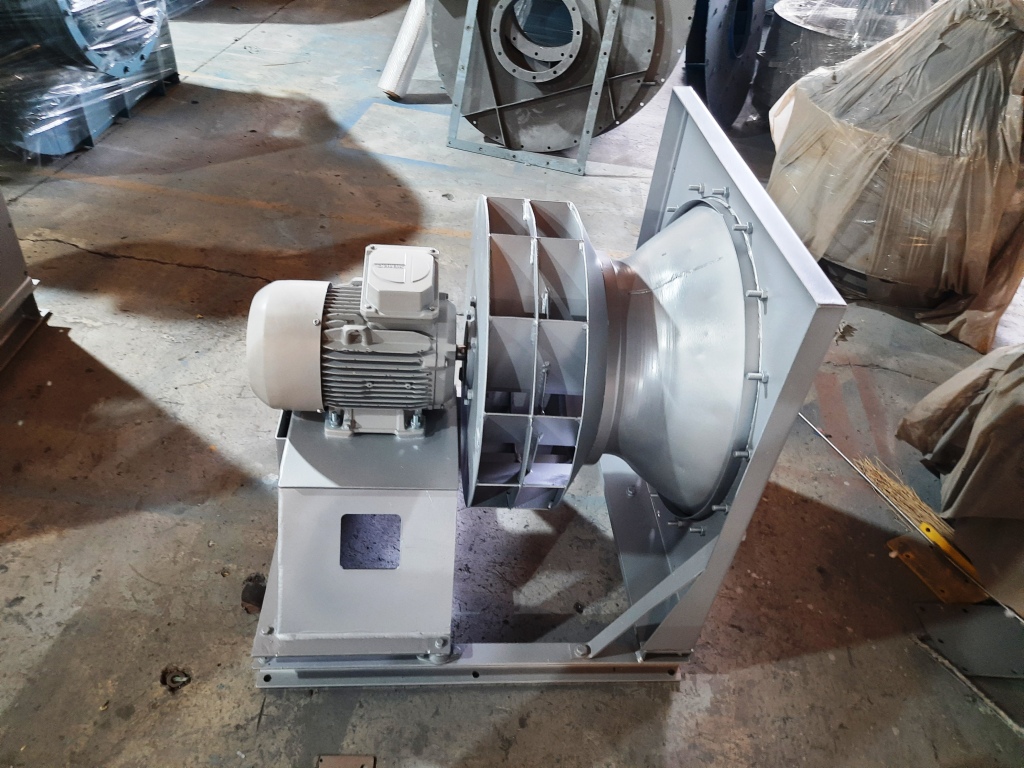
Low-vibration plenum-type centrifugal fan for cleanroom AHU duty on the Jitamitra shop floor
Home  /  Industries  /  Semiconductor & Electronics
Industries

Fans for the semiconductor & electronics fab — clean supply, corrosive exhaust.

A fab runs two opposite fan duties in the same building: on the clean side, cleanroom AHU and mini-environment supply that has to be quiet, stable and low-vibration enough to hold an ISO Class 3–6 environment; on the dirty side, acid-fume, solvent and process exhaust that eats ordinary steel. One demands ultra-low particulate and vibration, the other demands corrosion metallurgy and containment — and both run continuously, because a fab is never allowed to lose pressure. We engineer fans to a fab's duty, not off a shelf, and we have executed a handful of semiconductor & electronics duties — across the same envelope as our heaviest process fans, to 2,00,000 CMH, 2,000 mmWC, 400 HP and 600 °C.

ISO 3–6cleanroom class supplied
G1.0balance grade on application
316L / FRPacid-fume metallurgy
2,000 mmWCmax static
15,000+
fans built since 2011
200 HP
VFD test rig · IS 4894 / AMCA 210
99%
on-time delivery
3
working days to quote — always
CLEANROOM AHU · MINI-ENVIRONMENT · ACID-FUME EXHAUST · FUME HOOD · GENERAL VENTILATION
Where the fans sit

One building, two opposite jobs — and the fab is never allowed to lose pressure.

A semiconductor or electronics fab splits its fans into two worlds. On the clean side, the AHU and mini-environment fans push conditioned, HEPA-filtered air to hold the cleanroom under positive pressure and the required air-change rate. On the dirty side, the process-exhaust fans pull acid fume, solvent vapour and heat away from the tools and out through scrubbers. Both run continuously — a fab that loses pressure loses its batch.

The duties we run in a fab

The fan duties across a semiconductor or electronics fab — and the role each one plays.

A fab needs a family of fan duties that runs from the cleanest supply air in industry to the most corrosive process exhaust in the building. We have executed a handful of semiconductor & electronics duties across this list — each engineered to its own air quality, pressure and gas chemistry, not adapted from a catalogue near-fit. The underlying fan engineering is proven across our full range.

The fans we deploy here

Three fan types cover the fab — matched to how clean and how corrosive the air is.

The wheel is chosen by the air it moves: a high-efficiency aerofoil for the big, clean AHU supply where quietness and efficiency win; a backward-curved wheel for stable, non-overloading supply and return; and a backward-curved plate wheel — built in 316L or FRP — for the corrosive acid-fume exhaust. All three build across the same envelope — to 2,00,000 CMH, 2,000 mmWC, 400 HP and 600 °C.

Why fab fan duty is hard

Three things in a fab decide whether the fan protects the process or contaminates it.

A fab attacks a fan from two directions at once — on the clean side, any vibration or shed particle contaminates a batch worth more than the fan; on the dirty side, acid fume condenses and eats ordinary steel. And between the two sits a pressure cascade that has to hold to within a few pascal, continuously. Engineer for all three and the fan protects the process for years. Engineer for the duty point alone and it either seeds contamination or corrodes through in 12–24 months.

01 — CONTAMINATION

Vibration & particle shedding

On the clean side, a fan that vibrates or sheds particles contaminates the very air it supplies — and one contaminated batch can cost more than the whole fan. Ordinary balance and mild-steel internals shed enough to matter at ISO Class 3–6, where the tolerated particle count is near zero.

How we engineer it out

Precision balance to ISO 21940 G2.5, tightened to G1.0 on application; a sealed, low-shed wheel with a smooth or coated internal finish; and inlet, wheel and casing detailing that keeps the supply air as clean as the filter leaves it.

02 — CORROSION

Acid-fume & solvent attack

Fab process exhaust carries HF, HCl and H₂SO₄ acid fume plus solvent vapour that condenses on the wheel and casing and eats carbon steel within months — and a corroded exhaust fan is a safety exposure, not just a maintenance one.

How we engineer it out

The wetted path built in 316L, or a moulded FRP wheel and casing for the most aggressive acids; sealed shaft penetrations; and drainage detailing so condensate leaves the fan instead of pooling on the wheel.

03 — PRESSURE STABILITY

Holding the pressure cascade

The whole fab is a pressure staircase — each room held a few pascal above the next — and if a supply or exhaust fan hunts, overloads or drifts, the cascade collapses and contamination flows the wrong way. Filters load over their life, so the fan must hold its point as resistance climbs.

How we engineer it out

A backward-curved or aerofoil wheel with a stable, non-overloading curve; VFD control tied to room-pressure and airflow feedback; and the duty point placed on the flat, high-efficiency part of the curve so a rising filter DP does not upset the room.

How we design for the fab

Every balance grade, metallurgy and control choice is documented on the GA drawing you sign off — before we cut metal.

We don't sell a catalogue near-fit onto a fab. Each fan is engineered to its own duty — the cleanroom AHU to its air quality and noise limit, the acid-fume exhaust to its gas chemistry, the general ventilation to its cascade — at your operating point.

  • Ultra-clean, low-vibration supply — For the clean side, precision balance to ISO 21940 G2.5 and to G1.0 on application; a high-efficiency aerofoil or backward-curved wheel selected for low noise at best efficiency; and a sealed, low-shed construction with smooth or coated internals so the fan does not add particles to the supply air.
  • Corrosion metallurgy for acid fume — For the exhaust side, the wetted path in 316L, or a moulded FRP wheel and casing for HF and strong-acid service; sealed shaft penetrations, corrosion-resistant coatings and drainage detailing so acid condensate leaves the fan rather than sitting on the wheel.
  • Stable pressure & VFD control — A non-overloading backward-curved or aerofoil curve with the duty point on its flat, high-efficiency region; VFD speed control tied to room-pressure and airflow feedback so the fan holds the cascade as filters load — no throttling loss and no hunting on the staircase.
  • Single source across the fab — One engineering partner for both worlds — the clean-side AHU and mini-environment supply and the dirty-side acid-fume and fume-hood exhaust — with a handful of executed semiconductor & electronics duties, so the fans, materials and drives carry one convention across the plant.
Standards & conformity

Stated precisely — because procurement checks.

What our marks mean, in the words that survive an audit.

Performance

Tested to the AMCA 210 / ISO 5801 method, in-house on our 200 HP VFD rig. Tested-to-method — not AMCA-certified.

Quality system

ISO 9001:2015 — third-party certified. Our only third-party certification.

CE conformity

Self-declared per 2006/42/EC + 2014/35/EU (Module A). A self-declaration, not a notified-body certificate.

ATEX conformity

Self-declared, Zone 2/22, Category 3, per 2014/34/EU, where the area classification calls for it.

Oil & gas duty

Designed and built to API 673 as project-specific scope.

Welding

ASME Sec IX qualified welders + WPS for every joint.

Balance

ISO 21940 — G6.3 minimum, G2.5 / G1.0 on application.

Vibration

ISO 20816 evaluation; ISO 14694 for fan-specific limits.

Questions engineers ask

Semiconductor & electronics fab fan questions, answered straight.

Can you supply the fans for both the clean side and the exhaust side of a fab?
Yes, both, from one partner. On the clean side we engineer the cleanroom AHU and mini-environment supply fans, plus AHU supply and return for the surrounding areas; on the dirty side we engineer the acid-fume and process exhaust, fume-hood extraction, general dilution ventilation and local exhaust. Each fan is engineered to its own air quality, pressure and gas chemistry — the ultra-clean supply fan and the acid-fume exhaust fan are very different machines — but they come from one partner, on one engineering convention across the plant. We have executed a handful of semiconductor and electronics duties, and the underlying fan engineering is proven across our full range.
How do you keep a supply fan from contaminating the cleanroom it feeds?
Two ways, sized to your cleanroom class. First, vibration: we balance to ISO 21940 G2.5 as standard and tighten to G1.0 on application, so the fan runs smooth enough not to disturb the filtered air or the tools. Second, particle shedding: a sealed, low-shed wheel with a smooth or coated internal finish and inlet and casing detailing chosen so the fan does not add particles to the supply. The final HEPA stage sits downstream of the fan, but the fan is built so the air reaching it is as clean as we can make it. Tell us the ISO class, the air-change rate and the noise limit and we engineer to them.
Our process exhaust carries HF, HCl and solvent fume. What do you build the fan from?
We size the metallurgy to your gas analysis. For general acid fume the wetted path is built in 316L; for the most aggressive acids such as HF we build a moulded FRP wheel and casing, which does not corrode where stainless would. We add sealed shaft penetrations, corrosion-resistant coatings, and drainage detailing so acid condensate leaves the fan instead of pooling on the wheel. The right answer depends on your acid mix, concentration, temperature and moisture, so we engineer it to your gas, not a default.
How do you keep the fans from upsetting the fab's pressure cascade as filters load?
We select a fan with a stable, non-overloading curve — backward-curved or aerofoil — and place your duty point on the flat, high-efficiency part of it, so a rising filter differential pressure over the filter's life does not move the room. We pair it with VFD speed control tied to room-pressure and airflow feedback, so the fan trims itself to hold each zone a few pascal above the next dirtier one. Speed control also avoids the throttling loss of a damper at part load. The cascade stays exact even as the filters age.
Can you build a replacement to match our existing fab fan's duty and footprint?
Yes. We reverse-engineer to the existing duty point (flow, static pressure, air or gas temperature, density and, on the exhaust side, the gas chemistry), bearing centres, inlet and outlet orientation and foundation bolt pattern so the unit drops onto the existing base and ducting — whether it is a cleanroom AHU fan, a mini-environment fan or an acid-fume exhaust fan. Made to your installation, not a nearest-catalogue substitute. Send the old GA, the nameplate and a curve if you have one, and we match it.
Do you performance-test the fans, and what about AMCA, CE, ATEX and quality certification?
Every fan is performance-tested in-house to the AMCA 210 / ISO 5801 method on our 200 HP VFD test rig, and dynamically balanced to ISO 21940 G6.3 as standard, tightened to G2.5 or G1.0 on application for the clean-side fans. To be precise: that in-house testing is to the AMCA 210 / ISO 5801 method, not AMCA-certified; CE is self-declared per 2006/42/EC and 2014/35/EU, and ATEX Zone 2/22 is self-declared per 2014/34/EU (Category 3) where a solvent-laden exhaust area classification calls for it — those are self-declarations of conformity, not third-party certifications. Our only third-party certification is ISO 9001:2015.

Across the range

Where Semiconductor & Electronics fits — the fans we deploy, the duties we run, and adjacent industries.

The same engineering, viewed three ways — by fan family, by duty, and by industry. Follow the cross-references.

Take it further

Specs an engineer can use — not a brochure.

Engineer to engineer

Send us the duty point.
We'll quote in 3 working days — always.

No model numbers needed. Give us the operating conditions — flow, static, gas temperature, composition, particulate, and any tender standard — and our application engineers size the fan and quote it. Attach a spec or GA if you have one.

+91 90110 09155  ·  mihir.jitamitra@gmail.com