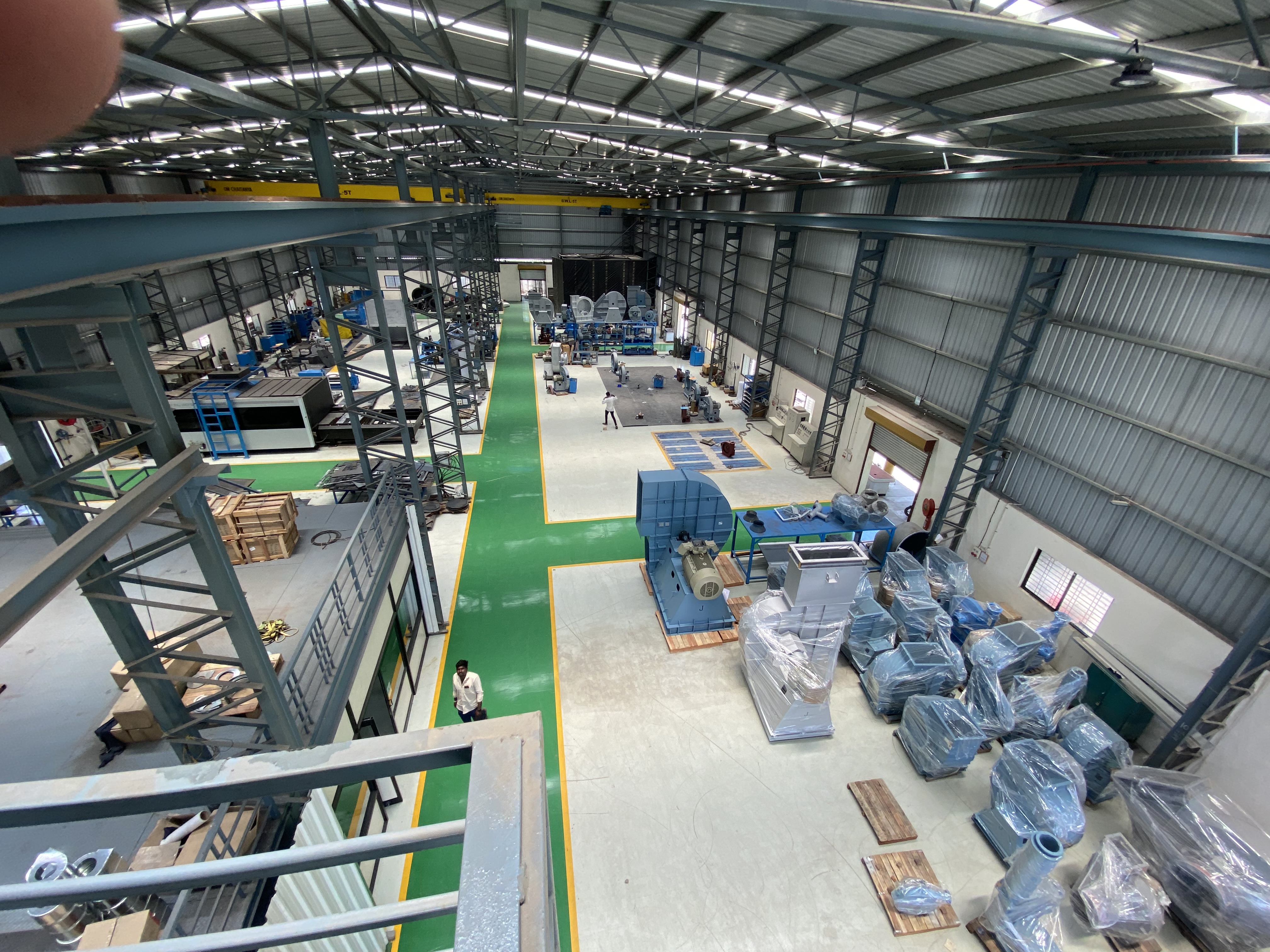
What actually decides whether an LEV fan protects the operator?
Capture velocity at the hood face. That is the air speed which overcomes the contaminant's own momentum and any room cross-draughts and pulls the fume or dust into the duct instead of letting it drift past the operator into the breathing zone. Design values run roughly 0.5 to 1.0 m/s for a contaminant released into still air and 2.5 to 10 m/s where it is actively thrown off, such as grinding or spraying. If the fan loses flow, capture velocity drops with it and the LEV silently stops working. So we size the fan to hold capture velocity across the whole moving system, not just at one fixed point, and default to VFD so it holds that velocity as the collector loads.
My LEV run has many hoods on blast-gates. How do you size for a branched system?
A branched LEV run re-splits its flow every time a blast-gate or interlocked auto-damper opens or closes, which changes both the total system resistance and how the air divides between branches. We size the fan to span the all-hoods-open and worst part-open resistance range onto the stable, falling region of the curve, keep at least 15 to 20 percent flow margin at the worst case, and default to VFD or static-pressure-controlled damper control so each branch stays within about 10 percent of its design flow as gates cycle. Give us the hood schedule and duty cycle, not just a single total, and we engineer to the range the system actually sees.
Our captured dust or vapour is combustible. Is your fan spark-resistant and ATEX-rated?
Yes. Because LEV pulls exactly the material you want out of the air, that stream is often combustible dust from grinding, buffing or woodworking, or flammable solvent vapour. We build spark-resistant construction to AMCA 99, which defines three types: Type A puts all parts in the airstream in non-ferrous material, Type B uses a non-ferrous rub ring and non-ferrous parts across the shaft opening, and Type C is an aligned construction that mechanically prevents ferrous contact. Type B is our LEV default for grinding and buffing capture, with Type A where the case is severe. For the explosion case we self-declare ATEX Zone 22, Category 3D, for combustible dust or Zone 2, Category 3G, for solvent vapour, per 2014/34/EU, with non-sparking impeller, bronze rub rings, bonded earthing, anti-static coatings and T-class bearing-temperature control. To be precise, that is a self-declaration of conformity, not a third-party certification; our only third-party certification is ISO 9001:2015. Higher ATEX category is available on application via a Notified-Body partner.
Should I specify VFD or a damper for control?
VFD is our default on LEV. As the collector loads between cleaning cycles the duct resistance climbs, and a fan without speed control coasts down and loses capture velocity at the hoods. VFD holds the design flow across that swing so capture stays constant, and on intermittent duty it turns the fan down when hoods close and back up when they open, which saves energy and keeps sound down near the occupied floor. A static-pressure-controlled damper is an alternative where the existing motor and starter cannot take a drive. We quote whichever your installation calls for, and where the duty is intermittent we can trigger the fan on hood-open interlocks or a CO/VOC sensor.
Where does the fan sit — before or after the collector?
Most LEV fans sit downstream of the collector, on the clean side, handling filtered air or clean vapour. That is the easier duty: wear is minimal and the design focus is capture-velocity hold, curve stability across filter loading, spark resistance where the contaminant is combustible, and noise. Some duties place the fan on the dirty side, ahead of the filter, where it handles the raw dust-laden capture and gets a radial-tipped self-cleaning wheel and wear protection. Tell us the position relative to the collector and we build to it; on dirty-side duty we assume the worst of your loading data, not the average.
We capture corrosive fume from plating and pickling. What materials do you use?
For acid fume from plating tanks and pickling lines we build in corrosion-resistant construction: 304 or 316L stainless for moderate duty, and FRP construction, or FRP with rubber-ebonite lining, for aggressive corrosive vapour where even stainless is attacked. Wash-down and condensing capture gets a shaft seal and a drain in the casing low point. The right material depends on your specific fume chemistry and concentration, so we select it to your stated contaminant, not a generic corrosive rating, and note it on the GA drawing.
What is the lead time for a standard LEV fan?
A standard engineered LEV fan runs roughly 9 to 14 weeks order-to-dispatch: offer in 3 to 5 working days, GA drawing 2 to 3 weeks from PO, manufacture, balance and paint 6 to 10 weeks, and performance test plus FAT about a week. A spark-resistant ATEX build or a corrosion-resistant FRP construction adds file prep and material lead time and runs about 12 to 16 weeks. The test and FAT are customer-witnessed on request.
Do you performance-test before dispatch, and what standards actually apply?
Yes. Every fan is performance-tested in-house to the AMCA 210 / ISO 5801 method on our 200 HP VFD test rig, and dynamically balanced to ISO 21940 G6.3 as standard, with G2.5 or G1.0 on application. To be precise about the claims: that is testing to the AMCA 210 method in-house, not an AMCA certification, and Jitamitra is not an AMCA member; spark-resistant construction is built to AMCA 99; and CE is self-declared per 2006/42/EC and 2014/35/EU, with ATEX Zone 2/22 self-declared per 2014/34/EU (Category 3), not third-party certified. Our only third-party certification is ISO 9001:2015. Bearing life is a design target of L10h greater than or equal to 40,000 hours continuous.