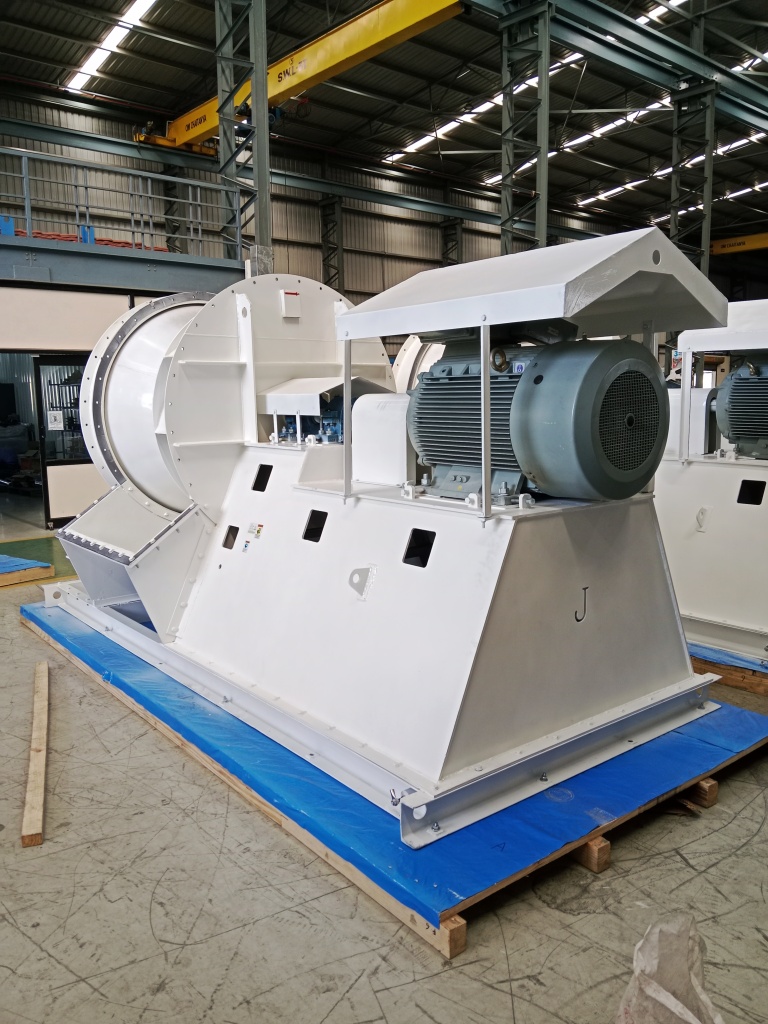
What is the maximum gas temperature your ID fans handle?
Continuous duty up to 600 °C across the envelope, with most ID fans running 150-400 °C. Above 400 °C we fit a shaft cooling disc as standard (available from 350 °C on request), plus metal or fabric expansion joints sized for the thermal growth (up to ~25 mm at 400 °C). The fan is built for your stated gas temperature and excursion case, not a generic rating.
How do you protect the impeller from fly-ash erosion?
Three measures, specified to your dust loading. Hard-faced (chrome carbide) leading edges or a 4140 / chrome-carbide wheel on abrasive duty; bolted-in AR400 wear plates at the volute throat and outlet with access doors for replacement; and wheel geometry chosen for the dust — radial-tipped backward-curved as default, straight-radial when fly-ash buildup dominates. The wear parts are replaceable in place, not welded in.
We have high-sulfur gas and acid dew-point risk. What materials do you use?
Below the acid dew point (typ ~120-150 °C) we keep the casing above dew point with insulation and heat tracing, and select corrosion-resistant materials for the gas: Corten, 316L, or higher alloys (Hastelloy / Inconel on request). The right answer depends on your SO₂/SO₃ and moisture, so we size the material and the dew-point margin to your gas analysis, not a default.
Can you build a replacement to match our existing fan's duty and footprint?
Yes. We reverse-engineer to the existing duty point (flow, static pressure, temperature, density), bearing centres, inlet/outlet orientation and foundation bolt pattern so the unit drops onto the existing base and ducting. Made to your installation, not a nearest-catalogue substitute. Send the old GA, nameplate and a curve if you have one and we'll match it.
What control and accessory scope comes with the fan: damper, VFD, expansion joints?
Scope is specified per duty. Draft control by inlet vane damper or VFD (VFD is our default for variable-draft service, since speed control avoids the throttling loss of a damper at part-load). We supply matched expansion joints (fabric or metal), bolted-in wear plates, access doors, drain, and shaft cooling disc where temperature requires. Tell us the battery limit and we quote the accessories inside it.
How fast can you ship a shutdown replacement?
Shutdown replacements ship within 6 weeks of a clean PO. A standard engineered ID fan runs roughly 9-14 weeks order-to-dispatch (GA approval 2-3 weeks, manufacture, balance and paint 6-10 weeks, test and FAT 1 week). For an emergency we prioritise the wheel and bearings and confirm a dated commitment against your shutdown window — a real date, not a placeholder.
Do you performance-test before dispatch, and can we witness it?
Yes. Every fan is performance-tested in-house to the AMCA 210 / ISO 5801 method on our 200 HP VFD test rig, and dynamically balanced to ISO 21940 G6.3 as standard (G2.5 / G1.0 on application). The test and FAT take about a week and are customer-witnessed on request. You see the curve and the balance report before the fan leaves the floor.
What about API 673, CE and ATEX requirements?
We design and build to API 673 for oil and gas duty as project-specific scope (allow 7-10 working days for the offer). CE is self-declared per 2006/42/EC and 2014/35/EU, and ATEX Zone 2/22 is self-declared per 2014/34/EU (Category 3) where the area classification calls for it. To be precise: those are self-declarations of conformity, not third-party certifications; our only third-party certification is ISO 9001:2015.