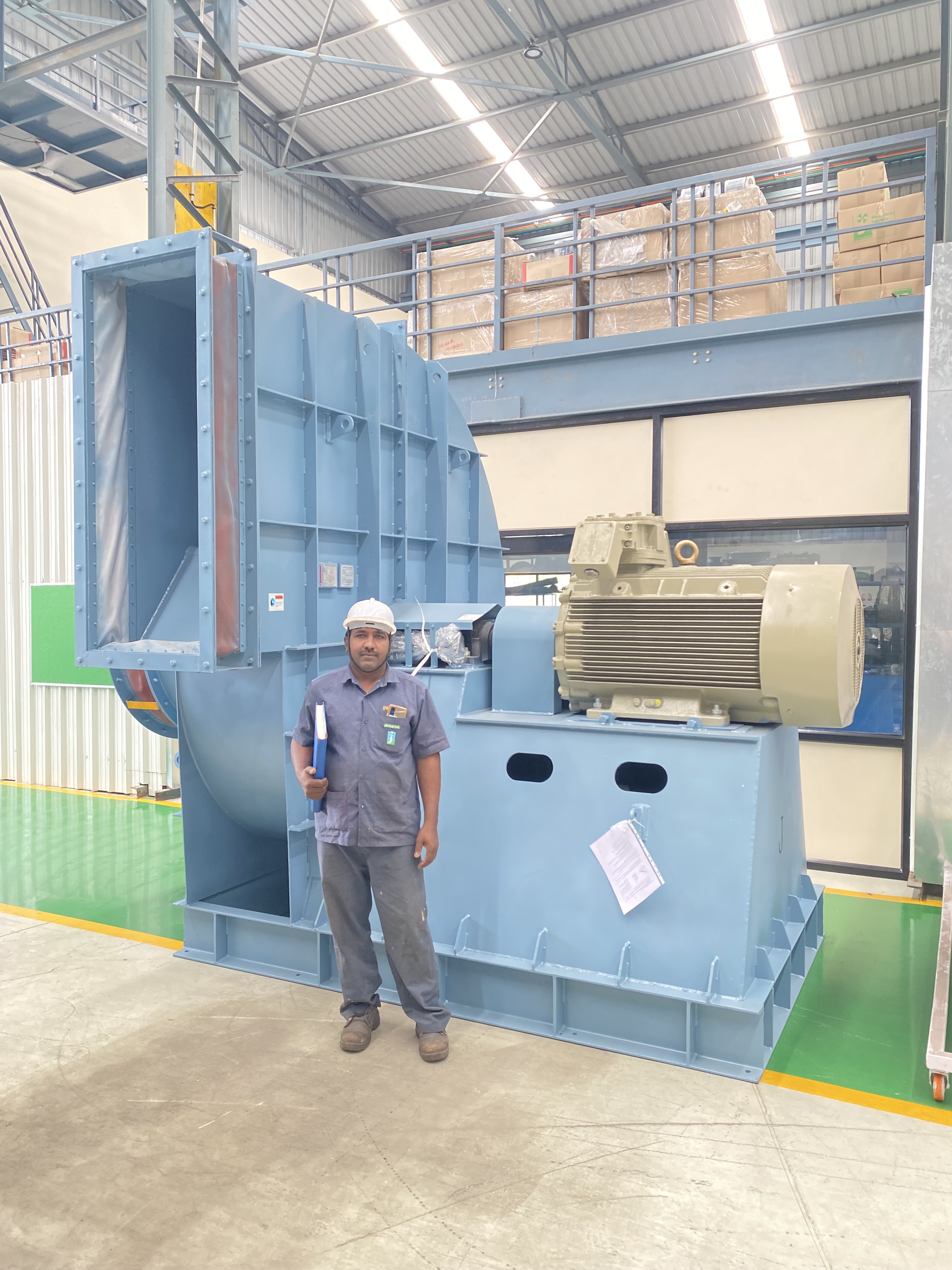
Backward-curved centrifugal fan impeller on the Jitamitra shop floor
Home  /  Products  /  Jitamitra Backward-Curved
Products

Backward-Curved fans — the efficient general-purpose wheel for clean and lightly-dusty air.

The Backward-Curved (BC) wheel is the everyday workhorse for moderate-pressure air handling: solid blades that curve away from rotation, giving high efficiency and a power curve that cannot overload the motor. It tolerates light dust — one step more rugged than a hollow aerofoil, one step more efficient than a plate or radial wheel. We build BC fans for forced-draft, primary and secondary air, bag-filter draught, dilute conveying, drying and combustion-air duty — each one engineered to its operating point, across the envelope below.

highstatic efficiency
light dusttolerance
non-overloadpower curve
to dutyengineered, not stocked
15,000+
fans built since 2011
200 HP
VFD test rig · IS 4894 / AMCA 210
99%
on-time delivery
3
working days to quote — always
SOLID BACKWARD-CURVED WHEEL · NON-OVERLOADING · CLEAN TO LIGHT DUST · MODERATE PRESSURE · ENGINEERED TO DUTY
What the wheel is

A backward-curved wheel does three things well — because of where the blade points.

In a Backward-Curved fan the solid plate blades curve backward, away from the direction the wheel spins. That single geometric choice sets its whole character: air leaves the blade tip with less turbulence, so more motor power becomes useful pressure, and the power demand peaks then falls instead of climbing without limit. It is the efficient, self-protecting, general-purpose centrifugal wheel.

  • 01
    Move air efficiently

    The backward-leaning blade sheds air cleanly — peak static efficiency second only to the Aerofoil in our range, so a given duty is met on the least motor power.

  • 02
    Protect its own motor

    Power is non-overloading — it rises with flow, peaks, then falls. If the duct resistance drops and flow runs out, the motor cannot be driven into overload.

  • 03
    Tolerate a little dust

    The solid plate blade is tougher than a hollow aerofoil, so it carries light particulate — general industrial air, not just filtered HVAC air.

GENERAL ARRANGEMENT to scale from our design drawings IMPELLER · BACKWARD-CURVED BLADE wheel schematic DISCHARGE ORIENTATIONS · ENGINEERED TO ORDER 45° 90° 135° 180° 225° 270°
Fig. 1General arrangement, impeller and 7 discharge orientations. Drawn to scale from our in-house design drawings; every fan engineered to your duty.
Why it is chosen — and where it stops

Three design drivers decide whether the BC wheel is the right family — or the wrong one.

The Backward-Curved fan is picked for efficiency, drive safety and light-dust capability. Push it past any of the three and a different family is the honest answer. We size to where the BC wheel is genuinely strong — and tell you when to step up to the Backward-Curved Plate family, the Radial-Tip family or the Radial family — rather than overselling one wheel into every duty.

01 — EFFICIENCY

Running cost over the fan's life

A fan running thousands of hours a year is mostly an electricity bill. An over-sized or low-efficiency wheel wastes power every hour and can sit in stall.

How we engineer it out

The backward-curved blade delivers one of the highest peak static efficiencies in our range; we select the wheel near its best-efficiency point on the duty, not the nearest oversized box.

02 — DRIVE SAFETY

Motor overload off-design

If the real system resistance is lower than calculated, flow runs out and a forward-curved or radial wheel can pull the motor past its rating.

How we engineer it out

The backward characteristic is non-overloading — power peaks then falls — so the motor stays protected even when the duct opens up.

03 — DUST CEILING

Erosion above the dust gate

Once dust rises beyond a light loading, the airstream starts to erode a high-efficiency blade and shorten wheel life — efficiency is no longer the right thing to optimise.

How we engineer it out

We hold BC to its light-dust gate and move heavier or abrasive dust to the Radial-Tip family (built for high dust) or the wear-plated Radial family (the toughest in the range) — the right wheel for the wear mode.

How we build it

Blade form, metallurgy, width and drive are all set on the GA drawing you sign off — before we cut metal.

We don't sell a catalogue near-fit. The BC fan is engineered to your flow, pressure, temperature, dust load and gas — then specified in plain construction terms on the drawing.

  • Wheel & blade form — Solid backward-curved plate blades on a graded range of wheel sizes (small / mid / large) at a 110 m/s welded tip speed — sized to sit near best efficiency rather than over-sped to chase a point.
  • Materials of constructionMS standard; SS304 / SS316 full or airstream-only; FRP (F suffix) and Corten / duplex for corrosive air; WP wear-plating if dust creeps toward the gate.
  • Construction suffixesHT high-temperature (heat-resistant build + shaft cooling disc above ~150 °C); SR spark-resistant (AMCA 99 Type A/B/C, ATEX-ready); F FRP; WP wear-plated — added only where the duty calls for them.
  • Width & driveSWSI single-inlet for pressure, DWDI double-inlet for high volume in a compact height; belt or direct drive, or plug/plenum (unhoused) for AHU and fan-array builds; VFD with shaft-earthing ring.
Engineered to your duty point

We size the wheel where its curve crosses your system — then prove it on the rig.

No catalogue fan forced onto your spec. Your operating point is engineered onto the stable, best-efficiency region of the selected BC wheel — well clear of stall — then verified on the 200 HP VFD test rig to the AMCA 210 / ISO 5801 method before dispatch.

avoid: unstable 0 40,000 80,000 1,20,000 1,60,000 2,00,000 VOLUME FLOW RATE  [ CMH ] 0 500 1000 1500 2000 STATIC PRESSURE  [ mmWC ] 0 25 50 75 100 STATIC EFFICIENCY  [ % ] Fan static pressure System resistance Static efficiency BEP 82% DUTY POINT 1,20,000 CMH · 450 mmWC Fan static pressure System resistance Static efficiency
Fig. 2Representative backward-curved characteristic — fan static pressure, the non-overloading power curve and static efficiency vs. flow, with the duty point engineered onto the best-efficiency region. Illustrative; every fan is sized to its own duty.
Capability envelope — BC service

What we can supply, and where it stretches on application.

ParameterStandardOn application
Volume flowup to 2,00,000 CMHhigher on enquiry
Static pressureup to ~800 mmWCto 2,000 mmWC envelope with the higher-pressure Backward-Curved Plate family
Continuous gas / air temperature10–350 °C typicalto 600 °C with HT construction + shaft cooling
Inlet dust loadingclean to light dustabove the gate, step to the Radial-Tip or Radial family
Peak static efficiencyhigh — second only to the Aerofoil family (exact figures shared with your enquiry)selected near best-efficiency point per duty
Drive powerup to 400 HPhigher with custom motor sourcing
Balance qualityISO 21940 G6.3G2.5 on application
Bearing life (design target)L10h ≥ 40,000 h continuouslonger L10 on application

The BC wheel is job-proven across 1,337–100,000 CMH and 25–610 mmWC on real builds; the published ~800 mmWC ceiling is the software-validated structural figure, and flow / power to the canon envelope is engineered-to-order on enquiry. Once dust becomes more than a light loading, or where the duty needs higher pressure at a given size, the honest pick is the Backward-Curved Plate family or a Radial-family wheel — we will tell you which.

How a Jitamitra Backward-Curved fan is specified

Specified, not picked from a shelf.

The same engineering language carries from your enquiry to the GA drawing to the nameplate — expressed in the standard AMCA conventions, with the BC family's own width, class, MOC and construction-suffix choices.

Specification fieldOptions
Arrangement (AMCA 99)Arr. 1 (overhung, fan bearings) / Arr. 4 (direct, motor on base) / Arr. 8 (overhung on common base) / Arr. 9 (overhung, motor side) / Arr. 10 (overhung, motor inside base) — plus plug/plenum (unhoused) for AHU and fan-array builds; selected by drive, access and temperature.
Width / inletSWSI (single width, single inlet) for higher pressure; DWDI (double width, double inlet) for high volume in a compact height.
Wheel typeSolid backward-curved plate blade — the efficient, non-overloading general-purpose wheel for clean to light-dust air. (The Aerofoil family for maximum efficiency on clean air; the Backward-Curved Plate family for higher pressure.)
Class (by pressure / outlet velocity)Class I / II / III selected from the duty point on the pressure-vs-outlet-velocity limits; higher class = heavier construction for higher pressure and tip speed (welded build to ~110 m/s tip).
Materials of constructionMS (standard) / SS304 or SS316 (full or airstream-only) / FRP (F suffix) / Corten or duplex for corrosive air / wear-plated (WP) where light dust creeps toward the family's dust gate.
Construction suffixHT (high-temperature build + shaft cooling disc above ~150 °C, to 600 °C) / SR (spark-resistant, AMCA 99 Type A/B/C, ATEX-ready) / F (FRP airstream) / WP (wear-plated) — added only as the duty requires.
DriveDirect-coupled / V-belt / VFD with shaft-earthing ring. Drive up to 400 HP across the envelope; SWSI or DWDI to suit pressure-vs-volume.
Discharge & rotation (AMCA orientation)Rotation CW or CCW (viewed from drive side) with discharge angle per AMCA — e.g. TH/BH/UB/DB — set to match your duct take-off and installed footprint.
The proof, not the promise

We test before we ship — and you're welcome to witness it.

Every job's performance is verified at our works on the 200 HP VFD test rig, to the AMCA 210 / ISO 5801 method, before dispatch.

  • Customer-witnessed FAT on request — at no extra cost
  • Rotors balanced to ISO 21940 G6.3 as standard (G2.5 / G1.0 on application) before they leave the floor
  • Full NDT in-house — DP, MPI, UT, RT — to what the duty demands
30+ INDUSTRIES · 45 APPLICATION / DUTY TYPES
Where our BC fans run

The general-purpose wheel across clean and lightly-dusty process air.

Boiler & Combustion Plants

Forced-draft, primary, secondary / overfire air; seal and cooling-air duty on package and cogen boilers.

Pollution Control / APC

Bag-filter and pulse-jet draught, clean-side filter fans for OEM dust-collection skids.

Cement & Minerals (clean side)

Coal-mill primary air, process and combustion air on the lightly-dusty side of the plant.

Food & Beverage

Spray, fluid-bed and flash drying; dilute pneumatic conveying of flour and powders.

Chemicals & Process

Combustion / process-air blowers, drying and quench / tempering-air duty (SS / FRP for corrosive air).

Pharmaceuticals

Process drying, dilute conveying and clean-side draught — SR construction where the area is ATEX-classified.

General Manufacturing

Plant ventilation, combustion-air supply and light-dust process draught across mixed industrial duty.

Your process

10 application/duty types this family serves. Tell us yours.

Standards & conformity

Stated precisely — because procurement checks.

What our marks mean, in the words that survive an audit.

Performance

Tested to the AMCA 210 / ISO 5801 method, in-house on our 200 HP VFD rig. Tested-to-method — not AMCA-certified.

Quality system

ISO 9001:2015 — third-party certified. Our only third-party certification.

CE conformity

Self-declared per 2006/42/EC + 2014/35/EU (Module A). A self-declaration, not a notified-body certificate.

ATEX conformity

Self-declared, Zone 2/22, Category 3, per 2014/34/EU, where the area classification calls for it.

Oil & gas duty

Designed and built to API 673 as project-specific scope.

Welding

ASME Sec IX qualified welders + WPS for every joint.

Balance

ISO 21940 — G6.3 minimum, G2.5 / G1.0 on application.

Vibration

ISO 20816 evaluation; ISO 14694 for fan-specific limits.

Lead time & process

From enquiry to a tested fan on your dock.

StageStandard dutyAPI-673 / engineered
Offer / quotation3 working days — always7–10 working days
GA drawing for approval2–3 weeks from PO3–4 weeks from PO
Manufacture + balance + paint6–10 weeks10–14 weeks
Performance test + witnessed FAT~1 week1–2 weeks
Order-to-dispatch (total)9–14 weeks14–20 weeks

Shutdown-driven replacements: we have shipped fans within 6 weeks of a clean PO. Tell us your shutdown window and we commit to a dated plan.

Questions engineers ask

The eight we hear most before a PO.

How much dust can the Backward-Curved fan handle?
Clean to light dust. The solid backward-curved blade is tougher than a hollow aerofoil, so it tolerates more particulate than the high-efficiency Aerofoil family, but it is still an efficiency-led family. Once dust becomes more than a light loading the blade starts to erode and efficiency is no longer the right thing to optimise, so we move you to the Radial-Tip family (built for high dust) or the wear-plated Radial family (the heaviest, most abrasive dust in our range). We pick the wheel for the wear mode, not the other way round — the exact dust-loading gates are shared with your enquiry.
Will the motor overload if the system resistance is lower than we calculated?
No. The backward-curved characteristic is non-overloading — power rises with flow, peaks, then falls. If the real duct resistance is lower than design and the fan runs out toward maximum flow, the power demand drops away rather than climbing, so the motor cannot be driven past its rating. That is one of the main reasons to choose a backward wheel over a forward-curved or radial wheel for variable or uncertain systems.
What is the highest pressure you have actually built on a BC fan?
610 mmWC is the job-proven maximum on a real build; we attest readiness to engineer to about 800 mmWC, which is the software-validated structural ceiling of the wheel. If your duty needs more pressure at a given size, the honest answer is our Backward-Curved Plate family, which is built for medium-to-high pressure (to 2,000 mmWC on a served job). We will not inflate a BC point that fails a motor-power check just to keep you on one family.
Can you run a BC fan hot, and what changes above 150 °C?
Yes. Most BC duty runs 10–350 °C, and the family is attested to 600 °C with high-temperature (HT) construction. Above about 150 °C we fit a shaft cooling disc as standard to protect the bearings, and add a heat-resistant build and expansion provision for the thermal growth. Tell us your operating and maximum (excursion) temperature and the fan is built for that case, not a generic rating.
Which duties is the Backward-Curved family the right pick for?
Clean-to-light-dust air at moderate pressure: forced-draft (FD), primary air (PA), secondary / overfire air (SA), seal / cooling / booster air, bag-filter and pulse-jet draught, dilute pneumatic conveying, drying (spray / fluid-bed / flash), quench / tempering air and combustion / process-air blower duty. For perfectly clean air where efficiency is everything, the Aerofoil family is the step up; for higher pressure at a given size, the Backward-Curved Plate family; for real dust, the Radial-Tip or Radial family.
Can you build it as a plug fan for our AHU or fan array?
Yes. The BC wheel is available in a plug/plenum (unhoused) configuration that drops straight into air-handling units and fan-wall / fan-array (N+1) builds, as well as the conventional housed scroll fan in SWSI or DWDI. Tell us whether it is a ducted housed fan or an AHU/array installation and we configure the arrangement and drive to match.
Do you performance-test before dispatch, and can we witness it?
Yes. Every fan is performance-tested in-house to the AMCA 210 / ISO 5801 method on our 200 HP VFD test rig, and dynamically balanced to ISO 21940 G6.3 as standard (G2.5 on application). The test and FAT take about a week and are customer-witnessed on request. You see the curve and the balance report before the fan leaves the floor — to be precise, that is testing to the AMCA 210 method in-house, not AMCA certification.
What about API 673, CE and ATEX requirements?
For petroleum, chemical and gas service we design and build to API 673 as project-specific scope (allow 7–10 working days for the offer). CE is self-declared per 2006/42/EC and 2014/35/EU, and ATEX Zone 2/22 is self-declared per 2014/34/EU (Category 3) with SR (spark-resistant) construction where the area classification calls for it. To be precise: those are self-declarations of conformity, not third-party certifications; our only third-party certification is ISO 9001:2015.

Across the range

Where the Backward-Curved wheel fits — duties it serves, industries it runs in, and its closest siblings.

The same engineering, viewed three ways — by fan family, by duty, and by industry. Follow the cross-references.

Take it further

Specs an engineer can use — not a brochure.

Engineer to engineer

Send us the duty point.
We'll quote in 3 working days — always.

No model numbers needed. Give us the operating conditions — flow, static, gas temperature, composition, particulate, and any tender standard — and our application engineers size the fan and quote it. Attach a spec or GA if you have one.

+91 90110 09155  ·  mihir.jitamitra@gmail.com