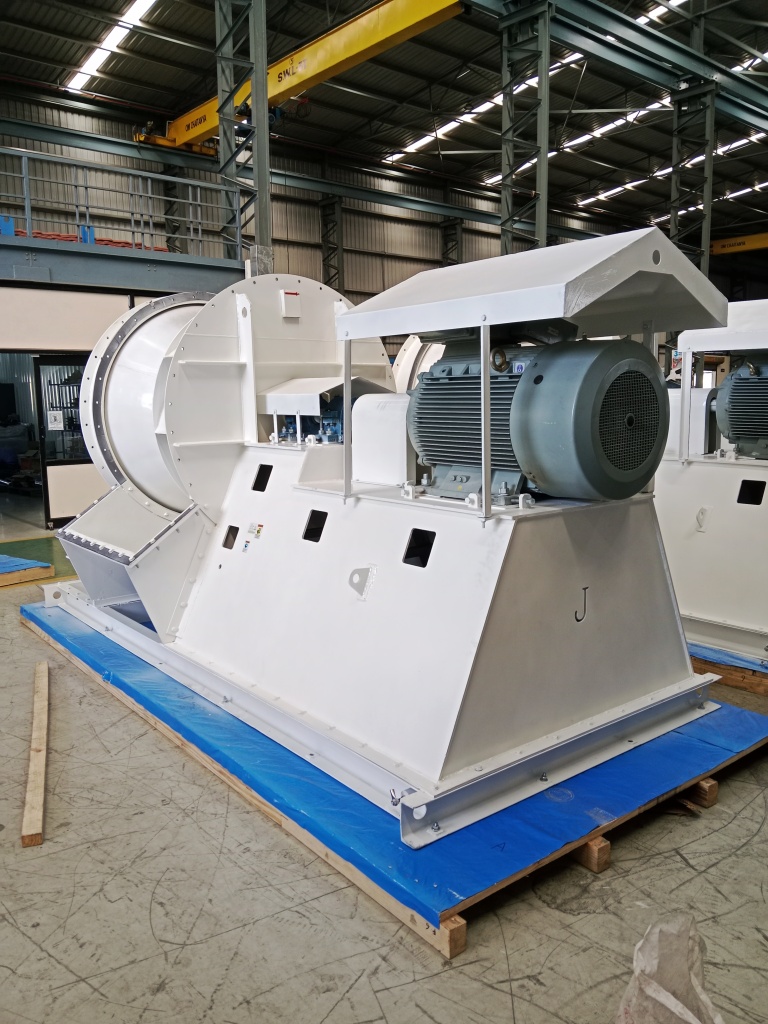
Why is the Backward-Curved Plate called your workhorse family?
It is the family we build and sell most. The flat steel-plate blade on a backward-curved pitch is the practical middle of the range — good efficiency, medium-to-high pressure, light-dust tolerance, and a robust, repairable wheel. That combination covers the bulk of everyday process-plant duty: forced-draft, primary and secondary air, combustion and process air, bag-filter draught and light-dust ID. For most industrial process-air enquiries it is the default first pick.
What is the highest pressure you have actually delivered with this family?
2,000 mmWC — three small-wheel high-pressure units built in 2022, with the motor power checked against the duty. That is a genuine served-above-software record, supported by a 1,524–1,700 mmWC band across five customers from 2022 to 2025 — not a catalogue claim. The family software ceiling is ~1,562 mmWC on the smallest wheel; above that is engineered-to-order, and we will only quote a pressure we can stand behind on a motor-power check.
How much dust can the plate wheel take, and what happens above that?
Light dust — bag-filter and pulse-jet draught, process air and light-dust ID. The solid plate blade is far more robust than a hollow aerofoil and is straightforward to wear-protect with leading-edge hardfacing and replaceable scroll liners as dust creeps toward the gate. Once dust becomes more than light this is the wrong wheel — we move you to the radial-tip family for moderate dust, or to the radial family, the toughest in our range, for dirty, abrasive, product-laden gas — so the fan lasts rather than erodes. The exact loading gates are shared with your enquiry.
Will the motor overload if the system resistance drops?
No. The backward-curved plate is a non-overloading wheel — power rises with flow, peaks, then falls, so if the duct opens up the motor cannot be driven past its rating. That makes drive sizing safer than a forward-curved wheel, which can overload off-design. We still size the motor to the verified absorbed power across your operating range, not to a rule-of-thumb margin.
Can you run this family hot, or in a hazardous area?
Yes to both, as specified construction. For hot process air we use HT (high-temperature) construction, attested to 600 °C, with a shaft cooling disc fitted above about 150 °C. For solvent, paint-booth and combustible-dust zones we build SR (spark-resistant) construction to AMCA 99 Type A/B/C with ATEX conformity. To be precise: ATEX is self-declared per 2014/34/EU (Category 3) where the area classification calls for it — a self-declaration of conformity, not a third-party certification.
How do I choose between this family and your other backward fans?
Match the wheel to what you most need. Backward-Curved Plate when you need medium-to-high pressure with light dust — the FD/process-air default. Step down to the curved Backward-Curved family for low-pressure clean ventilation where it may be cheaper, or up to the Aerofoil family for maximum efficiency on perfectly clean air. For high flow at medium-high pressure on a large fan, the Backward-Flat Plate family. Once dust goes beyond light loading, the Radial-Tip family. We size the duty first, then pick the family — we will tell you when this is the wrong one.
Do you performance-test before dispatch, and can we witness it?
Yes. Every fan is performance-tested in-house to the AMCA 210 / ISO 5801 method on our 200 HP VFD test rig, and dynamically balanced to ISO 21940 G6.3 as standard (G2.5 / G1.0 on application). The test and FAT take about a week and are customer-witnessed on request. You see the curve and the balance report before the fan leaves the floor. To be precise, that is testing to the AMCA 210 / ISO 5801 method in-house — not AMCA certification.
What about API 673, CE and ATEX requirements?
We design and build to API 673 for oil and gas process-fan duty as project-specific scope (allow 7–10 working days for the offer) — rotor balance to ISO 1940-1, vibration-transducer provisions, NACE materials where specified. CE is self-declared per 2006/42/EC and 2014/35/EU, and ATEX Zone 2/22 is self-declared per 2014/34/EU (Category 3) where the area classification calls for it. To be precise: those are self-declarations of conformity, not third-party certifications; our only third-party certification is ISO 9001:2015.