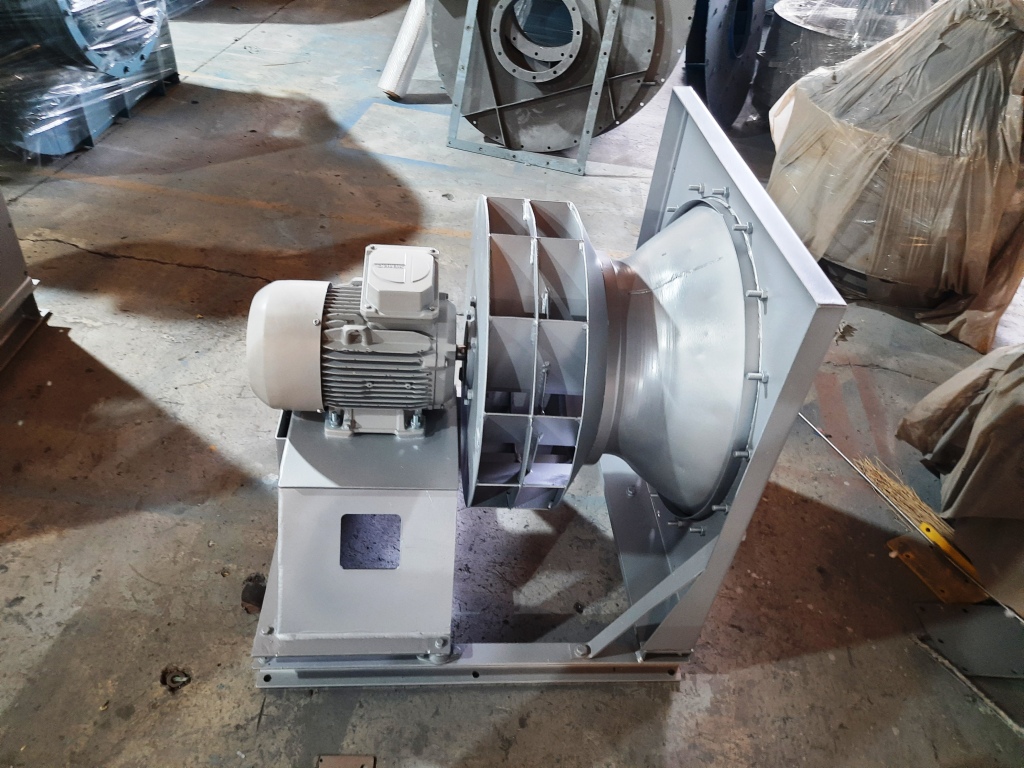
High-efficiency backward-curved plenum fan for a data-center air-handling unit on the Jitamitra shop floor
Home  /  Industries  /  Data Centers
Industries

Fans for the data center — cooling air, always on, quiet.

A data center runs on clean air, not hot dirty gas: CRAH and AHU cooling air moving through the white space, hot- and cold-aisle containment and general ventilation, cooling-tower draught, and the high-temperature smoke-and-fire fans that run only when everything else has failed. The duty is unusual because the gas is easy but the standard is brutal — the fans run 24×7 for years, redundancy is N+1, every watt shows up in PUE, and the sound power has a limit. We engineer each fan to your duty; the underlying fan design is proven across our range, up to 2,00,000 CMH, 2,000 mmWC, 400 HP and 600 °C.

24×7continuous cooling duty
N+1redundancy engineered in
highstatic efficiency, clean air
600 °C / 2 hsmoke-fan rating
15,000+
fans built since 2011
200 HP
VFD test rig · IS 4894 / AMCA 210
99%
on-time delivery
3
working days to quote — always
CRAH / AHU COOLING AIR · CONTAINMENT VENTILATION · COOLING TOWER · SMOKE & FIRE
Where the fans sit

One facility, three jobs the fans do — and the white space never goes dark.

Across a data center the fans do three distinct jobs: they move the cooling air that keeps the racks within their thermal envelope, they ventilate the containment, battery and support rooms, and they stand ready as the smoke-and-fire fans that only run in an emergency. The air itself is clean and cool — so the fight here is not wear or corrosion, it is 24×7 reliability, efficiency that shows up in PUE, and sound power kept under the limit.

The duties we run in a data center

The fan duties across a data-center facility — and the role each one plays.

A single facility needs a small family of fan duties, from the continuous cooling-air fans that run every second to the smoke fans that run once in a crisis. We have executed a small number of these duties in this sector, and the underlying fan design is proven across our range — each engineered to its own flow, static and sound limit, not adapted from a catalogue near-fit.

The fans we deploy here

Three clean-air fan types cover the facility — matched to efficiency and sound.

The air is clean and cool, so the wheel is chosen for efficiency and acoustics, not wear: an aerofoil wheel for the highest efficiency and lowest sound on the big cooling-air and AHU duty, a backward-curved wheel for the plenum and general ventilation, and a backward-curved plate wheel where the static climbs. All three build across the same envelope — to 2,00,000 CMH, 2,000 mmWC, 400 HP and 600 °C.

Why data-center fan duty is hard

Three things decide a data-center fan — and none of them is dust.

A data-center fan is not fighting hot abrasive gas; it is fighting three quieter enemies. The fan must run 24×7 for years without stopping the racks, it must waste as little energy as possible because every watt shows up in PUE, and it must hold its sound power under a hard limit. Engineer for all three and the facility runs efficient and silent for its design life. Miss one and you get a trip that threatens uptime, a fan that inflates the energy bill, or a noise complaint at the boundary.

01 — UPTIME

24×7 reliability & N+1 redundancy

The cooling-air fans run continuously for years, and a single trip can push the racks past their thermal envelope within minutes — so the design has to survive continuous service and share the duty across an N+1 set without a single point of failure.

How we engineer it out

A robust rotor balanced to ISO 21940 G6.3 (tighter on application); bearings sized for a long continuous L10h life; a non-overloading backward-curved or aerofoil wheel so a failed unit's load shifts to the standby without overloading the motor; and every unit performance-tested before it ships.

02 — ENERGY

Efficiency at part load (PUE)

The cooling fans run every hour of the year, so fan power is a standing cost that lands straight in PUE — and the IT load swings, so the fan spends most of its life at part load, where a wrong wheel or a throttling damper burns energy for nothing.

How we engineer it out

The duty point engineered onto the best-efficiency region of a high-efficiency aerofoil or backward-curved wheel, verified on the rig; VFD speed control as the default so part-load flow follows the fan laws instead of throttling; and the fan sized where its curve crosses your system, not forced onto a catalogue point.

03 — ACOUSTICS

Sound power under the limit

Fans near occupied areas, plant rooms and the site boundary run against a sound-power limit — and pushing a fan off its best-efficiency point or up its speed to make the duty raises the noise sharply, so a mis-selected fan fails the acoustic spec even when it makes the flow.

How we engineer it out

A low-tip-speed selection on the quietest wheel geometry for the duty; the operating point kept in the best-efficiency region where the fan is quietest; and matched inlet/outlet attenuator and acoustic-lagging scope where the limit is tight — the sound target engineered in, not measured as a surprise on site.

How we design for the facility

Every efficiency, reliability and sound choice is documented on the GA drawing you sign off — before we cut metal.

We don't sell a catalogue near-fit onto a data center. Each fan is engineered to its own duty — the continuous cooling-air fan to its efficiency and sound target, the smoke fan to its temperature rating — at your operating point.

  • Efficiency-first selection — A high-efficiency aerofoil or backward-curved wheel with the duty point engineered onto its best-efficiency region and proven on the rig; VFD speed control as the default so part-load flow follows the fan laws rather than throttling — because on a 24×7 cooling fan every point of efficiency lands in PUE.
  • Built for continuous & N+1 duty — A robust rotor dynamically balanced to ISO 21940 G6.3 as standard (G2.5 / G1.0 on application); bearings sized for a long continuous L10h life; and a non-overloading wheel so an N+1 set can shed a unit onto the standby without overloading the drive.
  • Acoustic engineering — A low-tip-speed selection on the quietest wheel geometry for the duty, the operating point held in the best-efficiency region where the fan is quietest, and matched inlet/outlet attenuators and acoustic lagging where the sound-power limit is tight — the target designed in, not discovered on site.
  • Emergency smoke-fan scope — For the life-safety duty, a fan rated to move smoke at 300 °C or 600 °C for its stated duration with high-temperature bearings and construction — the same platform that runs our hot-gas duty across the range to 600 °C, engineered here to sit idle for months and then run hot on demand.
Standards & conformity

Stated precisely — because procurement checks.

What our marks mean, in the words that survive an audit.

Performance

Tested to the AMCA 210 / ISO 5801 method, in-house on our 200 HP VFD rig. Tested-to-method — not AMCA-certified.

Quality system

ISO 9001:2015 — third-party certified. Our only third-party certification.

CE conformity

Self-declared per 2006/42/EC + 2014/35/EU (Module A). A self-declaration, not a notified-body certificate.

ATEX conformity

Self-declared, Zone 2/22, Category 3, per 2014/34/EU, where the area classification calls for it.

Oil & gas duty

Designed and built to API 673 as project-specific scope.

Welding

ASME Sec IX qualified welders + WPS for every joint.

Balance

ISO 21940 — G6.3 minimum, G2.5 / G1.0 on application.

Vibration

ISO 20816 evaluation; ISO 14694 for fan-specific limits.

Questions engineers ask

Data-center fan questions, answered straight.

Have you supplied fans for data centers before?
We have executed a small number of data-center duties, and the underlying fan engineering is proven across our range in far harder service than clean cooling air. A data-center fan is a clean-air, high-reliability, low-noise duty; the same aerofoil and backward-curved wheels we run there, and the same continuous-duty rotor and bearing engineering, are proven across cleanroom, HVAC and process work. We engineer each fan to your duty point and prove it on the test rig before it ships, whether it is your first unit from us or your fiftieth.
How do you engineer the fans for 24x7 uptime and N+1 redundancy?
Three ways. The rotor is dynamically balanced to ISO 21940 G6.3 as standard, tighter on application, and the bearings are sized for a long continuous L10h life rather than intermittent duty. The wheel is a non-overloading backward-curved or aerofoil type, so in an N+1 set a failed unit's share of the flow shifts to the standby fan without overloading its motor. And every fan is performance-tested in-house before dispatch, so the unit that goes into a live facility is a proven curve, not a catalogue promise. Tell us your redundancy scheme and the duty split and we size the set to it.
Fan energy lands straight in our PUE. How do you keep it efficient?
The cooling fans run every hour of the year, so we treat efficiency as the primary design driver, not an afterthought. We engineer your duty point onto the best-efficiency region of a high-efficiency aerofoil or backward-curved wheel, size the fan where its own curve crosses your system rather than forcing a catalogue point onto your spec, and default to VFD speed control so part-load flow follows the fan laws instead of burning energy across a throttling damper. Because the IT load swings, part-load efficiency matters as much as the design point, and we select for both. We prove the curve on the 200 HP VFD test rig before the fan leaves the floor.
We have a hard sound-power limit near the boundary. Can you meet it?
Yes, but the sound target has to be a design input, not a site surprise. We hold the fan at a low tip speed on the quietest wheel geometry for the duty and keep the operating point in the best-efficiency region, which is also where the fan is quietest. Where the limit is tight we add matched inlet and outlet attenuators and acoustic lagging inside the battery limit. Give us the sound-power or sound-pressure limit and the location, and we engineer the selection and the attenuation scope to meet it rather than measuring a problem after installation.
Do the emergency smoke and pressurisation fans really run hot, and can you build them?
Yes. Smoke-extraction and stairwell-pressurisation fans sit idle until a fire, then must move smoke hot for a stated duration, typically rated at 300 °C or 600 °C for a defined time. We build these on the same high-temperature platform that runs our hot-gas duty across the range up to 600 °C, with high-temperature bearings and construction, engineered here for the unusual case of sitting unused for months and then running hot on demand. Tell us the temperature rating, the duration and the airflow the life-safety scheme calls for and we build to it.
Do you performance-test the fans, and what about AMCA, CE, ATEX and quality certification?
Every fan is performance-tested in-house to the AMCA 210 / ISO 5801 method on our 200 HP VFD test rig, and dynamically balanced to ISO 21940 G6.3 as standard (G2.5 / G1.0 on application), so you get the proven curve and the balance report before dispatch. To be precise: that in-house testing is to the AMCA 210 / ISO 5801 method, not AMCA-certified, and we are not an AMCA member; CE is self-declared per 2006/42/EC and 2014/35/EU, and ATEX Zone 2/22 is self-declared per 2014/34/EU (Category 3) where the area classification calls for it — those are self-declarations of conformity, not third-party certifications. Our only third-party certification is ISO 9001:2015.

Across the range

Where Data Centers fits — the fans we deploy, the duties we run, and adjacent industries.

The same engineering, viewed three ways — by fan family, by duty, and by industry. Follow the cross-references.

Take it further

Specs an engineer can use — not a brochure.

Engineer to engineer

Send us the duty point.
We'll quote in 3 working days — always.

No model numbers needed. Give us the operating conditions — flow, static, gas temperature, composition, particulate, and any tender standard — and our application engineers size the fan and quote it. Attach a spec or GA if you have one.

+91 90110 09155  ·  mihir.jitamitra@gmail.com