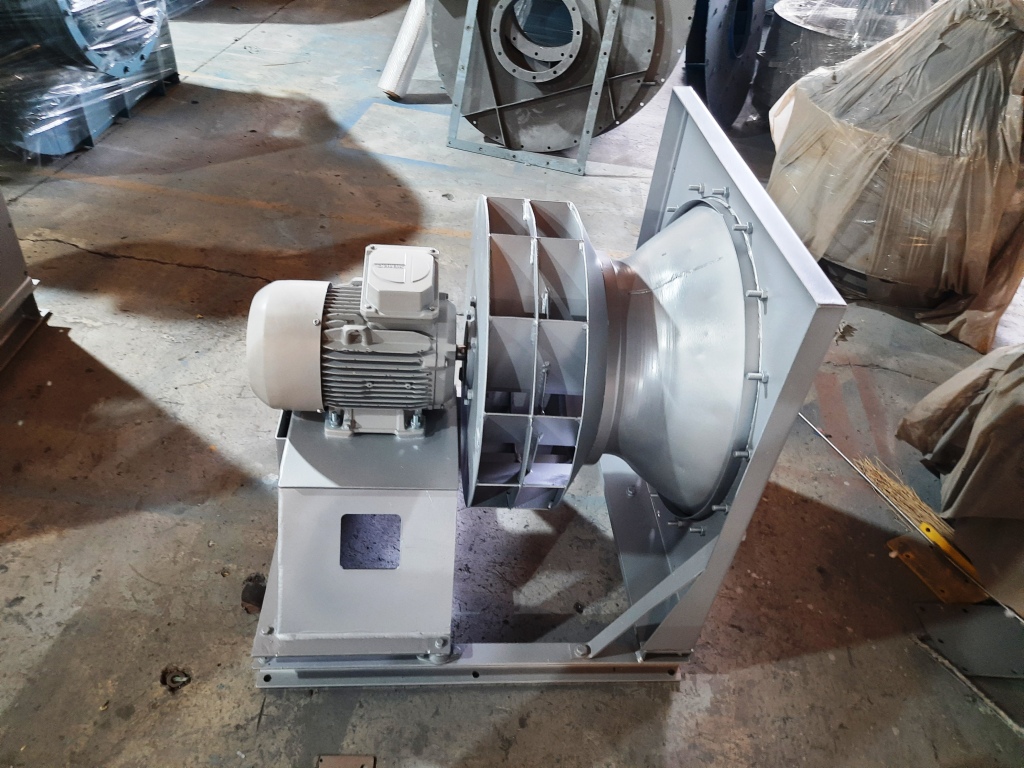
What is the difference between a plug/plenum fan and a housed AHU fan?
A plug/plenum fan is an unhoused impeller mounted directly on the motor shaft that discharges into the plenum section of the air-handling unit — no scroll casing. It is compact, gives a clean discharge into the AHU, and is the common choice for built-up and packaged units. A housed fan uses a conventional scroll volute and a defined discharge flange, which suits a directly ducted take-off. We supply both. Plug/plenum is our default inside an AHU; we build housed where the layout needs a ducted volute discharge, and we tell you the trade-off on the quote rather than defaulting to whichever is easier to make.
How efficient are your AHU fans, and why does it matter so much here?
We design for high static efficiency on standard duty, higher still on airfoil high-efficiency builds. It matters more on AHU duty than almost anywhere else because the fan runs near-continuously — 6,000 to 8,760 hours a year — and fan energy is the single largest electrical load in most air-handling systems. A 75 HP supply fan run several points below its best static efficiency wastes tens of MWh a year at 8,000 hours, and over a 20-year life that gap dwarfs the purchase price of the fan. We give you the offered efficiency on the quote, not a generic catalogue figure.
How do you keep the fan quiet where the AHU sits next to occupied space?
We predict sound power per octave band, select a low-tip-speed airfoil wheel that is inherently quieter, and size the attenuator scope to your room criterion. As standard we design to below 85 dB(A) at 1 m. Below 80 dB(A) is achievable with inlet and discharge silencers plus an acoustic-lagged casing; below 75 dB(A) needs an acoustic enclosure. Tell us the NC or RC target for the space and where the AHU sits relative to it, and we engineer the wheel selection and the attenuation to meet it rather than quoting a single-figure dB(A) that hides the low-frequency content.
Should I specify VFD or a discharge damper for control?
VFD is our default. AHU flow tracks occupancy and load across a wide range, and on a VAV system the unit spends most of the year well below design flow. VFD speed control is more efficient than a discharge damper across the operating range because it avoids the throttling loss at part-load, and it holds space pressure as VAV boxes open and close. On a supply/return pair we match the two drives so they turn down together. A damper remains available for a legacy retrofit where the existing motor and starter cannot take a drive.
How do supply and return fans stay balanced across turndown?
The building holds its target pressure only if the supply and return fans track each other as flow changes. We size both onto the stable, falling side of their curves so neither drifts toward stall at low flow, match the VFD drives so they turn down together on a common signal, and set the duty points so the intended supply-minus-return offset holds across the range. On a VAV system that spends most of the year at part-load, this is what keeps the space from going over- or under-pressure as boxes modulate. We document the paired duty on the GA so the balance is engineered, not left to site commissioning to rescue.
Can you build the fan for a pharma or food AHU that needs cleanable construction?
Yes. For pharma utility HVAC, food process areas and wash-down environments we build a stainless-steel wheel and a cleanable, crevice-minimised construction so the fan can be wiped down and does not trap product or moisture. Note this page covers general comfort and process HVAC; a classified cleanroom AHU — with its containment, filter-integrity and validation requirements — is a separate duty and a separate page. Tell us the hygiene standard and whether the return path is classified, and we build the material and detailing to it.
What is the lead time for a standard AHU fan?
A standard engineered AHU fan runs roughly 8 to 12 weeks order-to-dispatch: offer in 3 to 5 working days, GA drawing 2 to 3 weeks from PO, manufacture, balance and paint 5 to 8 weeks (shorter than a hot or abrasive fan because the materials are simpler and there is no wear package), and performance test plus FAT 1 week. A matched supply-and-return set, or an acoustic-enclosure build, adds a little to the schedule — we confirm a dated commitment against your AHU delivery window, not a placeholder.
Are your fans AMCA-certified, and what about CE and ATEX?
To be precise about the claims: performance is tested in-house to the AMCA 210 / ISO 5801 method on our 200 HP VFD test rig — that is testing to the AMCA method, not an AMCA certification, and Jitamitra is not an AMCA member. Every fan is dynamically balanced to ISO 21940 G6.3 as standard, with G2.5 or G1.0 on application. CE is self-declared per 2006/42/EC and 2014/35/EU, and ATEX Zone 2/22 is self-declared per 2014/34/EU (Category 3) where an AHU handles a classified return path — those are self-declarations of conformity, not third-party certifications, and ATEX Zone 2 service uses an aluminium impeller. Our only third-party certification is ISO 9001:2015.