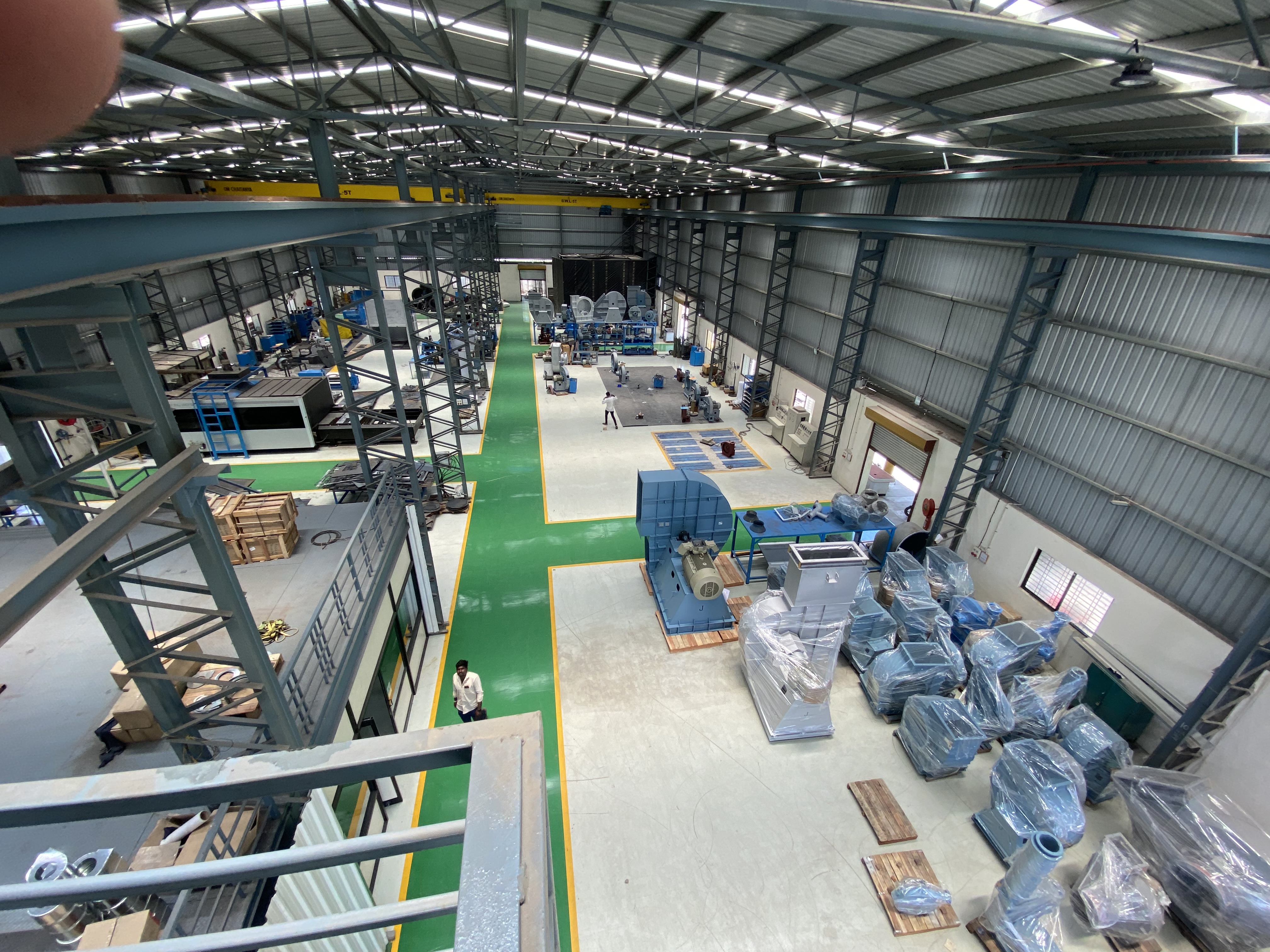
Corrosion-resistant roof-mounted laboratory exhaust fan on the Jitamitra shop floor
Home  /  Applications  /  Lab / fume-hood exhaust
Applications

Lab / fume-hood exhaust fans — corrosion-resistant, high-plume, built to contain.

A laboratory exhaust fan pulls chemical fume-hood and lab air through the duct, holds the whole run under negative pressure so nothing leaks into the building, and discharges it high and fast off the roof so the plume clears the intakes instead of drifting back in. The air is not dirty — it is corrosive: acid vapour, solvent fume, occasional radionuclide or biohazard-rated exhaust. Material selection and leak-tight containment decide the duty, not wear or heat. This is an engineered-capability page: we design to this duty and build to your specification — 45 application types engineered.

2,00,000CMH max flow
2,000mmWC max static
Zone 22ATEX self-declared
FRP / SScorrosion-resistant
15,000+
fans built since 2011
200 HP
VFD test rig · IS 4894 / AMCA 210
99%
on-time delivery
3
working days to quote — always
AT THE HOOD SASH · NEGATIVE-PRESSURE DUCT · CORROSION-RESISTANT FAN · HIGH-PLUME ROOF DISCHARGE
What it does

One containment-to-plume system — keep the fume in the duct, then throw it clear of the roof.

A laboratory exhaust fan runs the last leg of a fume-hood system: holding the hood, duct and fan under continuous negative pressure so corrosive fume never leaks into occupied space, then discharging it through a high-plume stack fast enough that the exhaust clears the building's own air intakes. Where a process ID fan fights heat and ash, this duty is won or lost on material selection, leak-tightness and discharge velocity.

  • 01
    Contain

    Hold the hood face at its rated capture velocity — typically 0.5 m/s across the sash opening — and the entire duct run under negative pressure so corrosive fume leaks inward, never out. Shaft seals and casing joints are specified leak-tight, not merely gasketed.

  • 02
    Resist

    The airstream is clean of dust but chemically aggressive: acid vapour, solvent fume, chlorides. The flow path is built in FRP, 316L or higher alloy so the fan survives the fume it moves — material, not wear protection, is the design lever here.

  • 03
    Disperse

    Discharge high and fast through a plume-boosting stack — exit velocity around 15 m/s or more — so the plume rises clear of the roof and the exhaust does not re-entrain into fresh-air intakes downwind.

INDUCED-DRAFT CENTRIFUGAL FAN Single-width single-inlet — scroll cut away to reveal the impeller inlet expansion joint MOTOR IE3 / VFD GAS IN GAS OUT n 1 2 3 4 5 6 7 8 9 10 1 Inlet cone (bell-mouth) 2 Backward-curved / radial-tipped impeller 3 Spiral volute casing 4 Replaceable AR wear plates (volute throat) 5 Shaft 6 Plummer-block bearings (L10 ≥ 40,000 h) 7 Shaft cooling disc (>400 °C duty) 8 Pedestal / base frame 9 Drive — motor + coupling 10 Outlet flange + duct take-off
Fig. 1Laboratory exhaust fan — corrosion-resistant centrifugal on a high-plume roof discharge, scroll cut away to reveal the FRP-lined backward-curved impeller and leak-tight shaft seal. Numbered components keyed below the drawing.
Why it is hard

Corrosion, containment and re-entrainment decide whether a lab fan protects people or quietly fails.

Lab exhaust looks like a simple ventilation duty until you name the airstream. Acid and solvent vapour eat a mild-steel flow path from the inside; a fan or duct that leaks under positive pressure puts fume into the occupied floor; and a plume that discharges too slow or too low gets pulled straight back through the building's own intakes. Design for the fume you actually have and the fan runs 10+ years and keeps the lab safe. Treat it as clean-air ventilation and the wetted surfaces corrode, a joint leaks, or the plume re-entrains within 1–3 years.

01 — CORROSION

Acid and solvent vapour attack the flow path

Fume-hood exhaust carries acid vapour (HCl, HNO3, HF), solvent fume and chlorides. On a mild-steel wheel and casing these attack the wetted surfaces from the inside, thinning the blade and unbalancing the rotor long before any duty-related wear would.

How we engineer it out

Flow path matched to the fume chemistry: FRP (fibre-reinforced plastic) construction for wet acid fume, 316L or higher alloy for mixed solvent/acid, and FRP-rubber-ebonite lining on metallic casings where a resin flow path is not viable. Material is selected against your stated fume analysis, not a default.

02 — CONTAINMENT

Any leak puts fume into the occupied floor

The hood, duct and fan run under negative pressure so fume is drawn away from people. But a leaking shaft seal or casing joint on the positive-pressure discharge side, or a duct run that goes positive at the fan, lets corrosive fume back into the building — the exact hazard the system exists to prevent.

How we engineer it out

Leak-tight construction end to end: purged or double-lip shaft seal, welded and gasket-sealed casing joints, and the fan kept on the negative-pressure side of the plume stack wherever the layout allows. On high-containment (radionuclide / biohazard) duty the whole flow path is bag-in/bag-out serviceable and pressure-decay leak-tested.

03 — RE-ENTRAINMENT

A weak plume gets pulled back through the intakes

Discharge the exhaust too slowly or too low and the plume hugs the roof, gets caught in the building wake, and is drawn straight back through fresh-air intakes — so the fume the lab expelled returns to the people it was meant to protect.

How we engineer it out

A high-plume discharge sized for exit velocity around 15 m/s and above, engineered into the fan's static so the stack throws a tall plume; on stringent sites a bypass-air (induced-dilution) nozzle raises effective exit velocity and dilutes the plume without adding fan power.

How we design for it

Every choice is documented on the GA drawing you sign off — before we cut metal.

We don't sell a catalogue near-fit. The fan is engineered to your fume chemistry, containment class, plume-discharge velocity, area classification and system resistance — made to order, not off a shelf.

  • Material of construction — Flow path matched to the fume: FRP for wet acid vapour, 316L or higher alloy for mixed solvent/acid, FRP-rubber-ebonite lining on a steel casing where a full resin build is not viable. Special coatings and gel-coat finishes selected against your stated chemistry — the wetted surface is the whole design here.
  • Containment & leak-tightness — Purged or double-lip shaft seal, welded and gasket-sealed casing joints, and the fan kept on the negative-pressure side of the plume stack where layout allows. High-containment (radionuclide / biohazard) duty gets a bag-in/bag-out serviceable flow path and a pressure-decay leak test to a stated leakage class.
  • High-plume discharge — Discharge engineered for exit velocity around 15 m/s and above so the plume clears the roof and downwind intakes; a bypass-air (induced-dilution) nozzle option lifts effective exit velocity and dilutes the plume. The stack pressure loss is built into the fan static, not left for the system to absorb.
  • Pressure-drop, control & redundancy — Sized to hold constant hood face velocity as sashes open and close across the lab — VFD default so the fan tracks demand and holds capture velocity instead of over- or under-exhausting. N+1 duty/standby with automatic changeover on critical labs, so a single fan trip never drops containment.
Engineered to your duty point

We size the fan for constant hood velocity across the sash range — then prove it on the rig.

No catalogue fan forced onto your spec. Your operating point is engineered across the varying-sash demand range — including the long-duct capture-to-stack resistance and the plume-stack loss — onto the best-efficiency region of a corrosion-resistant wheel, then verified on the 200 HP VFD test rig before dispatch.

avoid: unstable 0 40,000 80,000 1,20,000 1,60,000 2,00,000 VOLUME FLOW RATE  [ CMH ] 0 500 1000 1500 2000 STATIC PRESSURE  [ mmWC ] 0 25 50 75 100 STATIC EFFICIENCY  [ % ] Fan static pressure System resistance Static efficiency BEP 82% DUTY POINT 1,20,000 CMH · 450 mmWC Fan static pressure System resistance Static efficiency
Fig. 2Representative laboratory-exhaust characteristic — fan static pressure, system resistance (sashes open and closed) and static efficiency vs. flow, with the operating range engineered onto the best-efficiency region. Illustrative; every fan is sized to its own duty.
Capability envelope — laboratory / fume-hood exhaust service

What we can supply, and where it stretches on application.

ParameterStandardOn application
Volume flow2,000–50,000 CMH typicalup to 2,00,000 CMH for manifolded lab blocks
Static pressureup to 1,000 mmWCup to 2,000 mmWC incl. high-plume stack loss
Gas temperatureambient to 80 °Cup to 600 °C where the lab exhausts a hot process
Airstreamclean but corrosive — acid / solvent vapour, chloridesradionuclide / biohazard on application
Construction (corrosion)FRP / 316L flow pathhigher alloy / FRP-rubber-ebonite lining on application
Discharge (plume)exit velocity ≈15 m/sbypass-air induced-dilution nozzle on application
Drive powerup to 400 HPhigher with custom motor sourcing
Balance qualityISO 21940 G6.3G2.5 / G1.0 on application

The envelope above covers the great majority of laboratory and fume-hood exhaust duty. Most lab fans sit at the low-flow end — 2,000–50,000 CMH — but manifolded lab-block exhaust runs to 2,00,000 CMH; static pressure runs up to 1,000 mmWC on standard trains and up to 2,000 mmWC once a high-plume stack loss is included. The airstream is clean of dust but chemically aggressive, so the flow path is FRP, 316L or higher alloy selected against your fume analysis. Where a lab exhausts a hot process the duty is rated up to 600 °C; where combustible solvent vapour is present, spark-resistant construction is combined with ATEX Zone 22 (Cat 3D) self-declared per 2014/34/EU. Bearing life is a design target of L10h ≥ 40,000 h continuous, longer on application. This is a capability page: we engineer to this duty — specify yours and we quote to it.

How a Jitamitra LFHE fan is specified

Specified, not picked from a shelf.

The same engineering language carries from your enquiry to the GA drawing to the nameplate — expressed in the standard AMCA conventions, with the corrosion, containment and ATEX scope marked alongside.

Specification fieldOptions
Arrangement (AMCA 99)Arr. 1 (overhung, fan bearings) / Arr. 4 (direct, motor on base) / Arr. 8 (overhung on common base) / Arr. 9 (overhung, motor side) / Arr. 10 (overhung, motor inside base) — upblast roof mounting is the common lab configuration, selected by drive, access and containment.
Width / inletSWSI (single width, single inlet) default for lab exhaust; DWDI (double width, double inlet) for higher flow on manifolded multi-hood lab-block extraction.
Wheel typeBackward-curved / backward-inclined (default — clean corrosive air, high efficiency, low noise) / airfoil (large continuous manifolded duty) / plug / plenum (in-line roof-plenum discharge where a scroll is not wanted).
Materials of constructionFRP (wet acid vapour) / 316L or higher alloy (mixed solvent / acid) / FRP-rubber-ebonite lining on an MS casing / special coating & gel-coat finish selected against the stated fume chemistry — corrosion resistance is the primary selector, not wear.
Containment scopePurged or double-lip shaft seal, welded and gasket-sealed casing joints, negative-pressure fan position; on radionuclide / biohazard duty a bag-in/bag-out serviceable flow path and pressure-decay leak test to a stated leakage class.
Discharge / plume scopeHigh-plume upblast stack engineered for exit velocity ≈15 m/s and above; bypass-air (induced-dilution) nozzle option to raise effective exit velocity and dilute the plume clear of downwind intakes; no rain-cap that would suppress the plume.
ATEX scopeZone 22 self-declared (Cat 3D) per 2014/34/EU where combustible solvent vapour or metal dust is present — non-sparking impeller, bonded earthing, anti-static coatings, T-class bearing control, combined with spark-resistant construction. Zone 21 (Cat 2D) on application via Notified-Body partner.
DriveDirect-coupled / V-belt / VFD (default for constant-hood-velocity and sash-tracking control). N+1 duty/standby with automatic changeover on critical labs. Drive up to 400 HP across the envelope.
Accessories & acoustic scopeBypass-air induced-dilution nozzle; drain and washdown ports on the FRP casing; leak-tight isolation dampers for duty/standby changeover; inlet and outlet silencers with acoustic-lagged casing (down to <75 dB(A)) for rooftop-adjacent occupied space; inspection doors and corrosion-resistant flexible connections.
The proof, not the promise

We test before we ship — and you're welcome to witness it.

Every job's performance is verified at our works on the 200 HP VFD test rig, to the AMCA 210 / ISO 5801 method, before dispatch.

  • Customer-witnessed FAT on request — at no extra cost
  • Rotors balanced to ISO 21940 G6.3 as standard (G2.5 / G1.0 on application) before they leave the floor
  • Full NDT in-house — DP, MPI, UT, RT — to what the duty demands
30+ INDUSTRIES · 45 APPLICATION / DUTY TYPES
Where our lab exhaust fans run

Engineered where the fume is corrosive, contained or must clear the roof.

Pharmaceuticals

QC and R&D fume-hood exhaust, solvent-fume extraction, containment-suite and potent-compound lab discharge.

Chemicals & Petrochemicals

Acid-vapour fume-hood exhaust, corrosive process-lab extraction, high-plume rooftop discharge over dense plant.

Semiconductor & Electronics

Wet-bench and acid-etch exhaust, solvent and acid-fume scrubber-inlet fans, FRP flow path for HF and chloride fume.

Defence & Nuclear

Radionuclide and high-containment lab exhaust, bag-in/bag-out serviceable flow path, pressure-decay leak-tested build.

Research & Academic Labs

Teaching and research fume-hood manifolds, variable-sash constant-velocity control, low-noise rooftop installation.

Biotech & Life Sciences

Biosafety-cabinet and containment-lab exhaust, leak-tight construction, duty/standby N+1 redundancy on critical suites.

Surface Coating & Plating

Plating-line and acid-tank fume-hood exhaust — wet corrosive vapour, FRP or lined construction, high-plume discharge.

Your process

45 application/duty types engineered. Tell us yours.

Standards & conformity

Stated precisely — because procurement checks.

What our marks mean, in the words that survive an audit.

Performance

Tested to the AMCA 210 / ISO 5801 method, in-house on our 200 HP VFD rig. Tested-to-method — not AMCA-certified.

Quality system

ISO 9001:2015 — third-party certified. Our only third-party certification.

CE conformity

Self-declared per 2006/42/EC + 2014/35/EU (Module A). A self-declaration, not a notified-body certificate.

ATEX conformity

Self-declared, Zone 2/22, Category 3, per 2014/34/EU, where the area classification calls for it.

Oil & gas duty

Designed and built to API 673 as project-specific scope.

Welding

ASME Sec IX qualified welders + WPS for every joint.

Balance

ISO 21940 — G6.3 minimum, G2.5 / G1.0 on application.

Vibration

ISO 20816 evaluation; ISO 14694 for fan-specific limits.

Lead time & process

From enquiry to a tested fan on your dock.

StageStandard dutyAPI-673 / engineered
Offer / quotation3 working days — always7–10 working days
GA drawing for approval2–3 weeks from PO3–4 weeks from PO
Manufacture + balance + paint6–10 weeks10–14 weeks
Performance test + witnessed FAT~1 week1–2 weeks
Order-to-dispatch (total)9–14 weeks14–20 weeks

Shutdown-driven replacements: we have shipped fans within 6 weeks of a clean PO. Tell us your shutdown window and we commit to a dated plan.

Questions engineers ask

The eight we hear most before a PO.

The exhaust is corrosive acid and solvent vapour. What do you build the fan from?
We match the flow path to your fume chemistry, because on lab exhaust the wetted surface is the whole design. For wet acid vapour such as hydrochloric, nitric or hydrofluoric acid we build the impeller and casing in FRP (fibre-reinforced plastic). For mixed solvent and acid fume we use 316L or a higher alloy. Where a full resin build is not viable we line a mild-steel casing with FRP, rubber or ebonite. We select the material against your stated fume analysis and the temperature, not a default, and we mark it on the GA drawing you sign off. Tell us the chemistry, concentration and temperature and we specify the metallurgy to it.
How do you make sure corrosive fume can't leak back into the lab?
Containment is the point of the whole system, so we build it leak-tight end to end. The hood, duct and fan run under negative pressure so fume is drawn away from people; the risk is on the positive-pressure discharge side of the fan, at the shaft seal and casing joints. We fit a purged or double-lip shaft seal, weld and gasket-seal the casing joints, and keep the fan on the negative-pressure side of the plume stack wherever the layout allows. On high-containment duty such as radionuclide or biohazard exhaust, the whole flow path is bag-in/bag-out serviceable and pressure-decay leak-tested to a stated leakage class before dispatch.
Why does the fan need a high-plume discharge, and how do you engineer it?
If the exhaust discharges too slowly or too low, the plume hugs the roof, gets caught in the building wake, and is pulled straight back through the building's own fresh-air intakes, so the fume the lab expelled returns to the people it was meant to protect. To prevent that re-entrainment we engineer the discharge for an exit velocity around 15 metres per second and above, and build that stack loss into the fan static rather than leaving the system to absorb it. On stringent sites we add a bypass-air, or induced-dilution, nozzle that draws in ambient air to raise the effective exit velocity and dilute the plume without adding fan power. We do not fit a rain-cap that would suppress the plume.
Fume-hood sashes open and close all day. How do you hold the capture velocity?
A fume hood only protects the operator if the face velocity across the sash stays at its rated value, typically around 0.5 metres per second, whatever the sashes are doing. As sashes open and close across a lab the system demand moves, so we size the fan across that varying-sash range rather than a single point, and make VFD control the default so the fan tracks demand and holds constant hood face velocity instead of over-exhausting when sashes close or starving the hood when they open. On a manifolded lab block we engineer the fan to hold the design velocity at every hood on the run, and we prove the curve on the 200 HP VFD test rig before dispatch.
We exhaust flammable solvent vapour. Are you ATEX-rated for that?
Where the exhaust carries combustible solvent vapour or combustible dust we self-declare ATEX Zone 22 per 2014/34/EU, Category 3D, combined with spark-resistant construction so both the ember and the vapour cases are covered by one build. The configuration uses a non-sparking impeller, bonded earthing throughout, anti-static coatings and T-class bearing-temperature control. To be precise, that is a self-declaration of conformity, not a third-party certification. Zone 21 (Category 2D) is available on application via a Notified-Body partner. See the testing and standards question below for how we handle the AMCA method, CE and ISO 9001.
This is a capability page — have you actually built lab exhaust fans before?
We are honest about this: laboratory and fume-hood exhaust is a duty we engineer to rather than one we cite a long installed list against, so this page describes the engineered capability, not a track record. The construction it calls for is the same corrosion-resistant, leak-tight, made-to-order engineering we apply across our 45 application and duty types, and the FRP, 316L, containment and high-plume scope here are standard tools in that kit. Specify your duty and we design and quote to it exactly as we would any engineered fan, and we will tell you plainly where a requirement sits at the edge of what we have built rather than imply experience we do not have.
The lab is critical and can't lose containment. Can you supply duty/standby redundancy?
Yes. On a critical lab where a single fan trip must never drop containment we supply an N+1 duty and standby arrangement with automatic changeover, so the standby fan starts and picks up the duty on a fault without the hoods losing face velocity. Each fan is isolated with leak-tight dampers so the offline unit can be serviced without breaking containment on the running one, and on high-containment duty the flow path is bag-in/bag-out serviceable. We engineer the changeover logic and the isolation scheme to your control philosophy and document it on the GA drawing.
Do you performance-test before dispatch, and what standards actually apply?
Yes. Every fan is performance-tested in-house to the AMCA 210 / ISO 5801 method on our 200 HP VFD test rig, and dynamically balanced to ISO 21940 G6.3 as standard, with G2.5 or G1.0 on application. To be precise about the claims: that is testing to the AMCA 210 method in-house, not an AMCA certification, and we are not an AMCA member; spark-resistant construction is built to AMCA 99; and CE and ATEX are self-declared per the relevant EU directives, not third-party certified. Our only third-party certification is ISO 9001:2015. For a standard corrosion-resistant lab exhaust fan the offer turns around in 3 to 5 working days; an FRP, high-containment or ATEX build adds material lead time and file preparation. The test and FAT are customer-witnessed on request.

Across the range

Where lab / fume-hood exhaust fans fit — the fans that run them, related duties, and the industries served.

The same engineering, viewed three ways — by fan family, by duty, and by industry. Follow the cross-references.

Take it further

Specs an engineer can use — not a brochure.

Engineer to engineer

Send us the duty point.
We'll quote in 3 working days — always.

No model numbers needed. Give us the operating conditions — flow, static, gas temperature, composition, particulate, and any tender standard — and our application engineers size the fan and quote it. Attach a spec or GA if you have one.

+91 90110 09155  ·  mihir.jitamitra@gmail.com