How do you choose the material of construction for my corrosive gas?
By your gas analysis, not a default. We work up from the acid, its concentration, the operating temperature and the condensation point. SS304 handles mild acid fume; 316L is the step up where chlorides are present; duplex 2205 resists chloride stress-corrosion cracking; and Hastelloy, Inconel or titanium are used for aggressive or hot acid. Where the wet acid would eat any economic metal — typical of scrubber off-gas — we build in FRP or line the fan with FRP, rubber or ebonite instead. Send us the gas composition, temperature and whether it condenses, and we size the metallurgy or lining and the corrosion margin to it, not to a nearest-catalogue grade.
When do you use FRP or a lining instead of a metal fan?
When the airstream is a wet acid that would corrode even a stainless economically — commonly HCl scrubber off-gas, chlorine and chloride-bearing vents. There we build the fan in FRP or line a steel fan with FRP, rubber or ebonite, and add special linings such as Halar (ECTFE), glass-flake or Saekaphen where a specific acid demands it. The trade-off is temperature: FRP and lined construction is generally limited to around 200 °C, so on dry hot corrosive gas we go back to a metal fan in the right alloy, rated to 600 °C at the ceiling. We match the construction to your gas and temperature together.
My exhaust is corrosive and also carries solvent vapour. Can one fan handle both?
Yes, and it often has to. Many corrosive exhausts — pharma reactor vents, solvent-extraction off-gas, plating and coating fume — are also solvent-laden and therefore flammable. We build the corrosion-resistant fan with spark-resistant construction to AMCA 99 and self-declare ATEX Zone 2 per 2014/34/EU, Category 3G: non-sparking impeller, bronze rub rings, bonded earthing and anti-static coatings, on top of the SS, alloy or lined build. To be precise, that ATEX marking is a self-declaration of conformity, not a third-party certification. So both the corrosion and the ignition cases are covered by a single fan, engineered to your gas.
The gas is toxic. How do you stop it leaking at the shaft?
The shaft penetration is the natural leak path, so containment is part of the design. We select the shaft seal to your gas and pressure — a lip seal for general acid fume, a mechanical seal for toxic or higher-pressure duty, or a labyrinth and stuffing box with a gas purge where any leak is unacceptable — and pair it with a gas-tight, flanged casing. The sealing tier is documented on the GA drawing you sign off, so the containment is engineered and agreed before we cut metal, not left to the standard build.
What temperature can a corrosive-gas fan handle?
It depends on the construction. Wet-acid and FRP or lined fans are generally limited to around 200 °C, because that is the ceiling for the resins and elastomers that survive the acid. Dry hot corrosive gas is handled by a metal fan in the right alloy and runs up to 600 °C at the top of the envelope, with the casing, shaft and bearings engineered for the heat. We build to your stated gas temperature and excursion case, and where temperature and corrosion pull in opposite directions we tell you the trade-off rather than quietly picking one.
Do you add a scrubber or drain, or just the fan?
We supply the fan with a mounting flange and a flexible connection or expansion joint to your ducting, and a casing drain plug or connection so acid condensate can be taken off the low point rather than pooling in the casing. We add a bird or vermin screen on open stack discharges. The scrubber or absorber itself is your process package; we size the fan to its resistance, clean and loaded, and document the interface so the fan lands onto the existing train. Tell us the battery limit and we quote the accessory scope inside it.
Do you performance-test a lined or FRP fan before dispatch, and can we witness it?
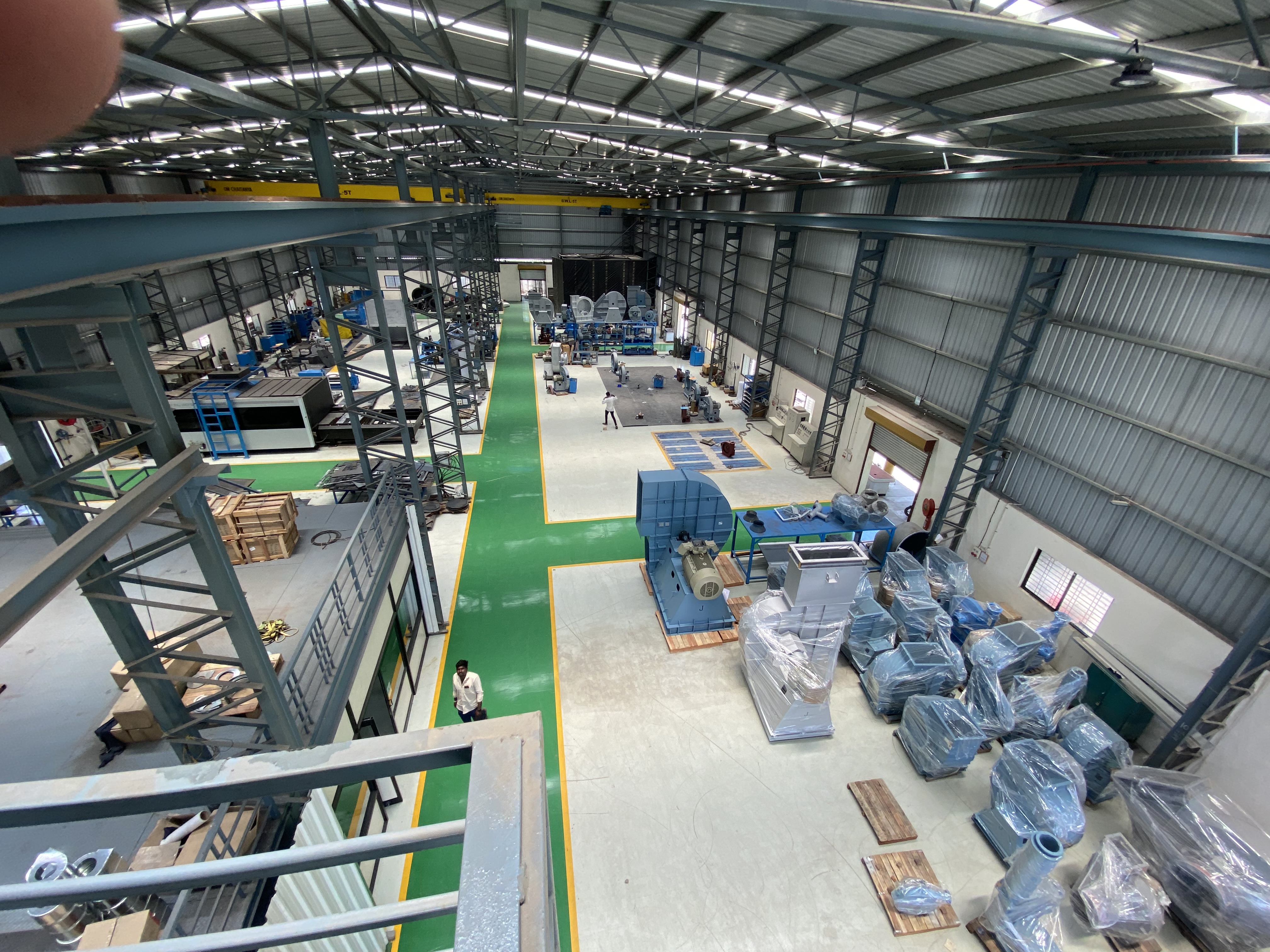
Yes. Every fan is performance-tested in-house to the AMCA 210 / ISO 5801 method on our 200 HP VFD test rig and dynamically balanced to ISO 21940 G6.3 as standard, with G2.5 or G1.0 on application. The lining, coating and seal are inspected as part of pre-dispatch, and the test and FAT take about a week and are customer-witnessed on request. You see the curve, the balance report and the corrosion-build inspection before the fan leaves the floor.
What do your AMCA, CE, ATEX and ISO claims actually mean?
We are precise about this. Performance is tested in-house to the AMCA 210 / ISO 5801 method on our 200 HP rig — that is testing to the method, not an AMCA certification, and we are not an AMCA member. CE is self-declared per the relevant EU directives, and ATEX Zone 2/22 is self-declared per 2014/34/EU (Category 3) where the area classification calls for it — those are self-declarations of conformity, not third-party certifications. Balancing is to ISO 21940 (G6.3 standard, G2.5 or G1.0 on application). Our only third-party certification is ISO 9001:2015.