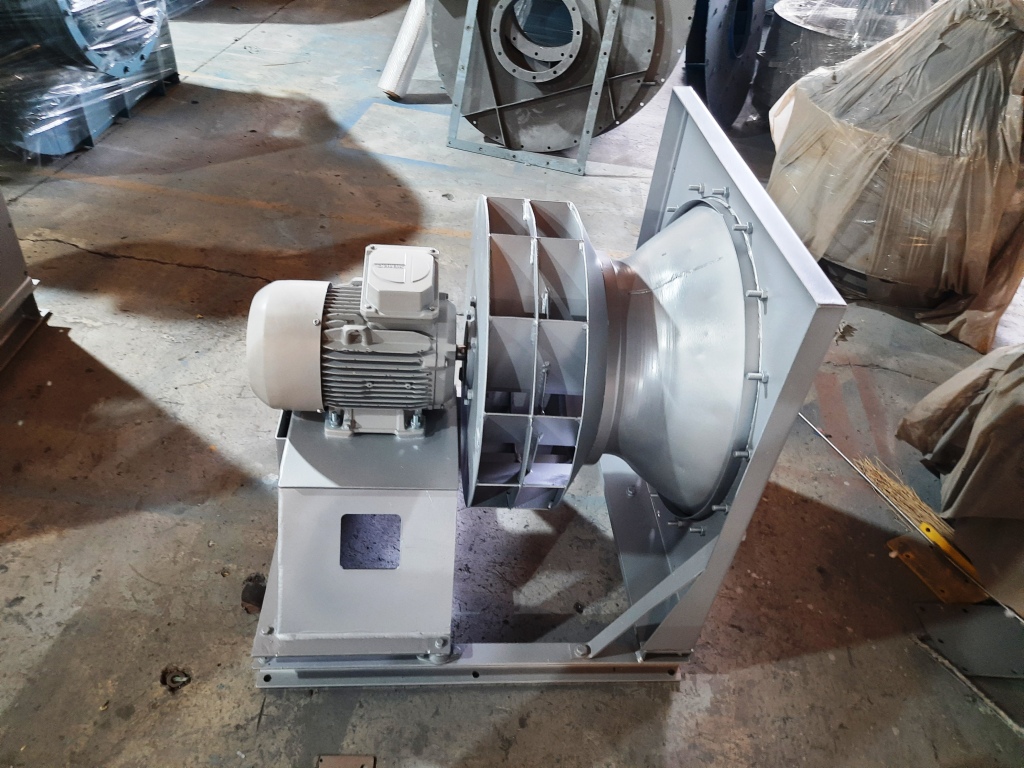
Can the Aerofoil handle dusty or dirty air?
No — and we say so plainly. The hollow, wing-profile aerofoil blade erodes in particulate, so it is a strictly clean-air family — filtered air, no more than a trace of dust. For light dust we move you to the Backward-Curved family; for FD / process / combustion air and light-dust draught to the Backward-Curved Plate family (the workhorse); and for moderate-to-heavy abrasive dust to the Radial-Tip family or the Radial family. Putting an aerofoil on dirty air is the fastest way to lose a wheel.
Why is the aerofoil the most efficient fan you make?
The wing-shaped backward blade moves air with the least turbulence, so more of the motor power becomes useful air pressure rather than noise and heat. Its peak static efficiency is the highest of any blade form in our range (exact figures are shared with your enquiry). On a fan running thousands of hours a year, that efficiency is the real lifetime-cost argument over the purchase price.
What is a non-overloading power curve, and why does it matter?
On a backward-bladed wheel, motor power rises with flow, reaches a peak, then falls. So if the system resistance drops — a filter removed, a damper opened — the power cannot keep climbing and the motor is protected. Practically, you can size the drive close to the duty without a large overload margin, unlike a forward-curved fan whose power keeps rising off-design and can overload the motor.
Can you build it as a plug fan for our AHU or fan array?
Yes. The plug / plenum (unhoused) configuration is available and suits AHUs and fan-wall / fan-array (N+1) installations, where several smaller plug fans give redundancy and turndown. We supply the plug/plenum mounting kit, and pair it with a VFD and shaft-earthing ring, flexible connectors and anti-vibration mounts as the install requires.
What temperature can the aerofoil run at?
We attest a 400 °C ceiling with high-temperature (HT) construction. Above that, hotter duty is quoted on enquiry only. Most Aerofoil duty is HVAC and AHU air well below that — the HT scope exists for the occasional hot clean-air application, not as a routine rating.
SWSI or DWDI — which width do we need?
SWSI (single width, single inlet, -S) develops higher pressure for a given wheel and is the default for ducted housed duty; DWDI (double width, double inlet, -D) moves high volume in a compact height and is common on large AHU supply. The family's peak efficiency point is on the largest DWDI wheel. We select the width from your flow-and-static pair and the available height, not from a default.
Do you performance-test and balance before dispatch, and can we witness it?
Yes. Every fan is performance-tested in-house to the AMCA 210 / ISO 5801 method on our 200 HP VFD test rig, and dynamically balanced to ISO 21940 G6.3 as standard, with G2.5 available on request for occupied-building and pharma jobs. A witnessed FAT — run-test plus a 3-axis vibration record per bearing — is offered for spec-driven HVAC and pharma work. You see the curve and the balance report before the fan leaves the floor.
What about CE, ATEX and ISO compliance?
Spark-resistant (SR) construction to AMCA 99 Type A/B/C and ATEX 2014/34/EU is available where the area classification requires it — those are self-declarations of conformity, not third-party certifications. CE is self-declared per the Machinery Directive 2006/42/EC for EU export. Performance is rated to the AMCA 210 / ISO 5801 method, tested in-house (not AMCA-certified). Our only third-party certification is ISO 9001:2015.