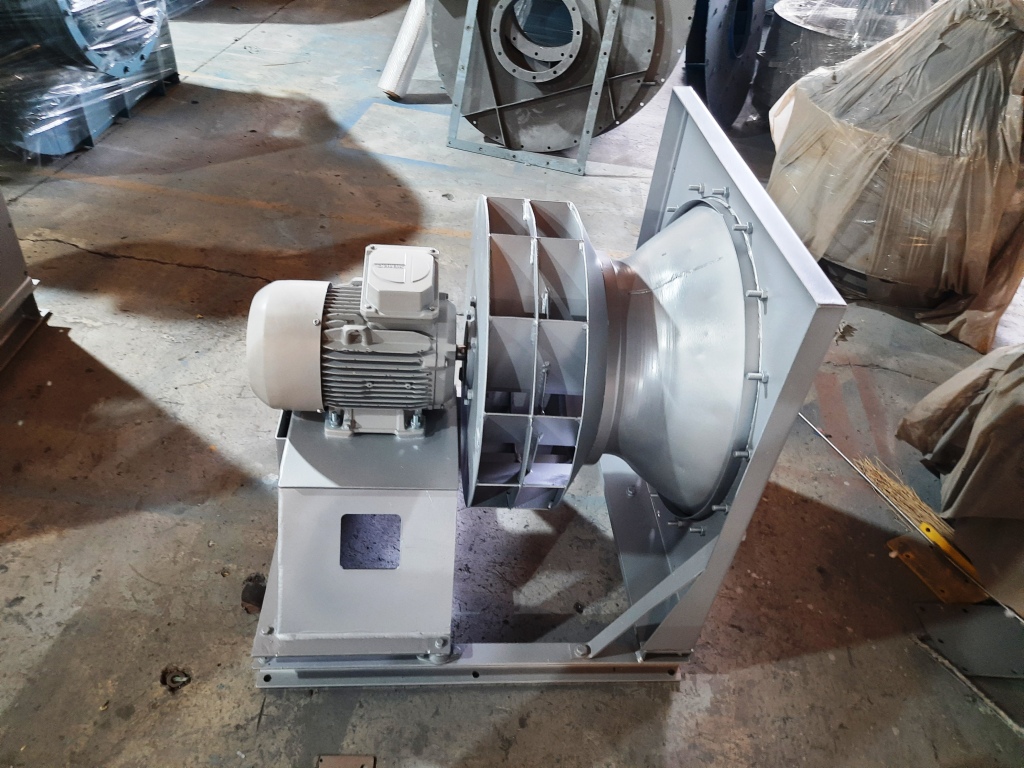
Plug/plenum centrifugal fan with airfoil impeller for data-center cooling air on the Jitamitra shop floor
Home  /  Applications  /  Data-center cooling air
Applications

Data-center cooling-air fans — efficient, quiet, and redundant by design.

A data-center cooling fan moves clean, conditioned air through CRAH units, air-handling units and hot/cold-aisle containment — matched to an IT load that never sits still. The duty is clean and low-temperature, so nothing wears; the whole engineering weight falls on three things that decide the PUE and the SLA — part-load efficiency across a swinging load, sound in and around white space, and availability on an N+1 deck that must never drop below the IT heat it carries. We build these fans across the envelope below — up to 2,00,000 CMH, 2,000 mmWC and 400 HP — though cooling-air duty typically sits low-flow-to-moderate at modest static.

2,00,000CMH max flow
2,000mmWC max static
highstatic efficiency
N+1redundant by design
15,000+
fans built since 2011
200 HP
VFD test rig · IS 4894 / AMCA 210
99%
on-time delivery
3
working days to quote — always
THROUGH THE CRAH / AHU · INTO THE COLD AISLE · TRACKING IT LOAD · REDUNDANT BY DESIGN
What it does

It carries the IT heat load — continuously, quietly, and with a spare in reserve.

A data-center cooling fan sits inside the CRAH unit, the AHU or the containment plenum: pushing conditioned air across the cooling coil and into the cold aisle, holding cold-aisle pressure against the IT-server draw, and turning down or up in step with the IT load so the room neither over-cools nor starves.

  • 01
    Move

    Conditioned air across the coil and into the cold aisle — sized on air-side density, not flue gas. Cooling duty typically runs 20,000–1,20,000 CMH per unit at 150–600 mmWC across coil, filter and containment.

  • 02
    Track

    The IT load, which swings hour to hour. VFD or EC control holds cold-aisle differential pressure — typically +5 to +25 Pa — so the fan follows the servers instead of throttling against a fixed damper.

  • 03
    Stay up

    On an N+1 (or 2N) deck the failure of one fan must not drop cooling. We size so the remaining units carry the full IT heat, and build for uptime measured against the SLA, not a duty cycle.

INDUCED-DRAFT CENTRIFUGAL FAN Single-width single-inlet — scroll cut away to reveal the impeller inlet expansion joint MOTOR IE3 / VFD GAS IN GAS OUT n 1 2 3 4 5 6 7 8 9 10 1 Inlet cone (bell-mouth) 2 Backward-curved / radial-tipped impeller 3 Spiral volute casing 4 Replaceable AR wear plates (volute throat) 5 Shaft 6 Plummer-block bearings (L10 ≥ 40,000 h) 7 Shaft cooling disc (>400 °C duty) 8 Pedestal / base frame 9 Drive — motor + coupling 10 Outlet flange + duct take-off
Fig. 1Data-center cooling fan — plug/plenum centrifugal with airfoil impeller, direct-driven, shown without a scroll as installed in an AHU/CRAH plenum. Numbered components keyed below the drawing.
Why it is hard

Clean air, but three numbers decide the PUE, the SLA and the acoustic sign-off.

Nothing erodes and nothing corrodes here — the duty is clean, low-temperature air. What makes it hard is that the fan runs 8,760 h/yr against a moving IT load, sits close to occupied and white space, and lives on a redundancy deck where losing one unit cannot lose the room. A cooling fan held several points below its achievable efficiency, at 8,760 h/yr, wastes tens of MWh a year — and every wasted kW lands straight in the PUE.

01 — PART-LOAD

Efficiency across a swinging IT load

IT load is rarely at design. A fan optimised only for the peak duty runs most of its life at part-load, where a throttled damper wastes power and a poorly-matched wheel drops off its efficiency island — driving up the mechanical PUE for the whole facility.

How we engineer it out

Airfoil-bladed backward-curved wheels flat-topped for high static efficiency, sized so the part-load operating band — not just the peak — sits on the efficiency island; VFD or EC drive as default so the fan tracks load by speed, not by throttling.

02 — ACOUSTICS

Sound in and around white space

Cooling fans sit close to occupied plant rooms and, in some containment layouts, near the white space itself. Blade-pass tone and low-frequency content carry through the plenum and into the room, and acoustic limits are a hard line-item on the sign-off.

How we engineer it out

Low-tip-speed airfoil selection for a broadband, tone-free signature; designed to <85 dB(A) @ 1 m as standard, <80 dB(A) with inlet/outlet silencers and acoustic-treated casing, <75 dB(A) with an acoustic enclosure or sound hood.

03 — AVAILABILITY

N+1 redundancy and uptime

Cooling is life-support for the IT load — lose it and the room over-heats in minutes. On an N+1 or 2N deck the loss of any one fan must be invisible to the cold aisle, and the design must not hide a single point of failure behind a shared bearing, shaft or drive.

How we engineer it out

Each fan sized to carry its share with the redundant unit in reserve; long bearing-life design target of L10h ≥ 40,000 h continuous, vibration monitoring provision, and a balance quality that keeps the unit inside its envelope for the full run between planned outages.

How we design for it

Every choice is documented on the GA drawing you sign off — before we cut metal.

We don't sell a catalogue near-fit. The fan is engineered to your air-side duty, your part-load band, your acoustic limit and your redundancy scheme — made to order, not off a shelf.

  • Impeller geometry — Airfoil-bladed backward-curved for the highest static efficiency on clean cooling air; backward-inclined where the build is smaller and the CAPEX-to-hours case favours it. Wheel sized so the part-load band, not just the peak, sits on the efficiency island.
  • Configuration — plug / plenum — Direct-driven plug/plenum (unhoused) fan as the default inside CRAH and AHU plenums — no scroll, low installed footprint, even plenum discharge across the coil; housed SWSI where a ducted take-off is required. Fan-array (multiple small plug fans) on application for finer redundancy granularity.
  • Control — VFD / EC as default — The IT load turns down deeply, so the fan must too. VFD is more efficient than an inlet damper across the range because it avoids the throttling loss at part-load, and is our default; EC-motor direct-drive on the smaller units for tight, quiet speed control and a clean part-load efficiency curve. Both track cold-aisle ΔP rather than a fixed setpoint.
  • Materials & reliability — Mild steel + epoxy coating standard on clean conditioned air; stainless where the inlet air is humid or coastal. Bearings selected for L10h ≥ 40,000 h continuous, low residual unbalance to protect the SLA, and vibration-monitoring provision for condition-based maintenance on the redundant deck.
Engineered to your duty point

We size the fan onto its efficiency island across the part-load band — then prove it on the rig.

No catalogue fan forced onto your spec. Your operating point — and the part-load band it swings through — is engineered onto the best-efficiency region of the selected airfoil wheel, so the fan stays efficient from 40% to 100% IT load, then verified on the 200 HP VFD test rig before dispatch.

avoid: unstable 0 40,000 80,000 1,20,000 1,60,000 2,00,000 VOLUME FLOW RATE  [ CMH ] 0 500 1000 1500 2000 STATIC PRESSURE  [ mmWC ] 0 25 50 75 100 STATIC EFFICIENCY  [ % ] Fan static pressure System resistance Static efficiency BEP 82% DUTY POINT 1,20,000 CMH · 450 mmWC Fan static pressure System resistance Static efficiency
Fig. 2Representative data-center cooling characteristic — fan static pressure, system resistance and static efficiency vs. flow, with the part-load band engineered to stay on the best-efficiency island. Illustrative; every fan is sized to its own duty.
Capability envelope — data-center cooling-air service

What we can supply, and where it stretches on application.

ParameterStandardOn application
Volume flowup to 2,00,000 CMHcooling duty typically 20,000–1,20,000 CMH per unit
Static pressureup to 2,000 mmWCcooling duty typically 150–600 mmWC across coil, filter and containment
Air temperatureambient conditioned air 15–40 °Chigher on application for warm-air / free-cooling schemes
Static efficiencyhigh static efficiency on airfoil buildsheld across the 40–100% part-load band
Sound level<85 dB(A) @ 1 m<75 dB(A) with acoustic enclosure / sound hood
ControlVFD default; EC on smaller unitstracking cold-aisle ΔP (+5 to +25 Pa)
Drive powerup to 400 HPcooling duty typically well below the ceiling
Balance qualityISO 21940 G6.3G2.5 / G1.0 on application

The envelope above is the full build ceiling; data-center cooling-air duty sits low in it — clean conditioned air at moderate flow and modest static, so wear protection and high-temperature metallurgy are not required and the engineering weight moves to efficiency, acoustics and redundancy. Per-unit flow and static are sized to your CRAH/AHU or containment scheme and the N+1/2N split. Bearing life is a design target of L10h ≥ 40,000 h continuous, with longer L10 on application; for duty beyond the envelope we engineer to spec and quote on enquiry.

How a Jitamitra DCCA fan is specified

Specified, not picked from a shelf.

The same engineering language carries from your enquiry to the GA drawing to the nameplate — expressed in the standard AMCA conventions.

Specification fieldOptions
Arrangement (AMCA 99)Arr. 4 (direct, motor on base — the plug/plenum default) / Arr. 1 (overhung, fan bearings) / Arr. 8 (overhung on common base) / Arr. 9 (overhung, motor side) — selected by drive, plenum access and unit envelope.
ConfigurationPlug / plenum (unhoused, direct-driven) default inside CRAH and AHU plenums; housed SWSI (single width, single inlet) where a ducted take-off is required; fan-array of multiple plug fans on application for finer N+1 granularity.
Wheel typeAirfoil-bladed backward-curved (default, highest efficiency on clean cooling air) / backward-inclined (smaller builds) — low tip speed selected for a tone-free acoustic signature.
Class (by pressure / outlet velocity)Class I / II selected from the duty point on the pressure-vs-outlet-velocity limits; cooling-air duty is typically Class I / II, well below the pressure ceiling.
Materials of constructionMild steel + epoxy coating (standard, clean conditioned air) / stainless steel for humid or coastal inlet air / special coating on application; no wear plates or high-temperature metallurgy required on this duty.
Drive & controlDirect-coupled with VFD (default) / EC-motor direct-drive on smaller units, tracking cold-aisle ΔP. Drive to 400 HP across the envelope; cooling duty typically well below it; speed set to the duty and the sound limit.
Redundancy schemeSized to the N+1 or 2N deck so the remaining units carry the full IT heat on a fan-out; vibration-monitoring provision and L10h ≥ 40,000 h bearings for uptime between planned outages.
Discharge & rotation (AMCA orientation)Even plenum discharge for the plug/plenum default; for housed builds, rotation CW or CCW (viewed from drive side) with discharge angle per AMCA — e.g. TH/BH/UB/DB — set to match your unit take-off and installed footprint.
Accessories & acoustic scopeVFD or EC control package; inlet and outlet silencers for low-frequency content; casing-wall acoustic lagging and acoustic enclosure / sound hood for <75 dB(A); flexible connections / expansion joints at the unit interface; inlet guide vanes (IGV) on application; inspection doors and drain.
The proof, not the promise

We test before we ship — and you're welcome to witness it.

Every job's performance is verified at our works on the 200 HP VFD test rig, to the AMCA 210 / ISO 5801 method, before dispatch.

  • Customer-witnessed FAT on request — at no extra cost
  • Rotors balanced to ISO 21940 G6.3 as standard (G2.5 / G1.0 on application) before they leave the floor
  • Full NDT in-house — DP, MPI, UT, RT — to what the duty demands
30+ INDUSTRIES · 45 APPLICATION / DUTY TYPES
Where our cooling-air fans run

Built for the load that never sits still.

Data Centers

CRAH-unit supply, AHU supply/return, hot/cold-aisle containment plenum fans on N+1 decks.

HVAC & Commercial Buildings

Built-up and packaged AHU supply/return where 24×7 run-hours make efficiency the lead spec.

Semiconductor & Electronics

Process-cooling and clean-air handling for fabs and electronics assembly with tight acoustic and reliability limits.

Telecom & Edge

Cooling-air fans for switch rooms, edge sites and containerised deployments where footprint and quiet running matter.

Airports & Large Infrastructure

Large AHU supply/return where continuous duty and acoustic performance carry the specification.

Pharmaceuticals

AHU supply/return on utility-grade HVAC adjacent to controlled areas, efficiency and low noise led.

Colocation & Hyperscale OEMs

Cooling fans supplied as a sub-package to CRAH, AHU and containment builders — interface documented up front.

Your process

45 application/duty types engineered. Tell us yours.

Standards & conformity

Stated precisely — because procurement checks.

What our marks mean, in the words that survive an audit.

Performance

Tested to the AMCA 210 / ISO 5801 method, in-house on our 200 HP VFD rig. Tested-to-method — not AMCA-certified.

Quality system

ISO 9001:2015 — third-party certified. Our only third-party certification.

CE conformity

Self-declared per 2006/42/EC + 2014/35/EU (Module A). A self-declaration, not a notified-body certificate.

ATEX conformity

Self-declared, Zone 2/22, Category 3, per 2014/34/EU, where the area classification calls for it.

Oil & gas duty

Designed and built to API 673 as project-specific scope.

Welding

ASME Sec IX qualified welders + WPS for every joint.

Balance

ISO 21940 — G6.3 minimum, G2.5 / G1.0 on application.

Vibration

ISO 20816 evaluation; ISO 14694 for fan-specific limits.

Lead time & process

From enquiry to a tested fan on your dock.

StageStandard dutyAPI-673 / engineered
Offer / quotation3 working days — always7–10 working days
GA drawing for approval2–3 weeks from PO3–4 weeks from PO
Manufacture + balance + paint6–10 weeks10–14 weeks
Performance test + witnessed FAT~1 week1–2 weeks
Order-to-dispatch (total)9–14 weeks14–20 weeks

Shutdown-driven replacements: we have shipped fans within 6 weeks of a clean PO. Tell us your shutdown window and we commit to a dated plan.

Questions engineers ask

The eight we hear most before a PO.

How efficient are your data-center cooling fans, and why does it matter?
We design for high static efficiency on airfoil builds, and we size the wheel so the part-load band, not just the peak duty, sits on the efficiency island. It matters because a cooling fan runs 8,760 hours a year against a moving IT load, and every watt it wastes lands straight in the mechanical PUE. A fan held several points below its achievable efficiency wastes tens of MWh a year. We tell you the offered efficiency on the quote, and the part-load points, not a single generic catalogue figure.
Can the fan track a variable IT load without throttling?
Yes, and it should. IT load swings hour to hour, so a fan sized only for the peak spends most of its life at part-load. We fit VFD as default, or an EC-motor direct-drive on the smaller units, and control on cold-aisle differential pressure, typically +5 to +25 Pa, so the fan follows the servers by speed instead of throttling against a fixed damper. VFD speed control is more efficient than an inlet damper across the range because it avoids the part-load throttling loss.
How do you design for N+1 or 2N redundancy?
We size each fan to carry its share with the redundant unit held in reserve, so the loss of any one fan is invisible to the cold aisle. The design avoids hiding a single point of failure behind a shared shaft or drive, uses bearings with an L10h design target of at least 40,000 hours continuous, and provides for vibration monitoring so you can run condition-based maintenance between planned outages. On a fan-array layout the redundancy granularity is finer still — one plug fan out of many can drop without a meaningful loss of cooling.
What sound levels can you meet, and how?
As standard we design to below 85 dB(A) at 1 m. Below 80 dB(A) is achievable on application with inlet and outlet silencers plus an acoustic-treated casing, and below 75 dB(A) with an acoustic enclosure or sound hood. We start from a low-tip-speed airfoil selection for a broadband, tone-free signature, then add silencing and casing lagging to the measured limit. Tell us the sound target and where the fan sits relative to occupied and white space, and we predict and engineer to it.
Why a plug/plenum fan rather than a housed scroll fan?
Inside a CRAH or AHU plenum a direct-driven plug/plenum fan has no scroll, a low installed footprint and an even discharge across the cooling coil, which suits the tight unit envelope and the plenum airflow. We use a housed SWSI fan where a ducted take-off is required, and a fan-array of several small plug fans where you want finer N+1 granularity and the ability to lose one unit without losing meaningful cooling. We build to your unit and containment scheme, not a fixed configuration.
Do you supply fans to CRAH, AHU and containment OEMs as a sub-package?
Yes. We supply cooling-air fans separately to CRAH manufacturers, AHU builders and containment integrators. You specify the air-side duty, the part-load band, the acoustic limit, the redundancy scheme and the integration interface — flange dimensions, mounting orientation, EC or VFD electrical interface and control protocol — and we document it up front and deliver the fan ready to mate. The engineering is identical to a direct-buyer fan; only the integration interface and who buys it differs. We have engineered to this duty and can size yours from your CRAH/AHU or containment data.
What is the lead time for a data-center cooling fan?
A standard engineered cooling fan runs roughly 8 to 13 weeks order-to-dispatch: offer in 3 to 5 working days, GA drawing 2 to 3 weeks from PO, manufacture, balance and paint 5 to 9 weeks (the materials are simple clean-air construction), and performance test plus FAT 1 week. A fan-array or a tightly acoustically-treated build adds file prep and runs a little longer. For a redundancy-deck expansion we confirm a dated commitment against your commissioning window, not a placeholder.
Do you performance-test these fans, and what standards actually apply?
Yes. Every fan is performance-tested in-house to the AMCA 210 / ISO 5801 method on our 200 HP VFD test rig, and dynamically balanced to ISO 21940 G6.3 as standard, with G2.5 or G1.0 on application. To be precise about the claims: that is testing to the AMCA 210 method in-house, not an AMCA certification, and Jitamitra is not an AMCA member. CE is self-declared per the relevant EU directives, and ATEX Zone 2/22 (Category 3) is self-declared per 2014/34/EU only where an area classification calls for it — those are self-declarations of conformity, not third-party certifications. Our only third-party certification is ISO 9001:2015. The test and FAT take about a week and are customer-witnessed on request.

Across the range

Where data-center cooling air fans fit — the fans that run them, related duties, and the industries served.

The same engineering, viewed three ways — by fan family, by duty, and by industry. Follow the cross-references.

Take it further

Specs an engineer can use — not a brochure.

Engineer to engineer

Send us the duty point.
We'll quote in 3 working days — always.

No model numbers needed. Give us the operating conditions — flow, static, gas temperature, composition, particulate, and any tender standard — and our application engineers size the fan and quote it. Attach a spec or GA if you have one.

+91 90110 09155  ·  mihir.jitamitra@gmail.com