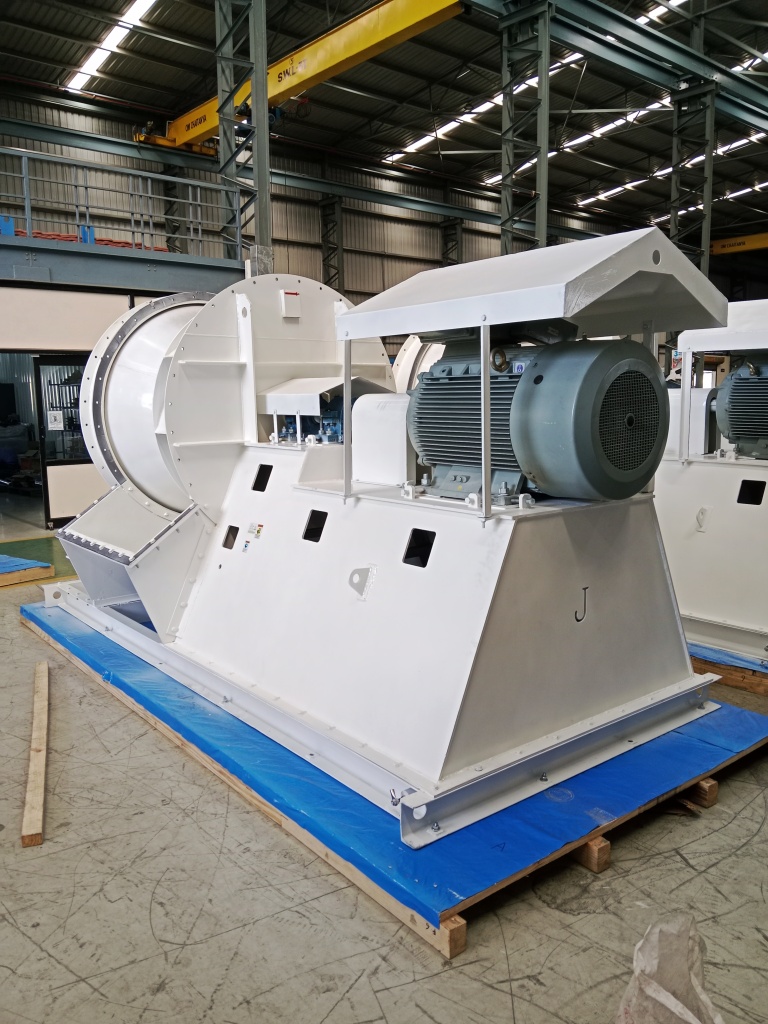
Can you supply the fans across the whole furnace line, or only one duty?
Across the whole line. We have executed 71 furnace, oven and heat-treatment duties spanning furnace and oven exhaust, combustion and process air, quench and tempering air, sustained hot-gas process, gas recirculation, and general and dilution ventilation. Each fan is engineered to its own gas temperature, atmosphere and pressure — the recirculation fan that lives at temperature and the clean quench fan are different machines — but they come from one partner, on one engineering convention across the plant.
What is the maximum gas temperature you handle on a furnace or recirculation fan?
Continuous duty up to 600 °C across the envelope, with most furnace exhaust and recirculation duty running 300 to 500 °C. This duty is sustained, not in bursts, so above about 450 °C we size the wheel for creep and stress at temperature, not just cold yield. Above about 350 °C we fit a shaft cooling disc, keep the bearings outside the airstream, and add expansion joints for the thermal growth (a 1 m shaft grows about 7 mm from cold to 600 °C). Refractory lining is attested to 600 °C for the hottest duty. The fan is built for your stated gas temperature and excursion case, not a generic rating.
A recirculation fan has no cool inlet. How do you keep heat off the bearings?
That is exactly the hard part, and the design assumption is a hot inlet, not a cool one. Heat tracks up the shaft from a hot wheel and cooks the bearing grease if it is not stopped. We fit a shaft cooling disc above about 350 °C that spins cool air across the shaft, mount the bearings outside the airstream on the cold side of a heat shield, and add a heat slinger and thermal barrier so the bearing housing runs well below the gas temperature. That is what lets a recirculation fan run 24x7 at process temperature instead of overhauling bearings every few months.
Our line runs a controlled atmosphere — endothermic or reducing gas. What metallurgy do you use?
We size the metallurgy to your atmosphere and temperature. A controlled atmosphere can swing the metal from oxidising to reducing and can carburise or scale a wheel that is the wrong alloy, so on reducing or scaling gas we specify heat-resisting stainless such as 309 or 310, or 316L where that suits, on the wetted surfaces, and step to higher heat-resisting alloys on request. We also choose a wheel design that tolerates an uneven temperature field without distorting. The right answer depends on your gas composition, temperature and how oxidising or reducing it runs, so we engineer it to your atmosphere, not a default.
Can you build a replacement to match our existing furnace fan's duty and footprint?
Yes. We reverse-engineer to the existing duty point (flow, static pressure, gas temperature, density and atmosphere), bearing centres, inlet/outlet orientation and foundation bolt pattern so the unit drops onto the existing base and ducting — whether it is a furnace exhaust fan, a recirculation fan, a combustion blower or a quench fan. Made to your installation, not a nearest-catalogue substitute. Send the old GA, the nameplate and a curve if you have one, and we match it.
Do you performance-test the fans, and what about AMCA, CE, ATEX and quality certification?
Every fan is performance-tested in-house to the AMCA 210 / ISO 5801 method on our 200 HP VFD test rig, and dynamically balanced to ISO 21940 G6.3 as standard (G2.5 / G1.0 on application). Because the rig runs cold air, hot-gas operation is extrapolated by fan-law correction for density. To be precise: that in-house testing is to the AMCA 210 / ISO 5801 method, not AMCA-certified; CE is self-declared per 2006/42/EC and 2014/35/EU, and ATEX Zone 2/22 is self-declared per 2014/34/EU (Category 3) where the area classification calls for it — those are self-declarations of conformity, not third-party certifications. Our only third-party certification is ISO 9001:2015.