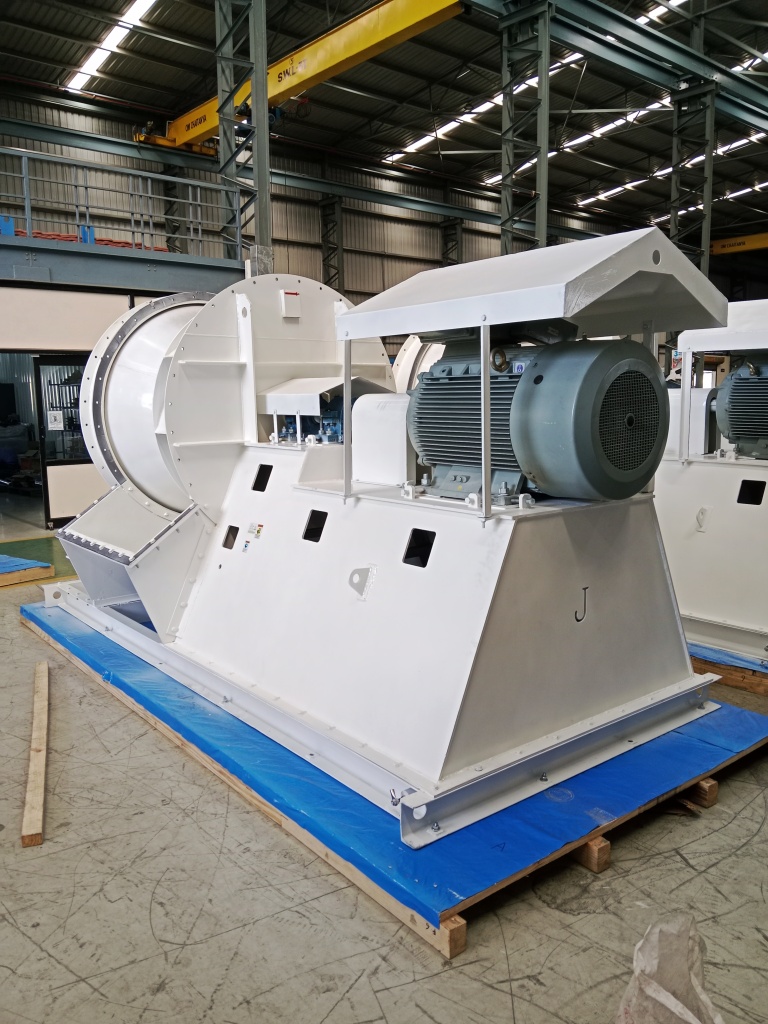
Heavy radial paddle-wheel centrifugal fan on the Jitamitra shop floor
Home  /  Products  /  Jitamitra Radial
Products

Jitamitra Radial — the rugged paddle wheel for dirty gas at high pressure.

When the gas is dirty, abrasive or sticky and the static is high, the efficient backward fans simply erode. The Radial trades efficiency for ruggedness: heavy, widely-spaced straight blades that pass grit and build-up without clogging, hardface and re-line in place, and — wear-plated — take the heaviest dust loads in our range. It develops the highest pressure in our range and runs the highest-duty ID, gas-recirculation and material-laden conveying service across cement, iron & steel, power, foundry and pollution-control plants.

heaviestdust in range (wear-plated)
2,000mmWC max static
by designefficiency traded for ruggedness
to dutyengineered, not catalogue
15,000+
fans built since 2011
200 HP
VFD test rig · IS 4894 / AMCA 210
99%
on-time delivery
3
working days to quote — always
STRAIGHT RADIAL PADDLE · WIDE BLADE SPACING · SELF-CLEANING · HIGHEST TIP SPEED · CLASS 5 BUILD
What this wheel is

A straight paddle wheel does three things no efficient fan can.

The Radial wheel carries heavy, widely-spaced blades pointing straight out from the hub — the simplest, strongest blade form there is. The wide gaps let dirty, abrasive and sticky material pass straight through; the flat blades are easy to hardface and re-line; and the high tip speed (Class 5 build) makes the highest pressure in the range. The price is efficiency — the lowest peak static efficiency of any family we build — and that trade is the whole point.

  • 01
    Pass dirt

    Wide-spaced straight blades are self-cleaning — grit, fly ash and sticky material pass without clogging — to the heaviest dust loading in our range when wear-plated.

  • 02
    Make pressure

    The highest tip speed in the range (175 m/s Class 5) develops static up to 2,000 mmWC — for high-draft ID, gas recirculation and HP-blower duty.

  • 03
    Take wear

    Heavy plate, hardfaced leading edges and bolt-in replaceable liners (steel, ceramic or basalt) — built to be re-lined in place, not scrapped when it wears.

GENERAL ARRANGEMENT to scale from our design drawings IMPELLER · RADIAL BLADE wheel schematic DISCHARGE ORIENTATIONS · ENGINEERED TO ORDER 45° 90° 135° 180° 225° 270°
Fig. 1General arrangement, impeller and 7 discharge orientations. Drawn to scale from our in-house design drawings; every fan engineered to your duty.
Why you choose it

Three drivers send a duty to the Radial — and each carries a trade-off.

You do not buy a Radial for running cost. You buy it when dust, abrasion or high static would destroy a more efficient wheel. Pick it for the right reason and it runs the dirtiest gas for years on a serviceable wear menu; pick it for clean air and you simply pay for power you did not need to spend.

01 — DUST

Heavy, abrasive, sticky dust

Beyond the moderate-dust ceiling of a radial-tip wheel, fly ash, mineral grit and sticky material clog and erode a curved blade in months.

How we engineer it out

Wide-spaced straight paddle blades that are self-cleaning, plus hardfacing and bolt-in replaceable liners — wear-plated for the heaviest dust loads, the highest tolerance in the range.

02 — PRESSURE

High static on dirty gas

High-draft ID, gas recirculation and pressure-blower duty need static a backward wheel cannot reach on a wheel that also survives the dust.

How we engineer it out

Class 5 build at a 175 m/s tip — per-model static to the canon ceiling of 2,000 mmWC — with FEA and NDT on the high-stress wheel.

03 — EFFICIENCY

The efficiency trade

Straight radial blades are aerodynamically blunt — the peak static efficiency is the lowest of any family we build.

How we engineer it out

Deliberate, not a defect: we size the wheel near its own best-efficiency region and reserve the Radial for dirty/high-pressure duty — for clean air we put you on a backward family instead.

How we build it

Every choice — blade form, metallurgy, wear menu, drive — is on the GA drawing you sign off before we cut metal.

This is not a catalogue box. The wheel form, the dust-protection package and the construction suffix are engineered to your gas, dust load, temperature and operating point.

  • Blade form & wheels — Radial paddle (straight blade, wide spacing) as the family form; radial-blade wheels from 310–3,050 mm diameter, compact HP blower to large ID fan; plus radial-paddle and open-paddle specials for the dirtiest material-transport duty.
  • Materials & wear protection — MS standard; wear-resistant plate + hardfacing (qualified WPS) and bolt-in replaceable scroll/blade liners; ceramic or basalt liners for severe abrasion; SS304 / 316 full or airstream; Corten / duplex and dew-point coating or steam-tracing for flue gas below dew point.
  • Construction suffixesWP wear-plated (the heavy-dust package); HT high-temp (refractory/heat-shield + shaft cooling disc); SR spark-resistant (AMCA 99 Type A/B/C, self-declared ATEX) for combustible-dust zones; F FRP / corrosion airstream; SWSI single-inlet standard for the high-static duty.
  • Drive & integrity — Direct-coupled, V-belt or VFD; G2.5 balance mandatory at the 175 m/s Class 5 tip with FEA + NDT on the high-stress wheel; split SNL plummer-block bearings; shaft cooling disc above ~150 °C; isolation / tandem dampers for gas-tight ID service.
Engineered to your duty point

We size the wheel where its curve crosses your system — then prove it on the rig.

No catalogue point forced onto your spec. Your duty is engineered onto the best-efficiency region of the selected radial wheel — accepting the family's deliberate efficiency character — then verified on the 200 HP VFD test rig to the AMCA 210 / ISO 5801 method before dispatch.

avoid: unstable 0 40,000 80,000 1,20,000 1,60,000 2,00,000 VOLUME FLOW RATE  [ CMH ] 0 500 1000 1500 2000 STATIC PRESSURE  [ mmWC ] 0 25 50 75 100 STATIC EFFICIENCY  [ % ] Fan static pressure System resistance Static efficiency BEP 82% DUTY POINT 1,20,000 CMH · 450 mmWC Fan static pressure System resistance Static efficiency
Fig. 2Representative Radial-fan characteristic — fan static pressure, system resistance and static efficiency vs. flow, with the duty point engineered onto the best-efficiency region. Note the steeper power curve of a radial wheel. Illustrative; every fan is sized to its own duty.
Capability envelope — Radial / paddle service

What we can supply, and where it stretches on application.

ParameterStandardOn application
Volume flowup to 2,00,000 CMHhigher on enquiry (engineered-to-order)
Static pressureup to 2,000 mmWChighest-pressure family in the range
Inlet dust loadingheaviest dust class we build, wear-plated (WP)loading limits shared with your enquiry
Peak static efficiencylowest in the range — a deliberate traderuggedness over running cost
Continuous gas temperatureup to 600 °C with HT constructionhigher with refractory lining + special metallurgy
Drive powerup to 400 HPhigher with custom motor sourcing
Blade tip speed (build class)175 m/s Class 5 (open-paddle special 125 m/s)FEA + NDT on the high-stress wheel
Balance qualityISO 21940 G2.5 at the Class 5 tipG6.3 general / G1.0 on application

The envelope above is our published ceiling; the Radial reaches the top of our static and dust range and the bottom of our efficiency range — that is its engineering character, not a compromise. Bearing life is a L10h ≥ 40,000 h continuous design target. Dust tolerance is duty-dependent: the heaviest-dust rating applies to the wear-plated (WP) package; clean-side radial duty needs no wear plating. High-flow and heavy-dust duty above the published envelope is engineered-to-order on enquiry.

How a Jitamitra Radial fan is specified

Specified, not picked from a shelf.

The same engineering language carries from your enquiry to the GA drawing to the nameplate — expressed in the standard AMCA conventions, with the Radial's wear and high-temp scope called out explicitly.

Specification fieldOptions
Arrangement (AMCA 99)Arr. 1 (overhung, fan bearings) / Arr. 8 (overhung on common base) / Arr. 9 (overhung, motor side) / Arr. 10 (overhung, motor inside base) — selected by drive, access and temperature; overhung is the usual radial-ID configuration.
Width / inletSWSI (single width, single inlet) standard for the Radial — single-inlet suits the high-static, dust-laden duty; DWDI considered only where flow demands it at moderate pressure.
Wheel typeRadial blade / paddle default; radial-paddle and open-paddle specials for the dirtiest, stickiest material-transport duty; choose by dust character, pressure and flow.
Class (by pressure / tip speed)Class 5 heavy build at the 175 m/s tip for high pressure — heavier plate, FEA and NDT mandatory; lower class only where the duty point allows a lower tip speed.
Materials of constructionMS (standard) / wear-resistant plate + hardfaced (chrome-carbide WPS) blades with bolt-in replaceable liners / ceramic or basalt liners (severe abrasion) / 304L, 316L, Corten or duplex for corrosive and below-dew-point flue gas.
Construction suffixWP wear-plated (heavy-dust package) / HT high-temp (heat shield + shaft cooling disc) / SR spark-resistant (AMCA 99 Type A/B/C, self-declared ATEX Cat 3) / F FRP-or-SS airstream — combined as the gas requires (e.g. WP+HT for hot abrasive kiln gas).
DriveDirect-coupled / V-belt / VFD. Drive up to 400 HP across the envelope; G2.5 balance with FEA + NDT at the Class 5 tip; split SNL bearings; shaft cooling disc above ~150 °C.
Discharge & rotation (AMCA orientation)Rotation CW or CCW (viewed from drive side) with discharge angle per AMCA — TH/BH/UB/DB — set to match your duct take-off and installed footprint; isolation / tandem dampers for gas-tight ID.
The proof, not the promise

We test before we ship — and you're welcome to witness it.

Every job's performance is verified at our works on the 200 HP VFD test rig, to the AMCA 210 / ISO 5801 method, before dispatch.

  • Customer-witnessed FAT on request — at no extra cost
  • Rotors balanced to ISO 21940 G6.3 as standard (G2.5 / G1.0 on application) before they leave the floor
  • Full NDT in-house — DP, MPI, UT, RT — to what the duty demands
30+ INDUSTRIES · 45 APPLICATION / DUTY TYPES
Where Radial fans run

Proven where the gas is dirtiest and the static is highest.

Cement & Lime

Kiln / preheater ID, raw & cement mill, clinker-cooler and mill-vent fans.

Iron & Steel / Metals

Sinter-plant ID, EAF fume extraction (spark-resistant), material-laden draught.

Thermal Power

Boiler ID on the dirty side, gas recirculation (GRF) on alloy-radial construction.

Foundry & Casting

Cupola / furnace fume, sand-handling dust, abrasive material extraction.

Mining & Minerals

Ore-dust collection, material handling, abrasive mineral conveying.

Pollution Control / APC OEM

ESP / baghouse main fans, dust-extraction and conveying for APC packagers.

Pharma & Process

Dust collection (dirty-side), grinding / welding dust, dilute & dense conveying.

Your dirty-gas duty

8 radial wheels engineered to dust, pressure and wear. Tell us yours.

Standards & conformity

Stated precisely — because procurement checks.

What our marks mean, in the words that survive an audit.

Performance

Tested to the AMCA 210 / ISO 5801 method, in-house on our 200 HP VFD rig. Tested-to-method — not AMCA-certified.

Quality system

ISO 9001:2015 — third-party certified. Our only third-party certification.

CE conformity

Self-declared per 2006/42/EC + 2014/35/EU (Module A). A self-declaration, not a notified-body certificate.

ATEX conformity

Self-declared, Zone 2/22, Category 3, per 2014/34/EU, where the area classification calls for it.

Oil & gas duty

Designed and built to API 673 as project-specific scope.

Welding

ASME Sec IX qualified welders + WPS for every joint.

Balance

ISO 21940 — G6.3 minimum, G2.5 / G1.0 on application.

Vibration

ISO 20816 evaluation; ISO 14694 for fan-specific limits.

Lead time & process

From enquiry to a tested fan on your dock.

StageStandard dutyAPI-673 / engineered
Offer / quotation3 working days — always7–10 working days
GA drawing for approval2–3 weeks from PO3–4 weeks from PO
Manufacture + balance + paint6–10 weeks10–14 weeks
Performance test + witnessed FAT~1 week1–2 weeks
Order-to-dispatch (total)9–14 weeks14–20 weeks

Shutdown-driven replacements: we have shipped fans within 6 weeks of a clean PO. Tell us your shutdown window and we commit to a dated plan.

Questions engineers ask

The eight we hear most before a PO.

How much dust can the Radial really handle?
Wear-plated, it takes the heaviest dust loads of any family we build — by far the highest tolerance in our range (exact loading figures are shared with your enquiry). The wide-spaced straight paddle blades are self-cleaning, so grit, fly ash and sticky material pass through rather than caking, and the wear surfaces are bolt-in replaceable. Clean-side radial duty needs no wear plating at all; we specify the wear package to your actual dust loading, not a default.
Why is the efficiency lower than your backward-curved fans?
It is a deliberate engineering trade, not a fault. The rugged straight radial wheel buys you dust tolerance and high pressure at the cost of aerodynamic efficiency — its peak static efficiency sits at the bottom of our range. For clean air we would never sell you a radial; a backward-curved or aerofoil family runs the same duty on far less power. The Radial earns its place only where dust or high static would destroy a more efficient wheel.
How do you protect the wheel against abrasion, and can it be repaired in place?
Wear protection is an engineered, serviceable system — not an afterthought. Heavy wear-resistant plate, leading-edge hardfacing to a qualified WPS, and bolt-in replaceable scroll and blade liners; ceramic or basalt liners for severe abrasion. Everything is keyed to your wear mode and access, and we offer an impeller-overlay refurbishment service so the wheel is re-lined and rebuilt rather than scrapped — lower lifetime cost than a fan that wears out unrepaired.
What is the highest pressure the Radial reaches, and how do you build for it?
It is the highest-pressure family we make. Per-model static reaches the canon ceiling of 2,000 mmWC on a Class 5 build at a 175 m/s blade tip. At that tip speed the wheel is engineered properly: heavier plate, mandatory FEA on the high-stress geometry, NDT on the welds, and G2.5 balance as standard practice. We size the duty onto the wheel's own best-efficiency region rather than forcing a catalogue point.
Can you handle high-temperature or corrosive flue gas on a radial fan?
Yes, with the right construction suffix. For hot gas we add HT construction — heat shielding and a shaft cooling disc (standard above ~150 °C) — attested to 600 °C with high-temperature build and special metallurgy. For flue gas below the acid dew point we select corrosion-grade MOC (304L, 316L, Corten or duplex) and add dew-point coating or steam-tracing. We size both the metallurgy and the dew-point margin to your gas analysis, not a generic rating.
We have combustible dust — can the Radial be built spark-resistant / ATEX?
Yes. With the SR construction suffix the fan is built spark-resistant to AMCA 99 Type A/B/C (non-sparking material combinations and clearances) and self-declared for ATEX Zone 22 / Category 3 where the area classification calls for it. To be precise, that ATEX scope is a self-declaration of conformity, not a third-party certification; our only third-party certification is ISO 9001:2015. This suits grain, wood-dust, solvent and combustible-mineral extraction duty.
When should we choose the Radial over the Radial-Tip?
Dust loading and abrasion decide it. The Radial-Tip handles moderate dust at noticeably better efficiency — the right pick for cement mill-vent and dusty drying. The Radial is for genuinely heavy, abrasive or sticky dust beyond what a radial-tip wheel should see, and for the highest static. If your dust is moderate and running cost matters, we put you on the Radial-Tip; if it is dirty/abrasive at high pressure, the Radial is the only honest answer. We will tell you which line you are on.
Do you performance-test before dispatch, and can we witness it?
Yes. Every fan is performance-tested in-house to the AMCA 210 / ISO 5801 method on our 200 HP VFD test rig, and dynamically balanced — G2.5 as standard practice on the Class 5 radial wheels (G6.3 general, G1.0 on application). On the high-tip wheels we add FEA and NDT to the build record. The test and FAT take about a week and are customer-witnessed on request — you see the curve and the balance report before the fan leaves the floor.

Across the range

Where the Radial fits — the duties it runs, the industries it serves, and its nearest siblings.

The same engineering, viewed three ways — by fan family, by duty, and by industry. Follow the cross-references.

Take it further

Specs an engineer can use — not a brochure.

Engineer to engineer

Send us the duty point.
We'll quote in 3 working days — always.

No model numbers needed. Give us the operating conditions — flow, static, gas temperature, composition, particulate, and any tender standard — and our application engineers size the fan and quote it. Attach a spec or GA if you have one.

+91 90110 09155  ·  mihir.jitamitra@gmail.com