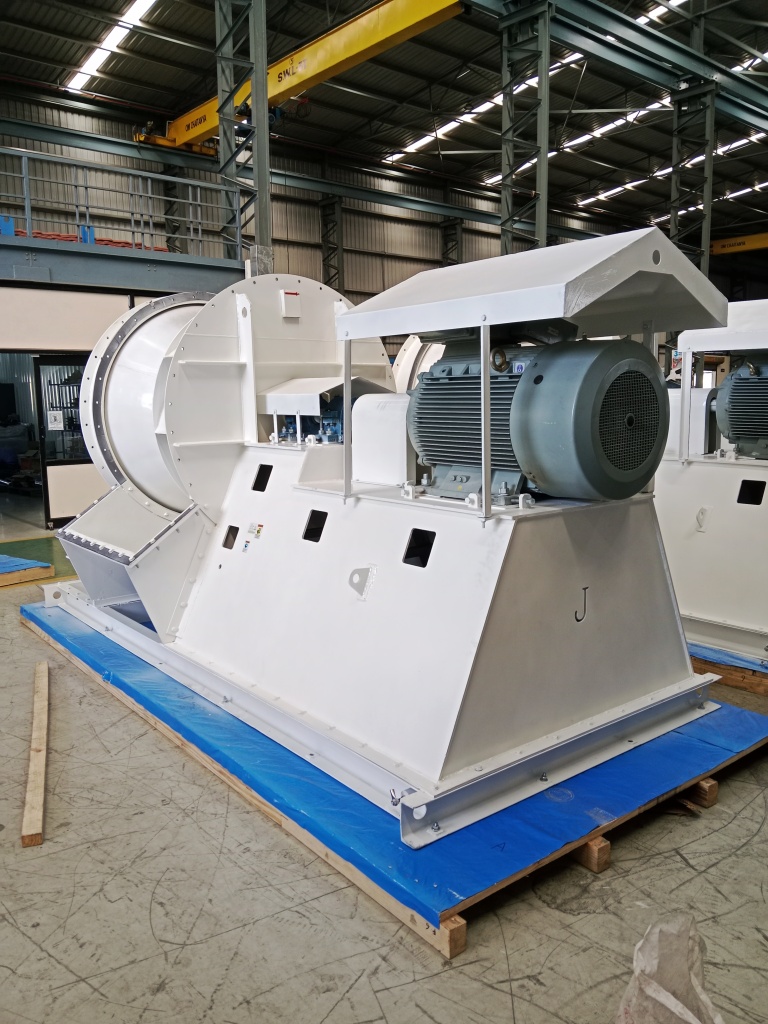
Heavy-duty boiler draught centrifugal fan for a thermal power plant on the Jitamitra shop floor
Home  /  Industries  /  Thermal Power
Industries

Fans for the thermal power boiler island — ID to FGD.

A boiler island runs a complete draught set, and every fan in it is different: induced draught pulling hot, ash-laden flue gas; forced and primary air pushing clean combustion air; secondary and overfire air trimming the flame; gas recirculation, the ESP main fan and the FGD booster on the back end. The dirty-side fans wear, the clean-side fans decide your auxiliary power bill — and when a draught fan trips, the unit trips with it. We build the whole suite, not one duty off a shelf: 66 executed thermal-power duties, across the full envelope below — up to 2,00,000 CMH, 2,000 mmWC, 400 HP and 600 °C.

66executed thermal-power duties
ID / FD / PA / SAcomplete draught set
600 °Chot flue-gas duty
2,000 mmWCmax static
15,000+
fans built since 2011
200 HP
VFD test rig · IS 4894 / AMCA 210
99%
on-time delivery
3
working days to quote — always
ID · FD · PA · SECONDARY AIR · GAS RECIRC · ESP MAIN · FGD BOOSTER
Where the fans sit

One boiler island, three jobs the fans have to do — and the unit trips if a draught fan does.

Across a boiler island the fans split into three jobs: they push clean combustion air into the furnace, they pull the hot ash-laden products of combustion out through the back end, and they trim and recirculate gas to hold the fire and the steam temperature. The clean-side air fans decide the plant's auxiliary power draw; the dirty-side flue-gas fans decide how long the plant runs between overhauls — and both are single points of failure on the unit.

The duties we run on a boiler island

The fan duties across a thermal power plant — and the role each one plays.

A single boiler island needs a complete family of fan duties, from the clean high-efficiency FD and PA fans to the hot dirty ID and the corrosive FGD booster. We have executed 66 thermal-power duties across this list — each engineered to its own gas, temperature, dust load and efficiency target, not adapted from a catalogue near-fit.

The fans we deploy here

Three fan types cover the boiler island — matched to the dust and the efficiency it has to make.

The wheel is chosen by the dust load and the efficiency the duty demands: a rugged radial for the dirtiest ash-laden ID, a backward-curved plate wheel for the clean high-efficiency FD and primary air, and an aerofoil wheel where the FD or PA duty is clean enough to earn its highest efficiency — where every point of efficiency is auxiliary power the plant does not burn. All three build across the same envelope — to 2,00,000 CMH, 2,000 mmWC, 400 HP and 600 °C.

Why thermal power fan duty is hard

Three things across a boiler island decide whether the fans run a maintenance cycle — or cost you every day.

A boiler island stresses its fans in three different ways at once — Indian high-ash coal erodes the dirty-side ID wheel, the clean-side FD and PA fans run continuously and their inefficiency shows up on the auxiliary power bill every hour, and the back-end ESP and FGD circuits drop the gas below its acid dew point. Engineer for all three and the fans run a full boiler campaign 5–8 years between wheel overhauls at their best efficiency. Engineer for the duty point alone and the ID erodes, the FD burns power, or the back end corrodes within 12–24 months.

01 — EROSION

Fly-ash erosion on the ID fan

Indian coal runs 30–45% ash, and fly-ash particles strike the ID wheel at >60 m/s. Material loss throws the rotor out of balance and cracks the blade root — the single most common draught-fan failure on a coal boiler.

How we engineer it out

A rugged radial wheel that sheds ash and resists erosion; chrome-carbide hard-facing on the blade leading edges and high-wear zones; and bolted-in, replaceable AR wear plates and liners at the volute throat and inlet, with access doors so worn parts change out in place — no dismantling the fan.

02 — AUXILIARY POWER

Parasitic power on the air fans

The FD, PA and ID fans run continuously, and fan power is a large slice of the plant's auxiliary consumption. A few points of fan static efficiency, or throttling a damper at part load instead of trimming speed, is power the plant burns every hour it runs — for the life of the unit.

How we engineer it out

The duty point engineered onto the best-efficiency region of a backward-curved plate or aerofoil wheel — not a catalogue fan forced near it — and VFD speed control as default for the variable-load air fans, so part-load draft comes from speed, not from throttling loss across a damper.

03 — DEW POINT

Acid dew-point & wet FGD corrosion

On the back end the flue gas drops below the acid dew point (~120–150 °C) on the ESP and clean-side ID and condenses sulphuric acid on the casing; downstream of a wet scrubber the FGD booster handles saturated gas that condenses continuously and eats an unprotected wheel and casing.

How we engineer it out

Metallurgy and dew-point margin sized to the gas — Corten or 316L on the wetted surfaces, higher alloys for wet FGD duty, insulation and heat tracing to hold the casing wall above dew point, and drains and access doors where condensate collects.

How we design for the island

Every wear, efficiency and metallurgy choice is documented on the GA drawing you sign off — before we cut metal.

We don't sell a catalogue near-fit onto a boiler island. Each fan is engineered to its own duty — the ID to its hot ash, the FD and PA to their efficiency, the FGD booster to its saturated gas — at your operating point.

  • Wear protection for fly ash — A rugged radial wheel that sheds ash on the dirtiest ID and gas-recirculation duty; chrome-carbide hard-facing on the blade leading edges and high-wear zones; bolted-in, replaceable AR wear plates and liners on the volute throat and inlet, with inspection and cleanout doors — the wear scope is replaceable in place, not welded in, for high-ash coal to 45% ash.
  • Efficiency on the air fans — The FD, PA and secondary-air duty engineered onto the best-efficiency region of a backward-curved plate or aerofoil wheel; VFD speed control as default for variable-load air fans so part-load draft avoids the throttling loss of a damper — the fan's efficiency shows up directly on the plant's auxiliary power draw.
  • High-temperature construction — Heat shield behind the wheel; shaft cooling disc standard above ~350 °C with bearings outside the airstream; casing metallurgy stepped up by temperature band (IS 2062 / 16Mo3); expansion joints sized for the thermal growth on hot ID and gas-recirculation duty to 600 °C.
  • Dew-point & FGD metallurgy — Corten or 316L on the wetted surfaces where the back-end gas drops below the acid dew point (~120–150 °C), stepping to higher alloys for saturated wet-FGD booster duty; casing insulation and heat tracing to hold the wall above dew point, with drains where condensate collects.
Standards & conformity

Stated precisely — because procurement checks.

What our marks mean, in the words that survive an audit.

Performance

Tested to the AMCA 210 / ISO 5801 method, in-house on our 200 HP VFD rig. Tested-to-method — not AMCA-certified.

Quality system

ISO 9001:2015 — third-party certified. Our only third-party certification.

CE conformity

Self-declared per 2006/42/EC + 2014/35/EU (Module A). A self-declaration, not a notified-body certificate.

ATEX conformity

Self-declared, Zone 2/22, Category 3, per 2014/34/EU, where the area classification calls for it.

Oil & gas duty

Designed and built to API 673 as project-specific scope.

Welding

ASME Sec IX qualified welders + WPS for every joint.

Balance

ISO 21940 — G6.3 minimum, G2.5 / G1.0 on application.

Vibration

ISO 20816 evaluation; ISO 14694 for fan-specific limits.

Questions engineers ask

Thermal power fan questions, answered straight.

Can you supply the complete boiler draught set, or only one fan?
The complete set. We have executed 66 thermal-power duties spanning induced draught, forced draught, primary air, secondary and overfire air, gas recirculation, the ESP or baghouse main fan and the FGD booster. Each fan is engineered to its own gas, temperature, dust load and efficiency target — the hot ash-laden ID and the clean high-efficiency FD are different machines — but they come from one partner on one engineering convention across the unit, so the fans, wear parts and drives carry one language across the island.
Our coal is high-ash. How do you protect the ID fan wheel and casing?
Indian coal running 30 to 45 percent ash is the most common cause of ID-fan wear, so we protect three ways sized to your ash loading. A rugged radial wheel that sheds ash and resists erosion; chrome-carbide hard-facing on the blade leading edges and high-wear zones; and bolted-in, replaceable AR wear plates and liners at the volute throat and inlet with inspection and cleanout doors, so worn parts change out in place. The wear scope is replaceable, not welded in — which is what keeps the ID fan running a full boiler campaign between overhauls.
The FD and PA fans run continuously. How do you keep the auxiliary power draw down?
Fan power is a large slice of a plant's auxiliary consumption, so on the clean-side air fans we engineer the duty point onto the best-efficiency region of a backward-curved plate or aerofoil wheel rather than force a catalogue fan near it. For variable-load air fans we make VFD speed control the default, so part-load draft comes from trimming speed, not from throttling loss across a damper. Every point of static efficiency and every avoided damper loss is power the plant does not burn for the life of the unit. We size it to your load profile, not a nameplate rating.
What is the maximum gas temperature you handle on an ID or gas-recirculation fan?
Continuous duty up to 600 °C across the envelope. Clean-side ID runs 130 to 180 °C, but upstream ID and gas-recirculation duty runs much hotter. Above about 350 °C we fit a shaft cooling disc to keep heat off the bearings, keep the bearings outside the airstream, and add expansion joints for the thermal growth (a 1 m shaft grows about 7 mm from cold to 600 °C). The fan is built for your stated gas temperature and excursion case, not a generic rating.
We have acid dew-point risk on the back end and a wet FGD. What materials do you use?
We size the metallurgy and the dew-point margin to your gas analysis. Below the acid dew point (typically 120 to 150 °C on the ESP and clean-side ID) we keep the casing wall above dew point with insulation and heat tracing and select Corten or 316L on the wetted surfaces. Downstream of a wet scrubber the FGD booster handles saturated gas that condenses continuously, so we step up to higher alloys and add drains and access doors where condensate collects. The right answer depends on your SO₂/SO₃, chloride and moisture, so we engineer it to your gas, not a default.
Do you performance-test the fans, and what about AMCA, CE, ATEX and quality certification?
Every fan is performance-tested in-house to the AMCA 210 / ISO 5801 method on our 200 HP VFD test rig, and dynamically balanced to ISO 21940 G6.3 as standard (G2.5 / G1.0 on application). Because the rig runs cold air, hot flue-gas operation is extrapolated by fan-law correction for density. To be precise: that in-house testing is to the AMCA 210 / ISO 5801 method, not AMCA-certified; CE is self-declared per 2006/42/EC and 2014/35/EU, and ATEX Zone 2/22 is self-declared per 2014/34/EU (Category 3) where the area classification calls for it — those are self-declarations of conformity, not third-party certifications. Our only third-party certification is ISO 9001:2015.

Across the range

Where Thermal Power fits — the fans we deploy, the duties we run, and adjacent industries.

The same engineering, viewed three ways — by fan family, by duty, and by industry. Follow the cross-references.

Take it further

Specs an engineer can use — not a brochure.

Engineer to engineer

Send us the duty point.
We'll quote in 3 working days — always.

No model numbers needed. Give us the operating conditions — flow, static, gas temperature, composition, particulate, and any tender standard — and our application engineers size the fan and quote it. Attach a spec or GA if you have one.

+91 90110 09155  ·  mihir.jitamitra@gmail.com