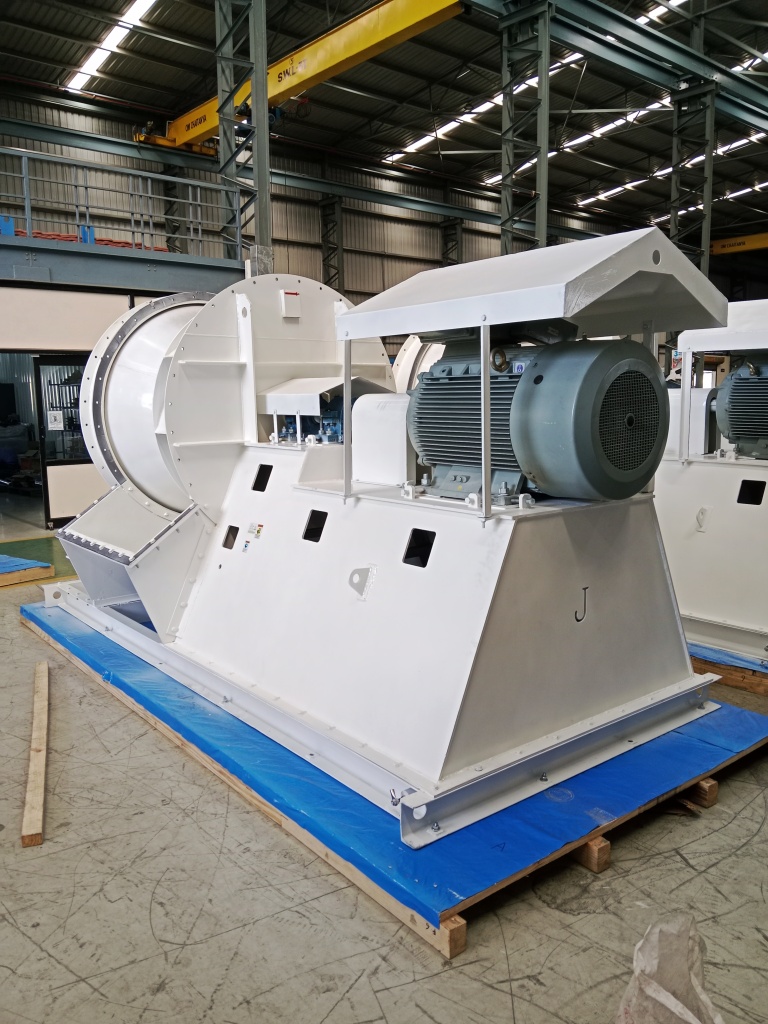
Spark-resistant centrifugal fume-extraction fan on the Jitamitra shop floor
Home  /  Applications  /  Fume extraction (weld/grind/EAF)
Applications

Fume-extraction fans — for weld, grind and EAF fume that carries sparks, grit and heat.

A fume-extraction fan pulls welding fume, grinding dust and electric-arc-furnace off-gas through the capture hood, ductwork and filter to the stack. The particulate is fine, metallic and abrasive; the airstream can carry hot embers and, on aluminium or magnesium grinding, combustible dust. We build fume fans for both positions — clean-side after the filter (the common case) and dirty-side / EAF primary, where the raw off-gas runs hot and abrasive — with spark-resistant construction where ignition is a real risk. This is our strongest application: 101 customer duties and counting.

2,00,000CMH max flow
2,000mmWC max static
Zone 22ATEX self-declared
600 °Cgas temperature
15,000+
fans built since 2011
200 HP
VFD test rig · IS 4894 / AMCA 210
99%
on-time delivery
3
working days to quote — always
AT THE HOOD · THROUGH THE DUCT · ACROSS THE FILTER · CLEAN FUME TO THE STACK
What it does

One capture-to-stack system, two fan positions — clean-side and dirty-side / EAF primary.

A fume-extraction fan drives a local exhaust ventilation (LEV) system: pulling weld, grind or furnace fume off the source at the hood, holding the duct and filter under negative pressure, and discharging the cleaned airstream to the stack. Where the fan sits relative to the filter decides the whole design — clean fume after the collector, or hot abrasive off-gas before it.

  • 01
    Capture

    Negative-pressure extraction at the source — welding-bench hoods, on-torch extraction, grinding booths, EAF canopy and fourth-hole draught. The fan holds the capture velocity that keeps fume out of the operator's breathing zone across every hood on the run.

  • 02
    Clean-side

    The common position: the fan sits downstream of the baghouse or cartridge collector, handling filtered air at low inlet loading. Wear is minimal — the focus shifts to spark resistance, curve stability across filter loading, and noise.

  • 03
    Dirty-side / EAF primary

    The hard duty: raw furnace off-gas ahead of the filter, hot and grit-laden, taken off a water-cooled duct that has already dropped the gas below the fan's temperature limit. Abrasion, temperature and spark all bear on the same wheel.

INDUCED-DRAFT CENTRIFUGAL FAN Single-width single-inlet — scroll cut away to reveal the impeller inlet expansion joint MOTOR IE3 / VFD GAS IN GAS OUT n 1 2 3 4 5 6 7 8 9 10 1 Inlet cone (bell-mouth) 2 Backward-curved / radial-tipped impeller 3 Spiral volute casing 4 Replaceable AR wear plates (volute throat) 5 Shaft 6 Plummer-block bearings (L10 ≥ 40,000 h) 7 Shaft cooling disc (>400 °C duty) 8 Pedestal / base frame 9 Drive — motor + coupling 10 Outlet flange + duct take-off
Fig. 1Fume-extraction centrifugal fan — single-width single-inlet, scroll cut away to reveal the radial-tipped impeller and spark-resistant rub ring. Numbered components keyed below the drawing.
Why it is hard

Sparks, abrasive metal dust and heat attack the same wheel from three directions.

Fume is not clean air. Fine metallic particulate erodes and unbalances a curved wheel; weld spatter and EAF embers arrive as live sparks; aluminium, magnesium and titanium grinding produce combustible dust. Design for the fume you actually have, and the fan runs 5+ years between overhauls. Specify it as a clean-air fan, and an abrasive or spark-laden duty takes it down in 6–18 months.

01 — ABRASION

Fine metallic dust erodes the wheel

Weld fume and grinding grit are fine, hard and metallic. On dirty-side and EAF duty they scour the blade and volute, and because the particulate is dense, uneven wear throws a curved wheel out of balance long before it wears through.

How we engineer it out

Radial-tipped wheels that reject dust from the blade root instead of packing it in, hard-faced (chrome-carbide) blade leading edges, and AR400 bolted-in wear plates at the throat and outlet — replaceable in place, not welded in.

02 — IGNITION

Sparks, embers and fire propagation

Weld spatter and EAF embers travel down the duct as live sparks. A hot ember reaching filter media or dust accumulation on the blade is a real fire — spark-through-to-baghouse is a documented failure mode on fabrication and furnace extraction.

How we engineer it out

Spark-resistant (SR) construction per AMCA 99 — Type A (all non-ferrous flow path), Type B (non-ferrous rub ring), or Type C (aligned construction that prevents ferrous contact), selected to the risk. Non-sparking rub rings, bonded earthing, and a spark arrestor upstream of the filter where embers are expected.

03 — COMBUSTIBLE DUST

Aluminium / magnesium / titanium grinding

Grinding light metals produces combustible metal dust. Suspended in the duct with an ignition source — a static spark, a hot bearing, metal-on-metal contact — it is an explosion hazard, and water is the wrong extinguishant for burning metal fines.

How we engineer it out

ATEX Zone 22 self-declaration per 2014/34/EU (Category 3): non-sparking impeller, bronze rub rings, bonded earthing throughout, anti-static coatings and T-class bearing-temperature control — combined with SR construction so the two risk cases are covered by one build.

How we design for it

Every choice is documented on the GA drawing you sign off — before we cut metal.

We don't sell a catalogue near-fit. The fan is engineered to your fume type, position relative to the filter, gas temperature, area classification and system resistance — made to order, not off a shelf.

  • Spark-resistant construction — AMCA 99 Type A / B / C selected to the ignition risk — Type B (non-ferrous rub ring) is the default for weld and grind fume; Type A (fully non-ferrous flow path) where the combustible-dust case is severe. Bonded earthing throughout, and a spark arrestor upstream of the filter on ember-carrying ducts.
  • Impeller & wear protection — Radial-tipped self-cleaning wheel for dirty-side and EAF duty; backward-inclined only on the cleanest post-filter discharge. Hard-facing to the abrasiveness of the grit — chrome-carbide leading edges and AR400 bolted-in wear plates with hinged access doors for in-place replacement on grinding-grit service.
  • Temperature — EAF primary — On direct EAF extraction the off-gas is taken off a water-cooled duct that drops it into the fan's window; the fan is rated to 600 °C at the ceiling, casing upgraded to IS 2062 or 16Mo3, shaft sized for thermal growth, and bearings selected for sustained 80–100 °C housing temperature.
  • Pressure-drop & control — Sized to span the clean-filter and fully-loaded points across long duct runs — minimum 20% flow margin at clean condition, curve extending through the loaded condition. VFD default: filter loading shifts air demand across pulse-clean cycles, and speed control holds hood capture velocity instead of letting it coast down.
Engineered to your duty point

We size the fan to span both filter conditions across the full duct run — then prove it on the rig.

No catalogue fan forced onto your spec. Your operating point is engineered across the clean-filter and loaded-filter range — including the long-duct capture-to-stack resistance — onto the best-efficiency region of the selected wheel, then verified on the 200 HP VFD test rig before dispatch.

avoid: unstable 0 40,000 80,000 1,20,000 1,60,000 2,00,000 VOLUME FLOW RATE  [ CMH ] 0 500 1000 1500 2000 STATIC PRESSURE  [ mmWC ] 0 25 50 75 100 STATIC EFFICIENCY  [ % ] Fan static pressure System resistance Static efficiency BEP 82% DUTY POINT 1,20,000 CMH · 450 mmWC Fan static pressure System resistance Static efficiency
Fig. 2Representative fume-extraction characteristic — fan static pressure, system resistance (clean and loaded filter) and static efficiency vs. flow, with both operating points engineered onto the best-efficiency region. Illustrative; every fan is sized to its own duty.
Capability envelope — fume-extraction service

What we can supply, and where it stretches on application.

ParameterStandardOn application
Volume flowup to 2,00,000 CMHhigher on enquiry
Static pressureup to 1,000 mmWCup to 2,000 mmWC for long-duct + high-resistance filter trains
Gas temperatureambient to 200 °C (clean-side)up to 600 °C for EAF primary off-gas
Inlet dust loadingclean side (low, post-filter loading); dirty side (high dust load)higher with enhanced wear protection
Construction (ignition)AMCA 99 spark-resistant Type BType A / C + ATEX Zone 22 (Cat 3) self-declared
Drive powerup to 400 HPhigher with custom motor sourcing
Speed600–1,800 RPM typicalper duty + sound limits
Balance qualityISO 21940 G6.3G2.5 / G1.0 on application

The envelope above covers the great majority of fume-extraction duty. Static pressure runs up to 1,000 mmWC on standard trains and up to 2,000 mmWC on long-duct or high-resistance ones; inlet loading is position-dependent — low on clean-side fans after the filter, and much heavier on dirty-side service. Spark-resistant construction is per AMCA 99 (Type A/B/C); on combustible metal dust it is combined with ATEX Zone 22 (Cat 3D) self-declared per 2014/34/EU. EAF primary duty is rated to 600 °C downstream of a water-cooled duct. Bearing life is a design target of L10h ≥ 40,000 h continuous, longer on application. For duty beyond the envelope we engineer to spec and quote on enquiry.

How a Jitamitra FUME fan is specified

Specified, not picked from a shelf.

The same engineering language carries from your enquiry to the GA drawing to the nameplate — expressed in the standard AMCA conventions, with the spark-resistant and ATEX marking alongside.

Specification fieldOptions
Arrangement (AMCA 99)Arr. 1 (overhung, fan bearings) / Arr. 4 (direct, motor on base) / Arr. 8 (overhung on common base) / Arr. 9 (overhung, motor side) / Arr. 10 (overhung, motor inside base) — selected by drive, access, temperature and dust ingress.
Width / inletSWSI (single width, single inlet) default for fume duty; DWDI (double width, double inlet) for high flow at moderate pressure on large EAF canopy extraction.
Wheel typeRadial-tipped self-cleaning (default for dirty-side and EAF) / straight-radial (heavy grit and build-up) / backward-inclined (clean post-filter discharge, high-efficiency duty).
Spark-resistant construction (AMCA 99)Type A (all non-ferrous parts in the airstream) / Type B (non-ferrous rub ring and non-ferrous parts across the shaft opening) / Type C (aligned construction that prevents ferrous rotating-to-stationary contact) — selected to the ignition risk; Type B is the fume-fan default.
Materials of constructionMS with AR400 bolted wear plates (weld / grind grit) / chrome-carbide-faced wheel (severe abrasion) / IS 2062 or 16Mo3 casing for EAF primary heat / 304 / 316L SS for corrosive fume / aluminium or bronze non-sparking parts for combustible metal dust.
ATEX scopeZone 22 self-declared (Cat 3D) per 2014/34/EU for combustible metal dust (aluminium, magnesium, titanium grinding) — non-sparking impeller, bronze rub rings, bonded earthing, anti-static coatings, T-class bearing control. Zone 21 (Cat 2D) on application via Notified-Body partner.
DriveDirect-coupled / V-belt / VFD (default for filter-loading and hood-velocity control). Drive up to 400 HP across the envelope; speed typically 600-1,800 RPM.
Accessories & acoustic scopeSpark arrestor upstream of the filter on ember-carrying ducts; VFD or damper control; bolted-in AR400 wear plates with hinged access doors; labyrinth + lip bearing seals against dust ingress; expansion joints and thermal scope on EAF duty; inlet and outlet silencers with acoustic-lagged casing (down to <75 dB(A)); drain and inspection doors.
The proof, not the promise

We test before we ship — and you're welcome to witness it.

Every job's performance is verified at our works on the 200 HP VFD test rig, to the AMCA 210 / ISO 5801 method, before dispatch.

  • Customer-witnessed FAT on request — at no extra cost
  • Rotors balanced to ISO 21940 G6.3 as standard (G2.5 / G1.0 on application) before they leave the floor
  • Full NDT in-house — DP, MPI, UT, RT — to what the duty demands
30+ INDUSTRIES · 45 APPLICATION / DUTY TYPES
Where our fume fans run

Proven where the fume is hottest, most abrasive or most combustible.

Iron & Steel

EAF primary and canopy fume extraction, fourth-hole draught, ladle-furnace and secondary fume capture.

Foundry, Casting & Forging

Melting-fume capture, pouring and shake-out fume, grinding-booth extraction.

Fabrication & Automotive

Welding-bench and on-torch fume, robotic weld-cell extraction, grinding and finishing booths.

Pollution-control OEMs

Fume fans supplied as a sub-package to baghouse, cartridge-collector and stack builders — interface documented up front.

Heavy Engineering

Structural-steel fabrication shops, plate-cutting and gouging fume, shipyard and pressure-vessel weld extraction.

Non-Ferrous & Light Metals

Aluminium and magnesium grinding — combustible metal dust, ATEX Zone 22 with spark-resistant construction.

Ferro-Alloys & Smelting

Submerged-arc and induction-furnace fume, tapping and casting-bay extraction at elevated temperature.

Your process

45 application/duty types engineered. Tell us yours.

Standards & conformity

Stated precisely — because procurement checks.

What our marks mean, in the words that survive an audit.

Performance

Tested to the AMCA 210 / ISO 5801 method, in-house on our 200 HP VFD rig. Tested-to-method — not AMCA-certified.

Quality system

ISO 9001:2015 — third-party certified. Our only third-party certification.

CE conformity

Self-declared per 2006/42/EC + 2014/35/EU (Module A). A self-declaration, not a notified-body certificate.

ATEX conformity

Self-declared, Zone 2/22, Category 3, per 2014/34/EU, where the area classification calls for it.

Oil & gas duty

Designed and built to API 673 as project-specific scope.

Welding

ASME Sec IX qualified welders + WPS for every joint.

Balance

ISO 21940 — G6.3 minimum, G2.5 / G1.0 on application.

Vibration

ISO 20816 evaluation; ISO 14694 for fan-specific limits.

Lead time & process

From enquiry to a tested fan on your dock.

StageStandard dutyAPI-673 / engineered
Offer / quotation3 working days — always7–10 working days
GA drawing for approval2–3 weeks from PO3–4 weeks from PO
Manufacture + balance + paint6–10 weeks10–14 weeks
Performance test + witnessed FAT~1 week1–2 weeks
Order-to-dispatch (total)9–14 weeks14–20 weeks

Shutdown-driven replacements: we have shipped fans within 6 weeks of a clean PO. Tell us your shutdown window and we commit to a dated plan.

Questions engineers ask

The eight we hear most before a PO.

My duty carries sparks and hot embers. Is your fan spark-resistant?
Yes. We build spark-resistant construction to AMCA 99, which defines three types. Type A puts all parts in the airstream in non-ferrous material; Type B uses a non-ferrous rub ring and non-ferrous parts across the shaft opening; Type C is an aligned construction that mechanically prevents a rotating ferrous part from touching a stationary one. Type B is our default for weld and grind fume, and Type A is used where the combustible-dust case is severe. On ducts that carry live embers from welding or an EAF we also fit a spark arrestor upstream of the filter, because the real fire risk is an ember reaching the filter media, not the fan itself. We select the type to your stated ignition risk and mark it on the GA drawing and nameplate.
We grind aluminium and magnesium. Is that a combustible-dust case, and are you ATEX-rated for it?
Yes, grinding aluminium, magnesium and titanium produces combustible metal dust, and it is a genuine explosion hazard suspended in the duct. For that duty we self-declare ATEX Zone 22 per 2014/34/EU, Category 3D, combined with spark-resistant construction so both the ember and the dust-explosion cases are covered by one build. The configuration uses a non-sparking impeller, bronze rub rings, bonded earthing throughout, anti-static coatings and T-class bearing-temperature control. To be precise, that is a self-declaration of conformity, not a third-party certification; our only third-party certification is ISO 9001:2015. Zone 21 (Category 2D) is available on application via a Notified-Body partner. Note that water is the wrong extinguishant for burning metal fines, so the collector and suppression design matter as much as the fan.
Should the fan sit on the clean side or the dirty side of the filter?
Clean side is the common position and the easier duty. Downstream of the baghouse or cartridge collector the inlet loading is low, so wear is minimal and the design focus is spark resistance, curve stability across filter loading, and noise. Dirty side, and EAF primary in particular, is much harder: the fan handles raw fume ahead of the filter at a much heavier dust load, hot and abrasive, so it gets the full wear package and a spark-resistant, heat-rated build. Tell us where the fan sits and we build to that position; on dirty-side duty we assume the worst of your loading and temperature data, not the average.
How hot can the fan run on direct EAF extraction?
On EAF primary or fourth-hole extraction the raw off-gas leaves the furnace far above any fan's limit, so the system takes it off a water-cooled duct that drops the gas into our window before it reaches the fan. Rated that way, the fan handles up to 600 °C at the ceiling of the envelope. We upgrade the casing to IS 2062 or 16Mo3, size the shaft for thermal growth, and select bearings for a sustained 80 to 100 °C housing temperature. The build is engineered to your stated gas temperature and excursion case downstream of the cooling duct, not a generic rating.
How do you stop fine metallic dust from eroding and unbalancing the wheel?
Weld fume and grinding grit are fine, hard and dense, so uneven erosion throws a curved wheel out of balance before it ever wears through. We default to a radial-tipped wheel that rejects dust from the blade root rather than packing it in, add chrome-carbide hard-facing on the blade leading edges for severe grit, and bolt in AR400 wear plates at the volute throat and outlet with hinged access doors so they can be replaced in place, not cut out and re-welded. The wear package is sized to your dirty-side loading, and on clean-side duty after the filter it is usually not needed at all.
The duct run is long and the filter pressure drop keeps climbing. How do you size for that?
Fume systems combine a long capture-to-stack duct run with a filter whose pressure drop climbs as media loads between pulse-clean cycles, so the system resistance is both high and moving. We size the fan to span the clean-filter point and the fully-loaded point without running at a control limit, with a minimum 20 percent flow margin at the clean condition and the curve extending through the loaded condition. VFD control is our default so the fan holds hood capture velocity as the filter fills, rather than coasting down and letting fume drift out of the hood. We then verify the curve on the 200 HP VFD test rig before dispatch.
We're a pollution-control OEM. Can you supply just the fan as a sub-package?
Yes. We supply fume fans separately to baghouse manufacturers, cartridge-collector OEMs and stack or scrubber integrators. You specify the duty and the integration interface — flange dimensions, mounting orientation, spark-resistant type, ATEX scope, electrical interface and control protocol — and we document it up front and deliver the fan ready to mate. The engineering is identical to a direct-buyer fan; only the integration interface and who buys it differ. Fume extraction is our strongest application by track record, with 101 customer duties across iron and steel, foundry, fabrication and pollution-control OEMs.
Do you performance-test before dispatch, and what standards actually apply?
Yes. Every fan is performance-tested in-house to the AMCA 210 / ISO 5801 method on our 200 HP VFD test rig, and dynamically balanced to ISO 21940 G6.3 as standard, with G2.5 or G1.0 on application. To be precise about the claims: that is testing to the AMCA 210 method in-house, not an AMCA certification; spark-resistant construction is built to AMCA 99; and CE and ATEX are self-declared per the relevant EU directives, not third-party certified. Our only third-party certification is ISO 9001:2015. For a standard clean-side fume fan the offer turns around in 3 to 5 working days and order-to-dispatch runs roughly 9 to 14 weeks; a spark-resistant ATEX or EAF-heat build adds file prep and runs about 12 to 16 weeks. The test and FAT take about a week and are customer-witnessed on request.

Across the range

Where fume-extraction fans fit — the fans that run them, related duties, and the industries served.

The same engineering, viewed three ways — by fan family, by duty, and by industry. Follow the cross-references.

Take it further

Specs an engineer can use — not a brochure.

Engineer to engineer

Send us the duty point.
We'll quote in 3 working days — always.

No model numbers needed. Give us the operating conditions — flow, static, gas temperature, composition, particulate, and any tender standard — and our application engineers size the fan and quote it. Attach a spec or GA if you have one.

+91 90110 09155  ·  mihir.jitamitra@gmail.com