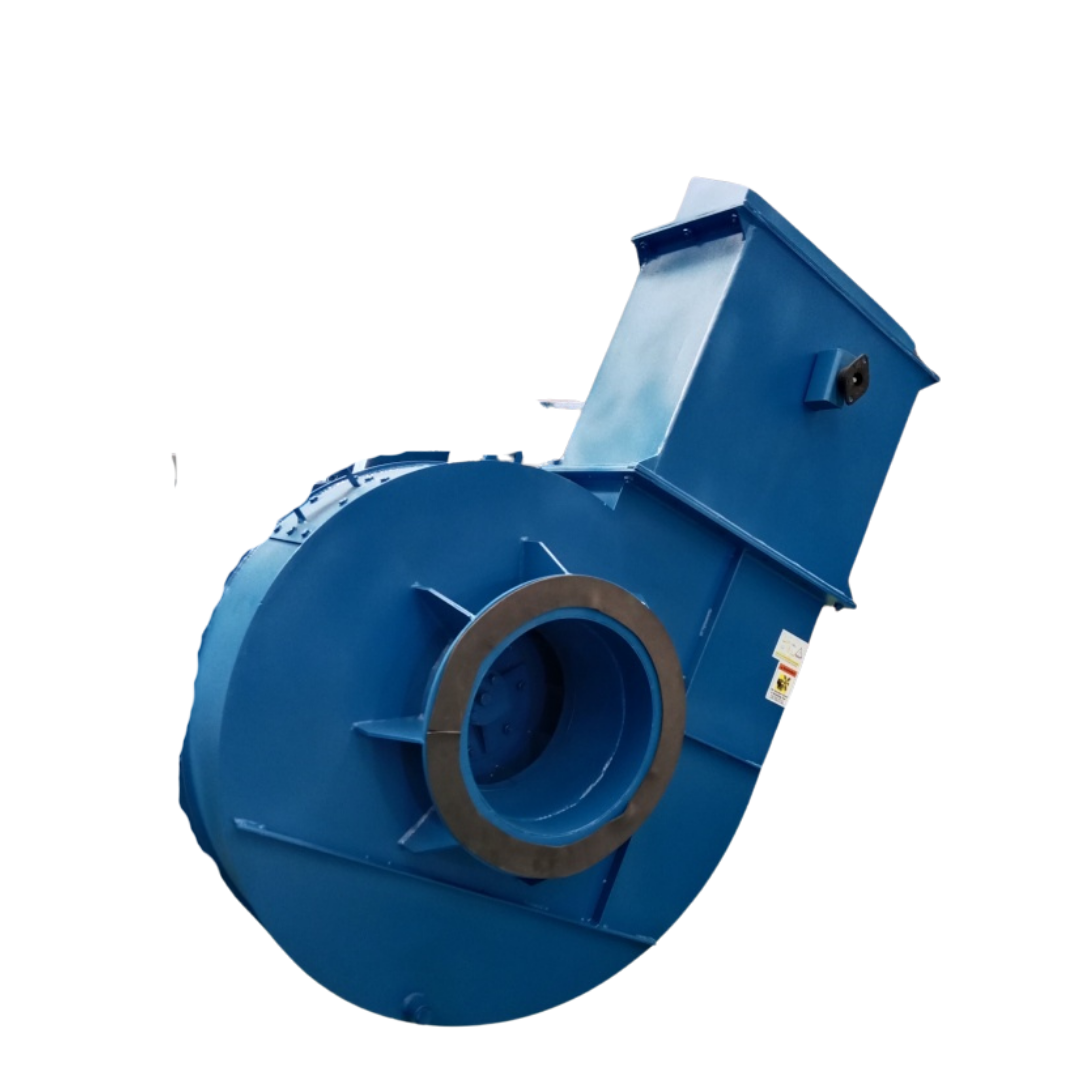
Can you supply the fans across the whole foundry, or only one duty?
Across the whole foundry. We have executed 29 foundry & casting duties spanning cupola, induction and arc-furnace fume extraction, cupola and core-oven exhaust, pouring and shake-out capture, local exhaust ventilation over the pour and grinding stations, sand-plant and reclamation dedusting, bag-filter and pulse-jet draught, dirty-side dust extraction, and the cupola-blast and combustion-air blowers. Each fan is engineered to its own gas, temperature and dust load — the hot spark-laden cupola fume and the clean cupola-blast fan are different machines — but they come from one partner, on one engineering convention across the shop.
What is the maximum gas temperature you handle on cupola or furnace fume?
Continuous duty up to 600 °C across the envelope. Most induction and arc-furnace fume runs 150 to 400 °C, while cupola and core-oven exhaust reaches the top of the band. Above about 350 °C we fit a shaft cooling disc to keep heat off the bearings, keep the bearings outside the airstream, and add expansion joints for the thermal growth. Refractory or heat-resistant lining is attested to 600 °C for the hottest cupola duty. The fan is built for your stated gas temperature and excursion case, not a generic rating.
Foundry sand is brutal on a fan. How do you protect the wheel and casing?
Green sand, reclaimed silica and casting grit are among the sharpest dust in any fan duty, and shake-out and shot-blast loads run heavy, so we protect three ways sized to your loading. A rugged radial wheel that sheds sand and resists erosion; chrome-carbide hard-facing on the blade leading edges and high-wear zones; and bolted-in, replaceable wear plates and liners at the scroll throat and inlet with inspection and cleanout doors, so worn parts change out in place. The wear scope is replaceable, not welded in, which is what keeps the fan running between overhauls.
Cupola and grinding fume carries live sparks. How do you handle the fire and explosion risk?
We size the fan for hot fume to 600 °C and build it spark-tolerant, with a spark-arrestor scope on request to knock down embers before they reach the fan or the bag filter. Where the area classification calls for it on combustible organic dust, ATEX Zone 2/22 is self-declared per 2014/34/EU (Category 3), and we choose blade geometry and finish so sticky binder fume does not build up into a fuel deposit. The right scope depends on your dust and area classification, so we engineer it to your shop, not a default.
Can you build a replacement to match our existing foundry fan's duty and footprint?
Yes. We reverse-engineer to the existing duty point (flow, static pressure, gas temperature, density and dust load), bearing centres, inlet/outlet orientation and foundation bolt pattern so the unit drops onto the existing base and ducting, whether it is a cupola fume fan, a shake-out extraction fan, a sand-plant dedusting fan or a cupola-blast blower. Made to your installation, not a nearest-catalogue substitute. Send the old GA, the nameplate and a curve if you have one, and we match it.
Do you performance-test the fans, and what about AMCA, CE, ATEX and quality certification?
Every fan is performance-tested in-house to the AMCA 210 / ISO 5801 method on our 200 HP VFD test rig, and dynamically balanced to ISO 21940 G6.3 as standard (G2.5 / G1.0 on application). Because the rig runs cold air, hot cupola-fume operation is extrapolated by fan-law correction for density. To be precise: that in-house testing is to the AMCA 210 / ISO 5801 method, not AMCA-certified; CE is self-declared per 2006/42/EC and 2014/35/EU, and ATEX Zone 2/22 is self-declared per 2014/34/EU (Category 3) where the area classification calls for it — those are self-declarations of conformity, not third-party certifications. Our only third-party certification is ISO 9001:2015.