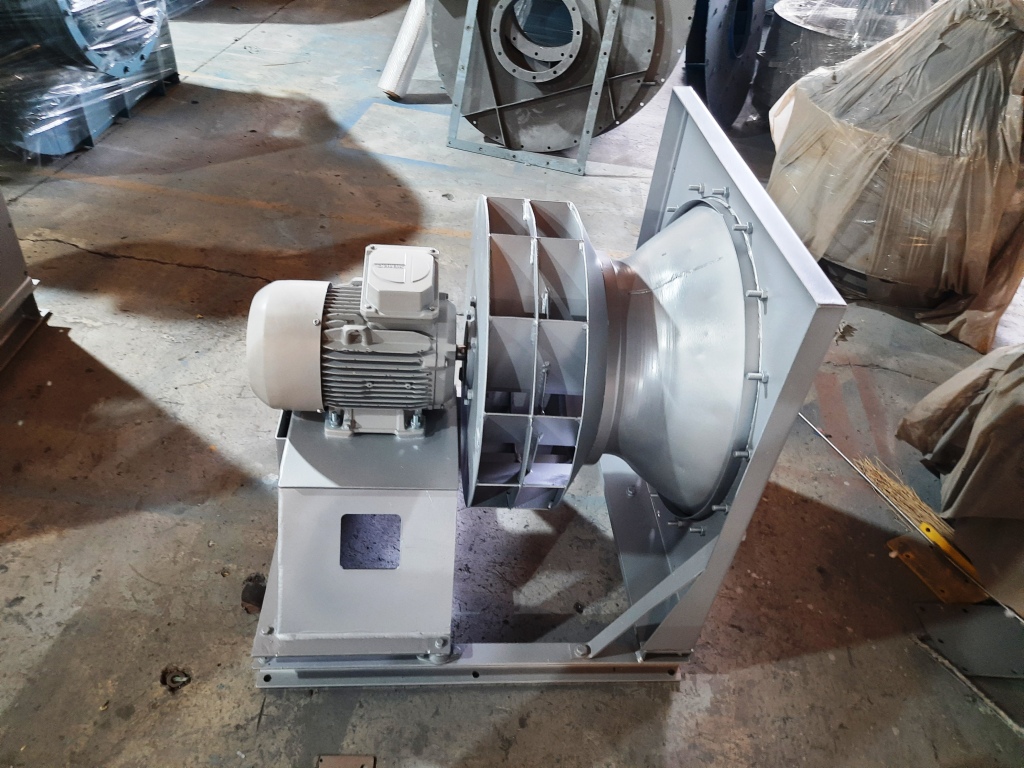
How is a radial-tip fan different from a radial (paddle) fan?
The blade. A radial-tip blade curves at the root and straightens to radial only at the outer tip; a full radial (paddle) blade is straight all the way from the hub. The curved root gives the radial-tip noticeably better peak efficiency than a paddle radial, while the straight tip stays self-cleaning. The radial-tip is sized for moderate dust; the Radial family is the wear-plated family for the heaviest abrasive loads in the range. We use the radial-tip when the dust is moderate so you do not pay the radial's efficiency penalty for dust you do not have.
How much dust can a radial-tip fan handle before I should move to a radial?
Moderate dust is the radial-tip's gate — more than a trace, but short of a genuinely heavy abrasive load. Below that, a backward family is more efficient on cleaner air; above it, or where the dust is heavy / abrasive / sticky, the rugged Radial family — wear-plated for the heaviest loads in the range — is the right family. Tell us the dust loading in g/m³ and whether it is abrasive, and we will place you on the family that survives the wear and runs at the best efficiency for that gas (the exact family limits are shared with your enquiry).
Will the wheel wear out in dusty gas, and can wear parts be replaced on site?
Wear is engineered for, not left to chance. On abrasive duty we specify leading-edge hardfacing to a qualified WPS and bolt-in replaceable scroll liners, sized to the wear mode, with access for in-place replacement. We also offer an impeller-overlay refurbishment service that keeps the wheel in service through its wear life rather than scrapping it. The wear parts are a planned, replaceable system — so wear is managed and budgeted, not a surprise failure.
What pressure and flow can a radial-tip fan reach?
The radial-tip is a medium-to-high-pressure family — the Class 4–5 build runs a 150 m/s tip to make real static. Across the envelope we engineer up to 2,00,000 CMH and 2,000 mmWC, with the wheel and pressure class selected from your duty point. The fan is built for your stated flow and static together — a flow figure alone cannot size a fan — not to a generic catalogue rating.
Can a radial-tip fan run hot — cement-mill or drying gas?
With high-temperature (HT) construction we engineer to 600 °C across the envelope, with a shaft cooling disc fitted above about 150 °C. We confirm hot duty on enquiry against your stated gas temperature and excursion case rather than quoting a generic ceiling. The construction follows the temperature you give us.
Why not just buy a cheaper full radial for our dusty mill-vent duty?
For genuinely heavy abrasive loads we would put you on the Radial family — that is exactly what it is for. But for moderate dust the radial-tip gives you noticeably better peak efficiency than a paddle radial, and on a fan running thousands of hours a year that efficiency is real electricity cost. We match the family to your actual dust loading so you neither erode a backward fan nor over-pay in running cost on a radial you did not need.
Do you performance-test before dispatch, and can we witness it?
Yes. Every fan is performance-tested in-house to the AMCA 210 / ISO 5801 method on our 200 HP VFD test rig, and dynamically balanced to ISO 21940 G6.3 as standard, with G2.5 fine balance for the 150 m/s tip on critical duty. The test and FAT take about a week and are customer-witnessed on request. You see the curve and the balance report before the fan leaves the floor.
What about API 673, CE and ATEX requirements?
We design and build to API 673 for oil and gas duty as project-specific scope (allow 7–10 working days for the offer). CE is self-declared per 2006/42/EC and 2014/35/EU, and ATEX Zone 2/22 is self-declared per 2014/34/EU (Category 3) with spark-resistant (SR) construction where the area classification calls for it. To be precise: those are self-declarations of conformity, not third-party certifications; our only third-party certification is ISO 9001:2015.