Can you supply the fans across the whole finishing line, or only one duty?
Across the whole line. We have executed 14 surface-coating & plating duties spanning plating-line and pickling acid-fume exhaust, paint and powder-coat booth exhaust, prep and grinding fume extraction, local lip and hood extraction, whole-shop general ventilation, and lab fume-hood exhaust. Each fan is engineered to its own acid chemistry and area classification — the acid-fume exhaust and the ATEX booth fan are different machines — but they come from one partner, on one engineering convention across the shop.
Our plating and pickling exhaust is aggressive acid. What materials do you use?
We size the metallurgy to your exact bath chemistry, because the right answer for chloride is wrong for chromic. For hydrochloric and mixed-acid streams we build in FRP or polypropylene; for sulphuric, chromic or nitric where a stainless holds, we use 316L or step up to a higher alloy. Bare mild steel and even 304 pit and perforate on saturated acid, so there is no bare steel in the airstream — internals are fully coated or lined, with a drain at the volute low point and a wash-down connection so condensate never pools. Send your bath chemistry, concentration and saturation and we specify the material to it, not a default.
Our paint booth carries solvent vapour. How do you make the fan ATEX-safe?
Booth and dip-coat exhaust that can sit in the flammable range is built as an ATEX Zone 2/22 duty. That means spark-resistant construction to the AMCA Type B/C rubbing-clearance approach, non-sparking materials where the wheel could contact the inlet, the whole assembly bonded and earthed against static, and a motor rated to the classified zone. To be precise: ATEX Zone 2/22 is self-declared per 2014/34/EU (Category 3) — it is a self-declaration of conformity, not a third-party certification. Tell us the zone and the solvent and we build the fan to that classification.
Paint overspray and plating salt build up on the wheel. Does that throw the fan out of balance?
It can, and it is a real failure mode on this duty — the build is uneven, so the rotor slowly loses balance until vibration climbs and a blade or seal fails. We design against it: a non-stick coated wheel and casing so the deposit sheds rather than keys on, access and cleanout doors and an optional wash-down spray so it can be cleaned in place, and balance held to ISO 21940 G6.3 with margin so the fan tolerates the build between wash cycles. Cleanable-by-design, not sealed shut.
Can you build a replacement to match our existing exhaust fan's duty and footprint?
Yes. We reverse-engineer to the existing duty point (flow, static pressure, gas condition, saturation and acid chemistry), bearing centres, inlet/outlet orientation and foundation bolt pattern so the unit drops onto the existing base and ducting — whether it is an acid-fume exhaust, a booth fan, a scrubber booster or an LEV fan. Made to your installation, not a nearest-catalogue substitute. Send the old GA, the nameplate and a curve if you have one, and we match it.
Do you performance-test the fans, and what about AMCA, CE, ATEX and quality certification?
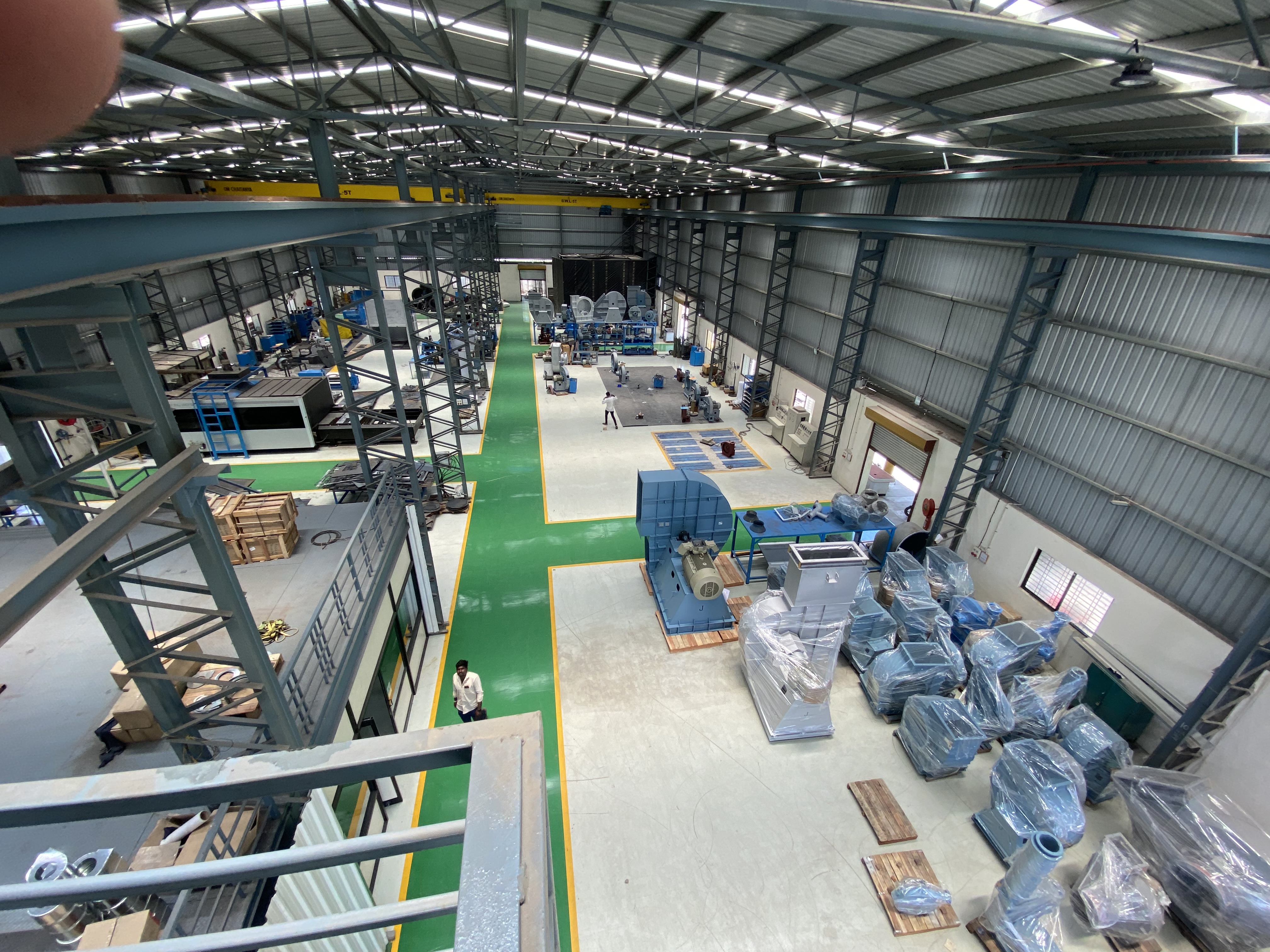
Every fan is performance-tested in-house to the AMCA 210 / ISO 5801 method on our 200 HP VFD test rig, and dynamically balanced to ISO 21940 G6.3 as standard (G2.5 / G1.0 on application). To be precise: that in-house testing is to the AMCA 210 / ISO 5801 method, not AMCA-certified; CE is self-declared per 2006/42/EC and 2014/35/EU, and ATEX Zone 2/22 is self-declared per 2014/34/EU (Category 3) where the booth or vapour area classification calls for it — those are self-declarations of conformity, not third-party certifications. Our only third-party certification is ISO 9001:2015.