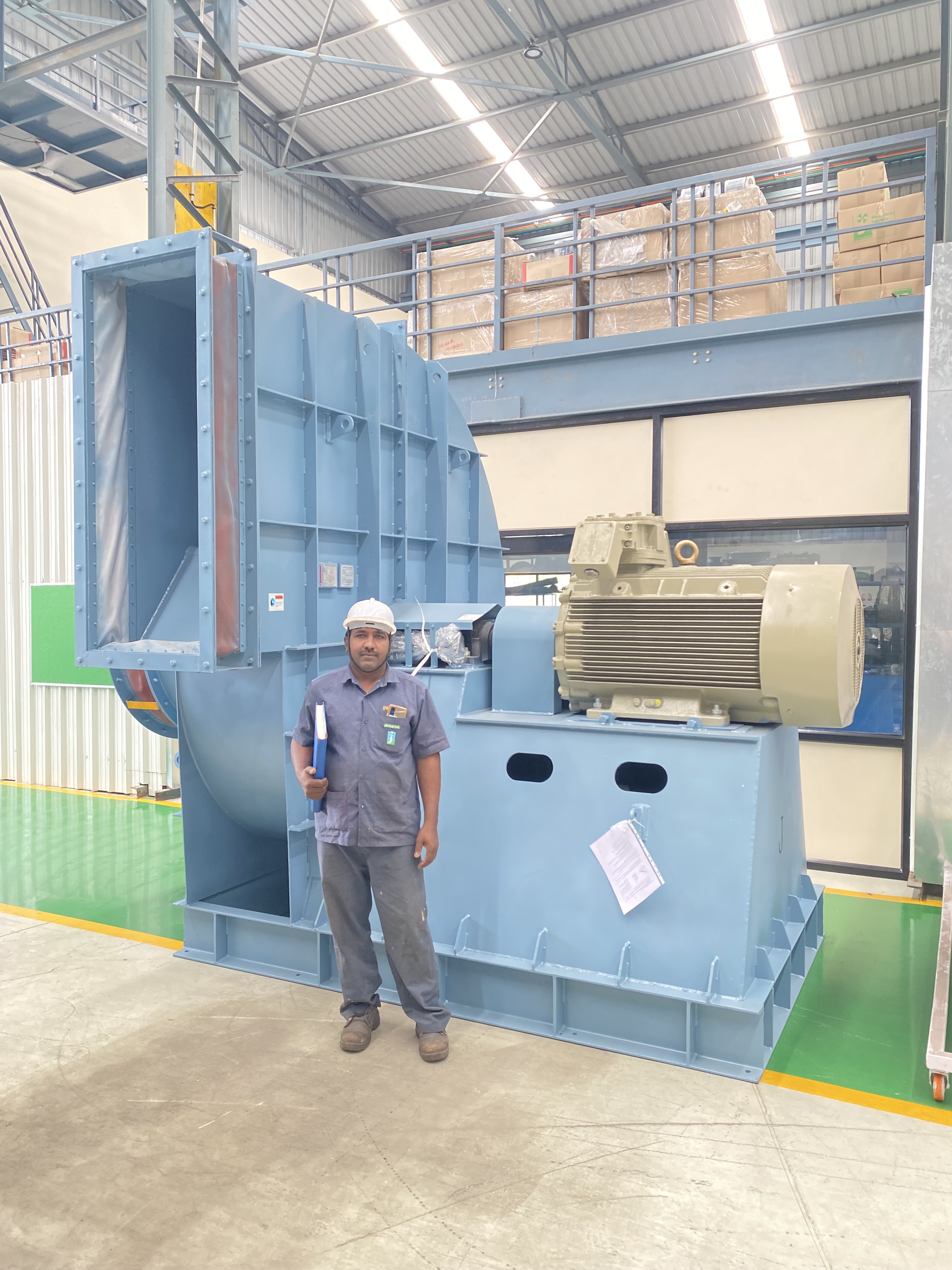
High-static centrifugal aeration blower for a wastewater plant on the Jitamitra shop floor
Home  /  Industries  /  Water & Wastewater
Industries

Fans & blowers for the water & wastewater plant — aeration to odour control.

A water or wastewater plant runs fan duty most people never see: deep-tank aeration blowers that push air through metres of water column every second of every day, digester and biogas boosters on flammable methane, odour-control and biofilter exhaust carrying corrosive H₂S, and sludge-drying air. The aeration blowers alone can draw the largest share of the plant's power bill, and they never stop — the biology dies if the air does. We engineer fans and blowers across the whole plant, not one duty off a shelf: a handful of executed water & wastewater duties, across the envelope below — up to 2,00,000 CMH, 2,000 mmWC, 400 HP and 600 °C.

24×7continuous aeration duty
2,000 mmWCmax static, deep-tank
H₂Scorrosive gas, alloyed for
ATEX 2/22biogas, self-declared
15,000+
fans built since 2011
200 HP
VFD test rig · IS 4894 / AMCA 210
99%
on-time delivery
3
working days to quote — always
AERATION BLOWER · DIGESTER / BIOGAS BOOSTER · ODOUR & BIOFILTER · SLUDGE DRYING
Where the fans sit

One plant, three jobs the fans do — and the aeration blowers can never stop.

Across a water or wastewater plant the fans and blowers do three distinct jobs: they aerate the biological treatment tanks, they boost and handle the biogas the digesters make, and they capture and treat the corrosive odour the whole process gives off. The aeration blowers are the plant's biggest continuous load and a hard single point of failure — starve the biology of air and the treatment collapses — while the biogas and odour duty add flammable and corrosive chemistry on top.

The duties we run on a water plant

The fan and blower duties across a water or wastewater plant — and the role each one plays.

A single treatment plant needs a family of fan and blower duties, from the high-static aeration blower down to the corrosive odour-control exhaust. We have executed a handful of water & wastewater duties across this list — each engineered to its own pressure, gas and corrosion load, not adapted from a catalogue near-fit.

The fans we deploy here

Three fan types cover the water plant — matched to the pressure and the gas.

The wheel is chosen by the pressure it has to make and the gas it has to survive: a rugged radial for the high-static aeration blower and dirty duty, a backward-curved plate wheel for the efficient odour and process exhaust, and an aerofoil for the clean, high-efficiency ventilation air. All three build across the same envelope — to 2,00,000 CMH, 2,000 mmWC, 400 HP and 600 °C.

Why water & wastewater fan duty is hard

Three things in a wastewater plant decide whether the fan runs for years or corrodes in a season.

A water or wastewater plant attacks a fan in three ways the datasheet rarely shows — corrosive H₂S and near-saturated air on the odour side, a continuous high-static aeration duty that never stops and drives the power bill, and flammable biogas that turns the digester circuit into an ATEX area. Engineer for all three and the fan runs a full 10+ years. Engineer for the duty point alone and it corrodes, wastes energy or fails a safety case within 12–36 months.

01 — CORROSION

H₂S & near-saturated corrosion

Odour, digester and sludge air carry hydrogen sulphide (H₂S) at high humidity; the gas and its condensate form sulphuric acid on the casing wall and, in a covered plant, attack carbon steel and even concrete — a fan built in plain mild steel can pit through in a season.

How we engineer it out

Metallurgy sized to the gas — 316L or Corten on the wetted surfaces, FRP or coated construction where the H₂S is severe; casing insulation and drainage so condensate cannot pool, and epoxy or rubber lining on the wheel and scroll where the analysis calls for it.

02 — HIGH STATIC · 24×7

Continuous high-static aeration duty

Deep-tank aeration pushes air under 4–8 m of water column — 400–800 mmWC continuous — and runs 24×7 as the plant's biggest single load. A wheel off its best-efficiency point burns energy every hour of every day, and a stoppage starves and kills the biology.

How we engineer it out

A rugged radial wheel sized onto its best-efficiency region at your exact aeration duty, not a catalogue near-fit; VFD control so the blower tracks the diurnal load without throttling loss; and bearings and construction rated for genuine continuous 24×7 service with a long L10 design life.

03 — FLAMMABLE GAS

Flammable biogas & ATEX area

Digester biogas is methane-rich and flammable — the booster and its surroundings are a classified hazardous area, and a spark from a rubbing wheel or a leaking casing is a real ignition and asphyxiation risk on a live plant.

How we engineer it out

Spark-resistant construction to AMCA 99 with non-sparking rubbing surfaces, gas-tight welded and sealed casing to contain the biogas, and ATEX Zone 2/22 self-declared per 2014/34/EU (Category 3) where the area classification calls for it — the safety scope engineered to your zone, not assumed.

How we design for the plant

Every metallurgy, pressure and safety choice is documented on the GA drawing you sign off — before we cut metal.

We don't sell a catalogue near-fit onto a treatment plant. Each fan is engineered to its own duty — the aeration blower to its water column, the biogas booster to its hazardous area, the odour fan to its H₂S — at your operating point.

  • Corrosion metallurgy for H₂S316L or Corten on the wetted surfaces where the air turns H₂S-laden and near-saturated; FRP, epoxy or rubber lining on the wheel and scroll where the gas analysis is severe; casing drainage and insulation so acidic condensate cannot pool and pit the wall.
  • High-static, continuous-duty build — A rugged radial wheel sized onto its best-efficiency point at your aeration duty of 400–800 mmWC; bearings and construction rated for genuine 24×7 service with a long L10 design life; VFD control so the blower tracks the diurnal load instead of throttling energy away.
  • Biogas safety & gas-tight scope — Spark-resistant construction to AMCA 99 with non-sparking rubbing surfaces; gas-tight welded and sealed casing to contain flammable digester biogas; ATEX Zone 2/22 self-declared per 2014/34/EU (Category 3) where the classified area calls for it.
  • Single source across the plant — One engineering partner for the whole plant — aeration blowers, digester and biogas boosters, odour-control and biofilter exhaust and sludge-drying air — with a handful of executed water & wastewater duties, so the fans, materials and drives carry one convention across the site.
Standards & conformity

Stated precisely — because procurement checks.

What our marks mean, in the words that survive an audit.

Performance

Tested to the AMCA 210 / ISO 5801 method, in-house on our 200 HP VFD rig. Tested-to-method — not AMCA-certified.

Quality system

ISO 9001:2015 — third-party certified. Our only third-party certification.

CE conformity

Self-declared per 2006/42/EC + 2014/35/EU (Module A). A self-declaration, not a notified-body certificate.

ATEX conformity

Self-declared, Zone 2/22, Category 3, per 2014/34/EU, where the area classification calls for it.

Oil & gas duty

Designed and built to API 673 as project-specific scope.

Welding

ASME Sec IX qualified welders + WPS for every joint.

Balance

ISO 21940 — G6.3 minimum, G2.5 / G1.0 on application.

Vibration

ISO 20816 evaluation; ISO 14694 for fan-specific limits.

Questions engineers ask

Water & wastewater fan questions, answered straight.

Can you supply the fans and blowers across the whole plant, or only one duty?
Across the whole plant. We engineer deep-tank aeration blowers, digester and biogas boosters, odour-control and biofilter exhaust, sludge-drying and handling air, corrosive H₂S exhaust, and the general and dilution ventilation of the pump and blower houses. Each is engineered to its own pressure, gas and corrosion load — the high-static aeration blower and the flammable-biogas booster are different machines — but they come from one partner, on one engineering convention across the plant.
Our odour and digester air is full of H₂S. What metallurgy do you use?
We size the metallurgy to your gas analysis. Hydrogen sulphide at high humidity forms sulphuric acid on the casing wall, so on the wetted surfaces we select 316L or Corten, step to FRP, epoxy or rubber lining where the H₂S is severe, and detail casing drainage and insulation so acidic condensate cannot pool and pit the steel. Plain mild steel can pit through in a season on this duty, so the right answer depends on your H₂S concentration, moisture and temperature, and we engineer it to your gas, not a default.
The aeration blowers run continuously and drive our power bill. How do you keep them efficient?
Deep-tank aeration is a continuous high-static duty, typically 400 to 800 mmWC under 4 to 8 m of water column, running 24x7 as the plant's biggest single load. We size the wheel onto its best-efficiency region at your exact aeration duty rather than forcing a catalogue fan onto the spec, and we default to VFD control so the blower tracks the diurnal air demand without the throttling loss of a damper. Bearings and construction are rated for genuine continuous service with a long L10 design life, because every point off best efficiency costs energy every hour of every day.
Digester biogas is flammable. How do you make the biogas booster safe?
The biogas booster and its surroundings are a classified hazardous area, so we build spark-resistant construction to AMCA 99 with non-sparking rubbing surfaces, a gas-tight welded and sealed casing to contain the methane-rich biogas, and we self-declare ATEX Zone 2/22 per 2014/34/EU (Category 3) where the area classification calls for it. We engineer the safety scope to your stated zone and gas composition, not a generic rating, and we name the boundary of that scope up front.
Can you build a replacement to match our existing blower's duty and footprint?
Yes. We reverse-engineer to the existing duty point (flow, static pressure, gas temperature, density and gas composition), bearing centres, inlet/outlet orientation and foundation bolt pattern so the unit drops onto the existing base and ducting, whether it is an aeration blower, a biogas booster or an odour-control fan. Made to your installation, not a nearest-catalogue substitute. Send the old GA, the nameplate and a curve if you have one, and we match it.
Do you performance-test the fans, and what about AMCA, CE, ATEX and quality certification?
Every fan is performance-tested in-house to the AMCA 210 / ISO 5801 method on our 200 HP VFD test rig, and dynamically balanced to ISO 21940 G6.3 as standard (G2.5 / G1.0 on application). To be precise: that in-house testing is to the AMCA 210 / ISO 5801 method, not AMCA-certified; CE is self-declared per 2006/42/EC and 2014/35/EU, and ATEX Zone 2/22 is self-declared per 2014/34/EU (Category 3) where the biogas area classification calls for it — those are self-declarations of conformity, not third-party certifications. Our only third-party certification is ISO 9001:2015.

Across the range

Where Water & Wastewater fits — the fans we deploy, the duties we run, and adjacent industries.

The same engineering, viewed three ways — by fan family, by duty, and by industry. Follow the cross-references.

Take it further

Specs an engineer can use — not a brochure.

Engineer to engineer

Send us the duty point.
We'll quote in 3 working days — always.

No model numbers needed. Give us the operating conditions — flow, static, gas temperature, composition, particulate, and any tender standard — and our application engineers size the fan and quote it. Attach a spec or GA if you have one.

+91 90110 09155  ·  mihir.jitamitra@gmail.com