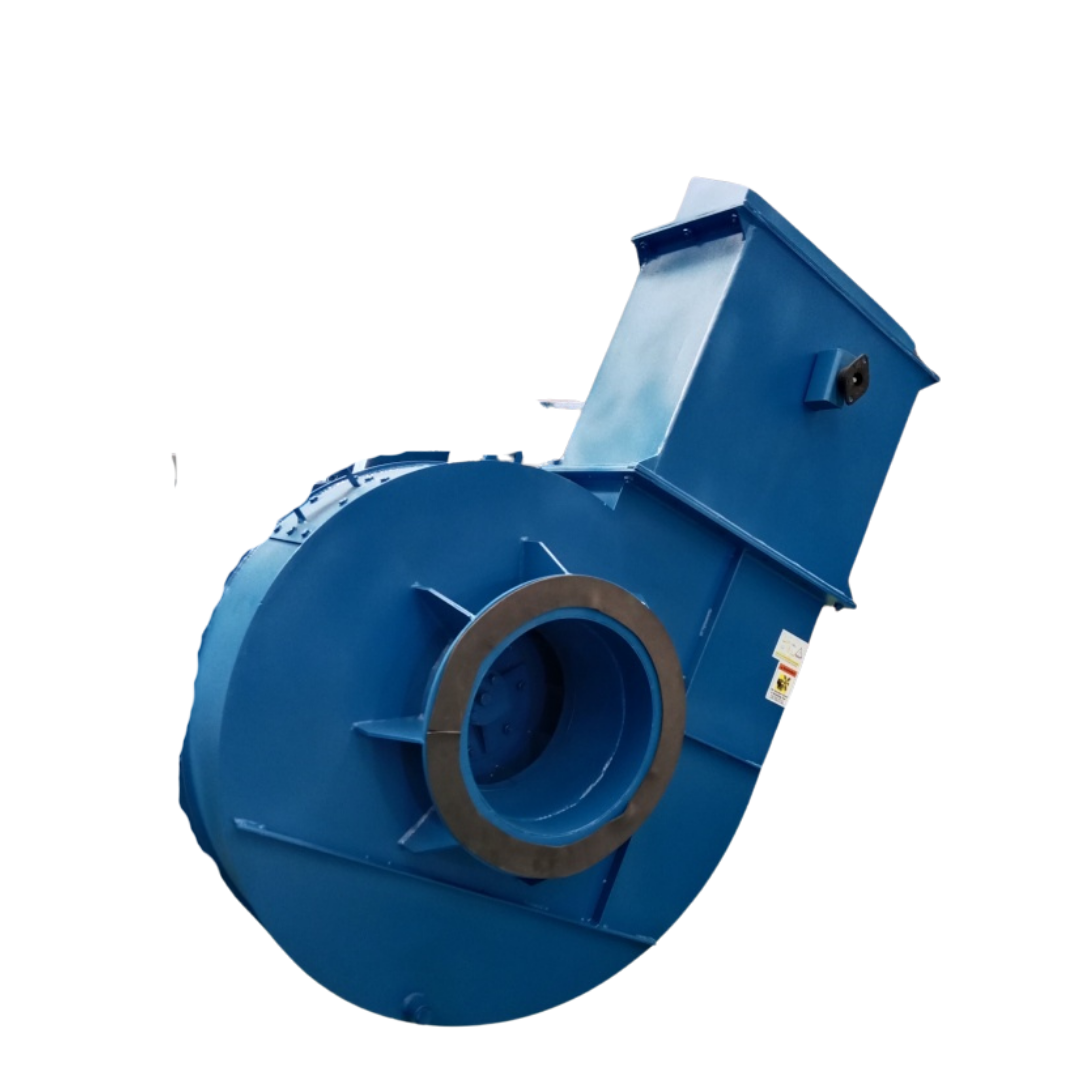
Our foul air is high in H2S. What materials do you use so the fan doesn't corrode through?
H2S dissolves and oxidises to sulphuric acid on every wetted surface, and organic acids add to the load, so carbon steel and standard stainless pit and thin from the inside out. We select the wetted metallurgy to your gas analysis: 316L stainless for moderate H2S, duplex stainless or FRP construction for high-H2S saturated air, and an FRP-rubber-ebonite lining or a heavy-duty special coating on the wetted casing where the acid load is severe. The right answer depends on your H2S concentration, moisture and any organic acids, so we size the metallurgy and the corrosion margin to your analysis, not a default.
The air is saturated and condenses. How do you keep condensate from wrecking the fan?
The airstream sits at its dew point, so condensate forms wherever the surface is cooler than the gas and pools in the casing. We slope the casing to a low-point drain with a trapped connection, continuously weld the internal seams so there are no crevice traps where acid concentrates, fit a shaft seal and a moisture slinger to keep condensate out of the bearing housing, and add drain and inspection doors so the scroll can be flushed in place. The drainage and sealing are engineered to the duty, because on saturated foul air they matter as much as the metallurgy.
The fan sits near a residential boundary. What sound levels can you meet?
As standard we design to below 85 dB(A) at 1 m. For a boundary or consent limit we take it lower on application: inlet and outlet silencers plus an acoustic-lagged casing bring it toward 80 dB(A), and a custom acoustic enclosure gets below 75 dB(A). Low-frequency and blade-pass content carry furthest and are the hardest to attenuate, so we predict the spectrum and engineer the acoustic scope to it. Tell us the sound limit and where the fan sits relative to the boundary, and we design to it rather than fitting silencers after the complaint.
How do you size the fan when the biofilter or scrubber resistance keeps rising as the media fouls?
A biofilter bed or scrubber packing starts at a clean resistance and climbs as the media wets, compacts or fouls between changeouts, so the system curve moves. We size the fan to span the clean-media point and the fouled-media point without running at a control limit, then run VFD as the default so the fan tracks the rising resistance and turns down when the load allows, instead of throttling against a damper and adding noise. We verify the curve across both conditions on the 200 HP VFD test rig before dispatch.
Why not just use a general-ventilation fan for odour extraction? The flow and pressure are low.
Because the duty is defined by chemistry, not by flow and pressure. The air is cool and low-pressure, so a general-ventilation fan looks adequate on the datasheet, but its carbon-steel or standard-stainless construction pits and perforates once saturated H2S-laden air condenses acid inside it, typically within 18 to 30 months. The odour-control fan is the same aerodynamic duty built in corrosion-resistant metallurgy with proper drainage, sealing and acoustic scope. We build to the foul air you actually have, not the flow and pressure alone.
Do you supply the fan as a sub-package to a biofilter or scrubber builder?
Yes. We supply odour-control fans separately to biofilter manufacturers, wet and chemical scrubber OEMs and effluent-plant integrators. You specify the duty, the foul-air analysis and the integration interface — flange dimensions, mounting orientation, wetted metallurgy, drainage arrangement, electrical interface and control protocol — and we document it up front and deliver the fan ready to mate. The engineering is identical to a direct-buyer fan; only the integration interface and who buys it differ.
Can you match a corroded fan we already have, to the same duty and footprint?
Yes. We reverse-engineer to the existing duty point (flow, static pressure, temperature, density), bearing centres, inlet and outlet orientation and foundation bolt pattern, so the replacement drops onto the existing base and ducting — and we upgrade the wetted metallurgy to fix the corrosion that took the old one out. Send the old GA, the nameplate and your current foul-air analysis, and we match the fit while correcting the material. We engineer to this duty; specify yours and we build to it.
Do you performance-test before dispatch, and what standards actually apply?
Yes. Every fan is performance-tested in-house to the AMCA 210 / ISO 5801 method on our 200 HP VFD test rig, and dynamically balanced to ISO 21940 G6.3 as standard, with G2.5 or G1.0 on application. To be precise about the claims: that is testing to the AMCA 210 method in-house, not an AMCA certification, and Jitamitra is not an AMCA member. CE is self-declared per 2006/42/EC and 2014/35/EU, and ATEX Zone 2/22 is self-declared per 2014/34/EU (Category 3) where an area classification calls for it — those are self-declarations of conformity, not third-party certifications. Our only third-party certification is ISO 9001:2015. Bearing life is a design target of L10h ≥ 40,000 h continuous.