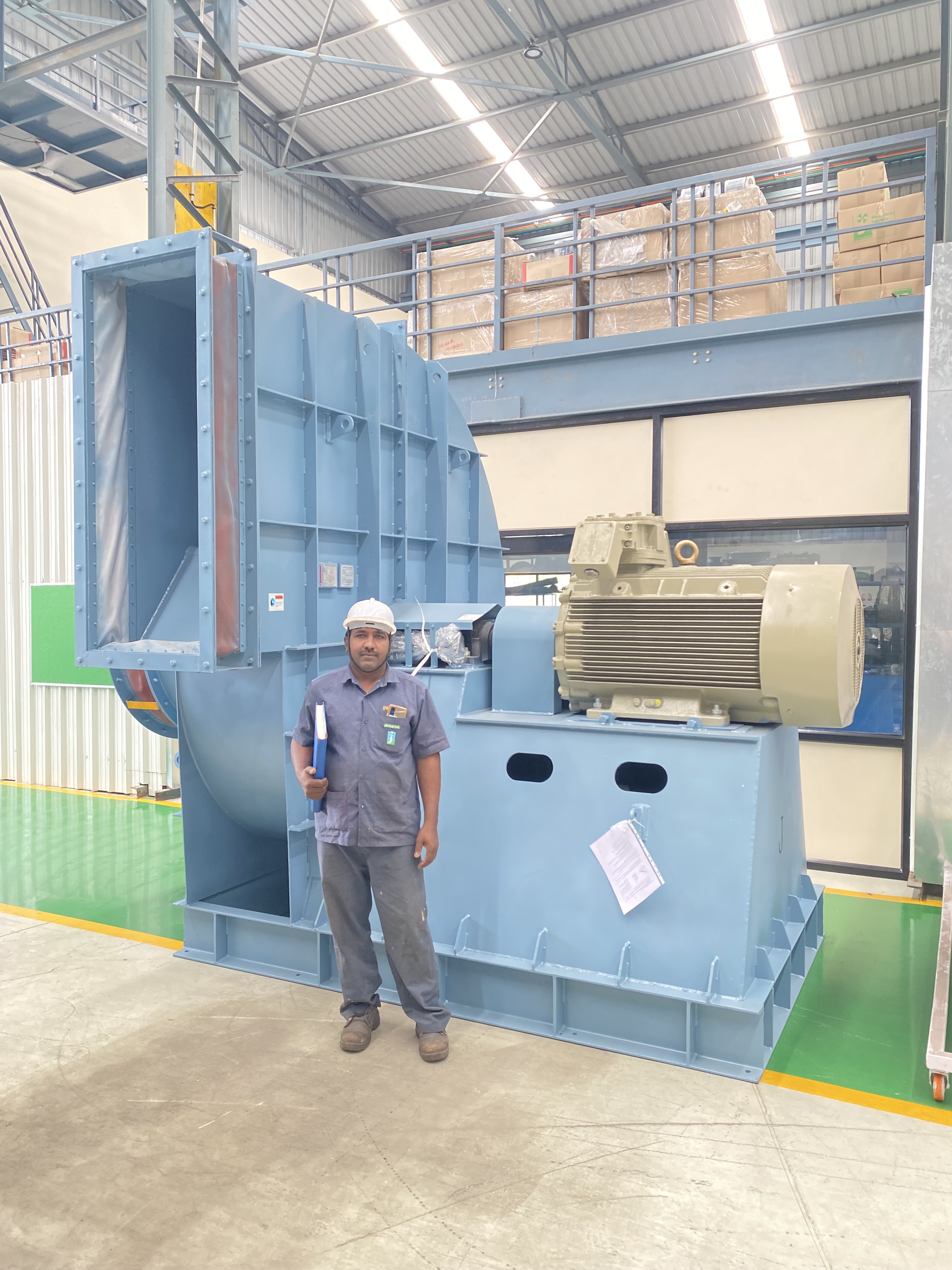
Is your biogas booster ATEX-rated, given the gas is flammable?
Biogas is roughly 50 to 65 percent methane, so it is flammable and the area around the booster is normally classified Zone 1 or Zone 2. As standard we self-declare ATEX Zone 2/22, Category 3, per 2014/34/EU, combined with spark-resistant construction per AMCA 99 — a non-sparking impeller, a non-ferrous rub ring, bonded earthing throughout, anti-static coatings and T-class bearing-temperature control. Zone 1/21 (Category 2) is available on application via a Notified-Body partner. To be precise: ATEX is a self-declaration of conformity, not a third-party certification. Performance is tested in-house to the AMCA 210 / ISO 5801 method, not AMCA-certified, and Jitamitra is not an AMCA member. Our only third-party certification is ISO 9001:2015. We mark the zone, category and spark-resistant type on the GA drawing and the nameplate.
How do you stop the flammable gas leaking out of the fan?
A conventional bolted, gasketed fan casing with a clearance seal is not built to contain a flammable gas, so we do not use one here. The casing is fully welded and leak-tested to a stated rate before dispatch, and the shaft is sealed with a mechanical or double-lip seal chosen for the duty, with an inert or gas purge on the highest-integrity builds. We document the leak rate and the seal type on the GA drawing so the containment scope is explicit, not assumed.
Our raw gas has high H2S. What materials do you use?
Raw biogas is saturated with water and often carries 500 to 3,000 ppm of hydrogen sulphide, sometimes more, so any cold surface condenses a weak sulphuric or sulphurous acid and the attack is corrosion, not erosion. We put the wetted parts in 304L or 316L stainless for sour, water-saturated gas, slope the casing to a drain at the low point so condensate cannot pool, and keep the seal between the condensate and the bearings. On lighter-sulphur gas a coated mild-steel build can be enough. We size the metallurgy to your stated H2S and moisture, not a default, so send the gas analysis with the enquiry.
What pressure rise can the booster deliver?
Raw gas leaves the digester dome at almost nothing, typically 10 to 50 mbar, and the booster lifts it to what the load needs — a CHP engine train usually wants around 80 to 300 mbar, and a flare or an upgrading skid can want more. That is roughly 800 to 3,000 mmWC, which a single-stage centrifugal booster covers up to about 2,000 mmWC within the envelope, and higher on enquiry. The flow is usually low, so the pressure rise and the gas analysis drive the design, not the volume.
Have you built biogas boosters before?
This is an engineered-capability page rather than a track-record page: we do not claim a list of executed biogas-booster references here. What we bring is the underlying engineering — gas-tight welded and leak-tested casings, ATEX Zone 2/22 self-declaration with spark-resistant construction, and stainless wetted-part metallurgy for sour, water-saturated gas — all of which we build routinely across our fan range. Tell us your gas analysis, pressure rise and area classification and we engineer the booster to it. We have engineered 45 application and duty types; tell us yours.
Can you supply just the booster to a digester or upgrading OEM?
Yes. We supply biogas boosters and flare-feed fans separately to digester builders, biogas-upgrading skid OEMs and flare-system integrators. You specify the duty and the integration interface — flange dimensions, mounting orientation, ATEX zone and category, spark-resistant type, gas-tightness target, electrical interface and control protocol — and we document it up front and deliver the fan ready to mate. The engineering is the same as a direct-buyer fan; only the interface and who buys it differ.
Do you performance-test the booster before dispatch?
Yes. Every fan is performance-tested in-house to the AMCA 210 / ISO 5801 method on our 200 HP VFD test rig and dynamically balanced to ISO 21940 G6.3 as standard, with G2.5 or G1.0 on application. The performance test is run on air to the stated method; the gas-tightness leak test is separate and proves the containment. Bearing life is a design target of L10h at least 40,000 hours continuous. The test and FAT take about a week and are customer-witnessed on request, so you see the curve and the balance and leak reports before the fan leaves the floor.
What is the lead time for a biogas booster?
The offer turns around in 3 to 5 working days. An engineered biogas booster then runs roughly 10 to 15 weeks order-to-dispatch — GA drawing 2 to 3 weeks from PO, then manufacture, welding and leak test, balance and paint, and the performance test plus FAT in about a week. An ATEX file, a purged mechanical seal or upgraded 316L metallurgy adds a little file-prep and procurement time. We confirm a dated commitment against your schedule, not a placeholder.