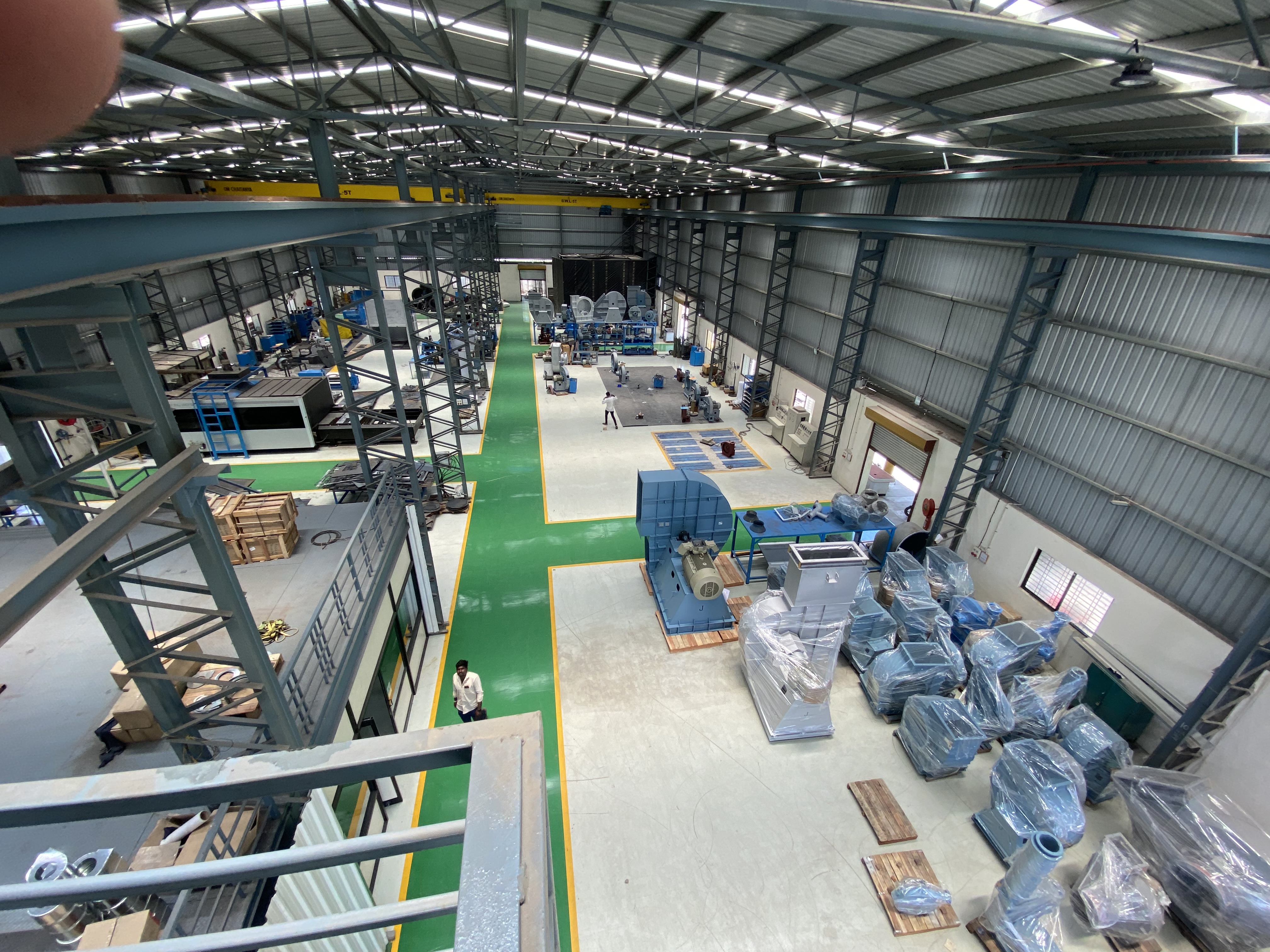
Backward-curved process-air centrifugal fan for a tobacco line on the Jitamitra shop floor
Home  /  Industries  /  Tobacco
Industries

Fans for the tobacco line — curing air to dust extraction.

A tobacco processing line runs on air that is warm, humid and full of fine leaf dust: leaf curing and redrying process air, fine-dust and fume extraction over the threshing and cutting floors, and the general and process ventilation that holds temperature and humidity across the plant. The dust is fine, sticky and combustible; the process air is hot and moist enough to condense. The underlying fan engineering is proven across our range — we engineer it to a tobacco line's duty across the full envelope below: up to 2,00,000 CMH, 2,000 mmWC, 400 HP and 600 °C. Tell us yours.

40–90 °Ccuring & redrying air
≤5 μmfine tobacco dust
ATEX Zone 22self-declared, on call
2,00,000 CMHmax flow
15,000+
fans built since 2011
200 HP
VFD test rig · IS 4894 / AMCA 210
99%
on-time delivery
3
working days to quote — always
CURING & REDRYING AIR · DUST & FUME EXTRACTION · PROCESS VENTILATION · PNEUMATIC HANDLING
Where the fans sit

One tobacco line, three jobs the fans have to do — and none of them likes standing dust.

Across a tobacco plant the fans do three distinct jobs: they move the warm, humid air that cures and redries the leaf, they extract the fine dust and fume off the threshing, cutting and cigarette-making floors, and they run the general and process ventilation that holds the plant's temperature and humidity. Every one of them handles fine, sticky tobacco dust that is combustible when it hangs in the air — so the fan has to keep the air moving cleanly and refuse to let dust build on the wheel.

The duties we run on a tobacco line

The fan duties across a tobacco plant — and the role each one plays.

A tobacco line needs a family of fan duties, from the warm humid curing air down to the fine-dust extraction over the cutting floor. Every one runs the same fine, combustible dust and the same heat-and-humidity air, so each is engineered to its own gas, temperature and dust load — not adapted from a catalogue near-fit.

The fans we deploy here

Three fan types cover the tobacco line — matched to the dust and the pressure.

The wheel is chosen by the cleanliness of the air and the pressure it has to make: an aerofoil wheel for the clean, high-volume curing and ventilation air where efficiency matters most, a backward-curved wheel for moderate process and exhaust duty, and a backward-curved plate wheel where light dust in the air rules out a hollow aerofoil blade. All three build across the same envelope — to 2,00,000 CMH, 2,000 mmWC, 400 HP and 600 °C.

Why tobacco fan duty is hard

Three things in tobacco air decide whether the fan runs clean or clogs and corrodes.

Tobacco air works on a fan in three quiet ways at once — fine dust that is both sticky and combustible, curing and redrying air warm and humid enough to condense, and a hygiene demand on the surfaces the process air touches. Engineer for all three and the fan runs balanced and clean between routine washdowns. Engineer for the duty point alone and it cakes up out of balance, corrodes at the casing, or fails a hygiene audit within 6–18 months.

01 — DUST

Fine, sticky, combustible dust

Tobacco dust is fine (much of it ≤5 μm) and sticky, so it cakes onto a wheel and throws the rotor out of balance; suspended in air above its minimum explosive concentration it is combustible, and a spark or hot bearing can ignite it.

How we engineer it out

A backward-curved plate wheel that sheds dust rather than trapping it in a hollow blade; spark-resistant construction (AMCA Type B/C) and an ATEX Zone 22 self-declaration where the area classification calls for it; and inspection and cleanout doors so the wheel is washed down without dismantling the fan.

02 — HUMIDITY

Warm, humid curing air

Curing and redrying air runs warm and moist — 40–90 °C at high humidity — and where the casing wall is cooler the moisture condenses, cakes hygroscopic tobacco dust into a hard deposit and corrodes plain steel over a season.

How we engineer it out

Casing insulation to hold the wall above the local dew point so moisture does not condense on it; corrosion-resistant metallurgy (304 / 316L) on the wetted surfaces where the air stays wet; and drains at the casing low points to clear any condensate that does form.

03 — HYGIENE

Product-contact hygiene

On the process air that touches the leaf, a rough weld, an internal ledge or a dead pocket collects dust and moisture, breeds a hygiene problem and fails a food-grade audit — and a coating that flakes contaminates the product.

How we engineer it out

Smooth, cleanable internal surfaces with ground continuous welds and no internal ledges; food-grade or stainless finish on the wetted path; and access doors positioned so every internal surface is reachable for washdown — cleanability designed in, not bolted on.

How we design for the line

Every dust, humidity and hygiene choice is documented on the GA drawing you sign off — before we cut metal.

We don't sell a catalogue near-fit onto a tobacco line. Each fan is engineered to its own duty — the curing-air fan to its warm humid air, the dust fan to its fine combustible load, the ventilation fan to its air-change target — at your operating point.

  • Dust handling & spark safety — A backward-curved plate wheel that sheds tobacco dust instead of trapping it; spark-resistant construction (AMCA Type B/C) and an ATEX Zone 22 self-declaration per 2014/34/EU (Category 3) where the area classification calls for it; inspection and cleanout doors so the wheel washes down in place.
  • Humidity & condensation control — Casing insulation to hold the wall above the local dew point on warm, humid curing and redrying air 40–90 °C; corrosion-resistant metallurgy (304 / 316L) on the wetted surfaces; drains at the casing low points to clear condensate before it cakes dust.
  • Hygienic, cleanable construction — Smooth internal surfaces with ground continuous welds, no internal ledges or dead pockets, and a food-grade or stainless finish on the process-air path that touches the leaf; access doors placed so every wetted surface is reachable for routine washdown.
  • Efficient, quiet air movement — An aerofoil or backward-curved wheel sized where its curve crosses your system for the clean, high-volume curing and ventilation duty, so the drive stays inside 400 HP; balanced to ISO 21940 G6.3 as standard (G2.5 / G1.0 on application) to keep vibration and noise low near the working floors.
Standards & conformity

Stated precisely — because procurement checks.

What our marks mean, in the words that survive an audit.

Performance

Tested to the AMCA 210 / ISO 5801 method, in-house on our 200 HP VFD rig. Tested-to-method — not AMCA-certified.

Quality system

ISO 9001:2015 — third-party certified. Our only third-party certification.

CE conformity

Self-declared per 2006/42/EC + 2014/35/EU (Module A). A self-declaration, not a notified-body certificate.

ATEX conformity

Self-declared, Zone 2/22, Category 3, per 2014/34/EU, where the area classification calls for it.

Oil & gas duty

Designed and built to API 673 as project-specific scope.

Welding

ASME Sec IX qualified welders + WPS for every joint.

Balance

ISO 21940 — G6.3 minimum, G2.5 / G1.0 on application.

Vibration

ISO 20816 evaluation; ISO 14694 for fan-specific limits.

Questions engineers ask

Tobacco fan questions, answered straight.

Have you built fans for tobacco processing before?
We do not claim a tobacco reference we have not earned, so we will be straight with you: this is an engineered-capability page. The underlying fan engineering — clean high-volume curing and ventilation air, fine-dust and fume extraction, spark-resistant and ATEX construction, hygienic cleanable build — is proven across our range in food, drying, dust-extraction and ventilation duty. We engineer it to a tobacco line's specific duty. Tell us your flow, temperature, humidity, dust load and area classification and we design to it.
Tobacco dust is fine and combustible. How do you handle the explosion risk?
We treat tobacco dust as a combustible dust and design to it. The wheel is a solid backward-curved plate type that sheds dust rather than trapping it in a hollow aerofoil blade, so deposits do not build and unbalance the rotor. Where the area is classified we build the fan spark-resistant to AMCA Type B or C construction and provide an ATEX Zone 22 self-declaration per 2014/34/EU (Category 3). We also fit inspection and cleanout doors so the wheel is cleaned down on schedule. The exact scope depends on your dust characteristics and area classification, so we size it to your job, not a default.
Our curing and redrying air is warm and humid. Will the fan corrode or clog?
Only if it is built wrong for that air. Curing and redrying air typically runs 40 to 90 °C at high humidity, and where the casing wall is cooler than the local dew point, moisture condenses, cakes hygroscopic tobacco dust into a hard deposit and corrodes plain steel. We insulate the casing to hold the wall above dew point, select corrosion-resistant metallurgy such as 304 or 316L on the surfaces that stay wet, and drain the casing low points so any condensate clears. Give us the air temperature, humidity and any excursion case and we engineer the material and insulation to it.
Can the fan meet a food-grade hygiene standard on the process air that touches the leaf?
Yes. On the process-air path that contacts the leaf we build smooth, cleanable internal surfaces with ground continuous welds, no internal ledges or dead pockets where dust and moisture collect, and a food-grade or stainless finish. Access doors are positioned so every wetted internal surface is reachable for washdown. Cleanability is designed in from the GA drawing, not bolted on afterwards, and we document the finish and material on the drawing you sign off.
Can you build a replacement to match our existing tobacco fan's duty and footprint?
Yes. We reverse-engineer to the existing duty point (flow, static pressure, air temperature, humidity, density and dust load), bearing centres, inlet and outlet orientation and foundation bolt pattern so the unit drops onto the existing base and ducting — whether it is a curing-air fan, a dust-extraction fan or a ventilation fan. Made to your installation, not a nearest-catalogue substitute. Send the old GA, the nameplate and a curve if you have one and we match it.
Do you performance-test the fans, and what about AMCA, CE, ATEX and quality certification?
Every fan is performance-tested in-house to the AMCA 210 / ISO 5801 method on our 200 HP VFD test rig, and dynamically balanced to ISO 21940 G6.3 as standard (G2.5 / G1.0 on application). To be precise: that in-house testing is to the AMCA 210 / ISO 5801 method, not AMCA-certified, and we are not an AMCA member; CE is self-declared per 2006/42/EC and 2014/35/EU, and ATEX Zone 2/22 is self-declared per 2014/34/EU (Category 3) where the area classification calls for it — those are self-declarations of conformity, not third-party certifications. Our only third-party certification is ISO 9001:2015.

Across the range

Where Tobacco fits — the fans we deploy, the duties we run, and adjacent industries.

The same engineering, viewed three ways — by fan family, by duty, and by industry. Follow the cross-references.

Take it further

Specs an engineer can use — not a brochure.

Engineer to engineer

Send us the duty point.
We'll quote in 3 working days — always.

No model numbers needed. Give us the operating conditions — flow, static, gas temperature, composition, particulate, and any tender standard — and our application engineers size the fan and quote it. Attach a spec or GA if you have one.

+91 90110 09155  ·  mihir.jitamitra@gmail.com