Can you supply the fans across the whole textile plant, or only one duty?
Across the whole plant. We have executed 17 textile duties spanning stenter and drying-range process air, humidification-plant supply and hall dilution ventilation, lint and fibre-dust extraction, local exhaust at singeing and process points, combustion and process air for the heaters, and roof or wall exhaust. Each fan is engineered to its own air temperature, humidity and lint load — the hot stenter fan and the clean humidification fan are different machines — but they come from one partner, on one engineering convention across the mill.
Lint fouls and unbalances a fan, and it is a fire load. How do you handle it?
Two ways, sized to your fibre load. On the extraction and dirty stenter-exhaust duty we use a backward-curved plate wheel with flat, self-shedding blades and generous tip clearance so lint does not pack on, plus smooth cleanable internals with large access and cleanout doors so what does build up clears quickly and does not throw the wheel out of balance. Where a dry lint layer is an ignition risk we build the fan spark-resistant per AMCA 99 (Type A or B construction) so there is no ferrous rubbing contact in the airstream. The wear and cleanout scope is built in, not an afterthought.
Our humidification and dryer-exhaust air is humid and condenses. What materials do you use?
We size the metallurgy to where the air condenses. On continuously wet duty we select corrosion-resistant construction — hot-dip galvanised, epoxy-coated, or 304 / 316 stainless on the wetted surfaces — with a self-draining scroll, cased drains and casing insulation to hold the wall above dew point so moisture does not sit on the metal or cake the lint. The right answer depends on your temperature, RH and any chemical carry-over from the process, so we engineer it to your air, not a default.
How do you keep the air even across the fabric width on a stenter or drying range?
Uniform drying and heat-setting depend on delivering the same temperature and velocity edge to edge, so we select a backward-curved wheel with a stable, non-overloading characteristic onto its best-efficiency point at your true duty, rather than forcing a catalogue fan near the point. The wheel is balanced to ISO 21940 G6.3 as standard for low vibration, and above about 350 °C we fit a shaft cooling disc with the bearings outside the airstream. Even, stable airflow is what keeps shade, shrinkage and hand consistent across the width.
What is the maximum air temperature you handle on a stenter or dryer fan?
Continuous duty up to 600 °C across the envelope, with most stenter and drying-range fans running 180 to 220 °C and gas-fired or thermic-fluid ranges going higher. Above about 350 °C we fit a shaft cooling disc to keep heat off the bearings, keep the bearings outside the airstream, and add expansion joints for the thermal growth. The fan is built for your stated air temperature and excursion case, not a generic rating.
Do you performance-test the fans, and what about AMCA, CE, ATEX and quality certification?
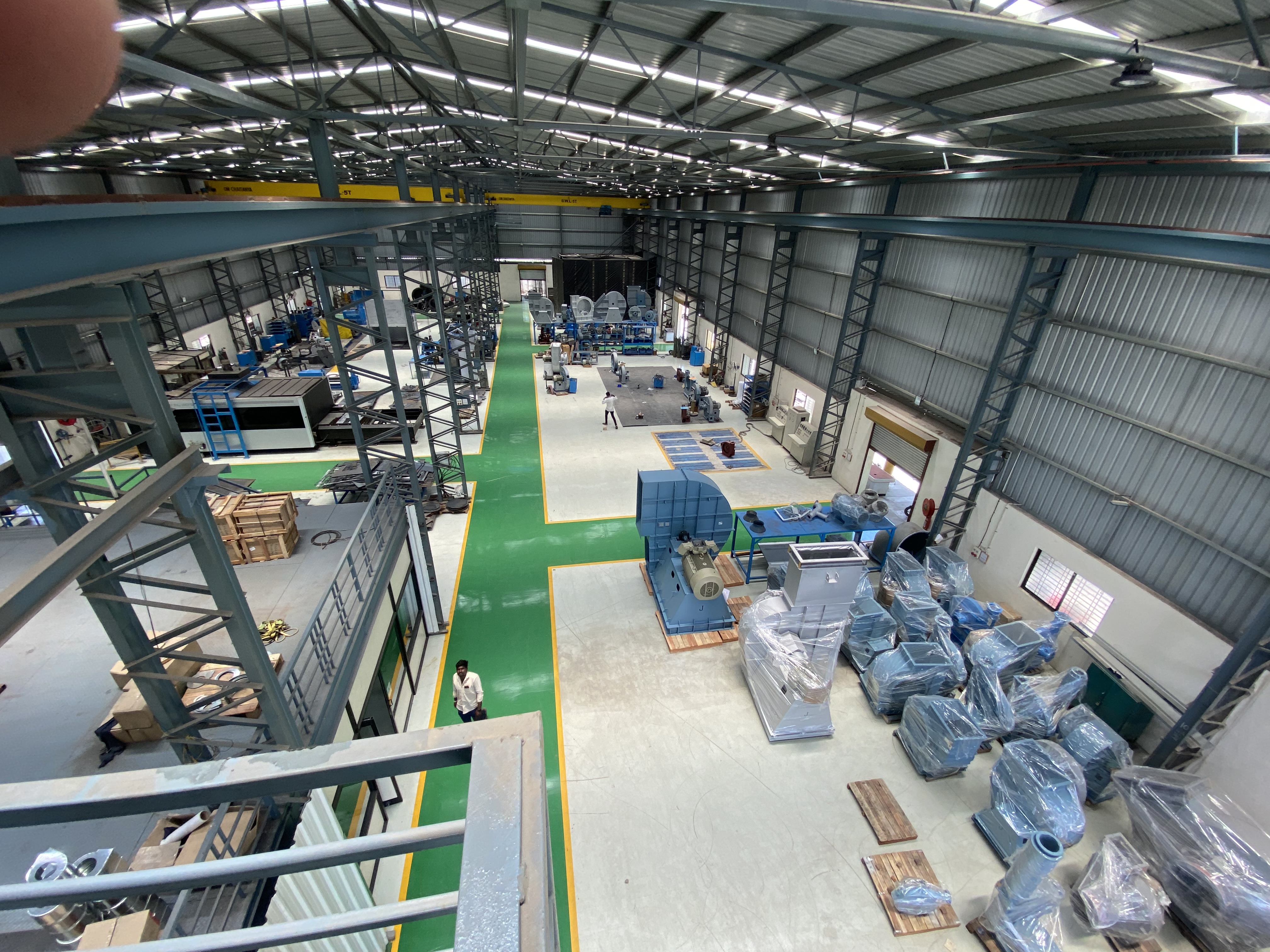
Every fan is performance-tested in-house to the AMCA 210 / ISO 5801 method on our 200 HP VFD test rig, and dynamically balanced to ISO 21940 G6.3 as standard (G2.5 / G1.0 on application). To be precise: that in-house testing is to the AMCA 210 / ISO 5801 method, not AMCA-certified; CE is self-declared per 2006/42/EC and 2014/35/EU, and ATEX Zone 2/22 is self-declared per 2014/34/EU (Category 3) where the fibre load or area classification calls for it — those are self-declarations of conformity, not third-party certifications. Our only third-party certification is ISO 9001:2015.