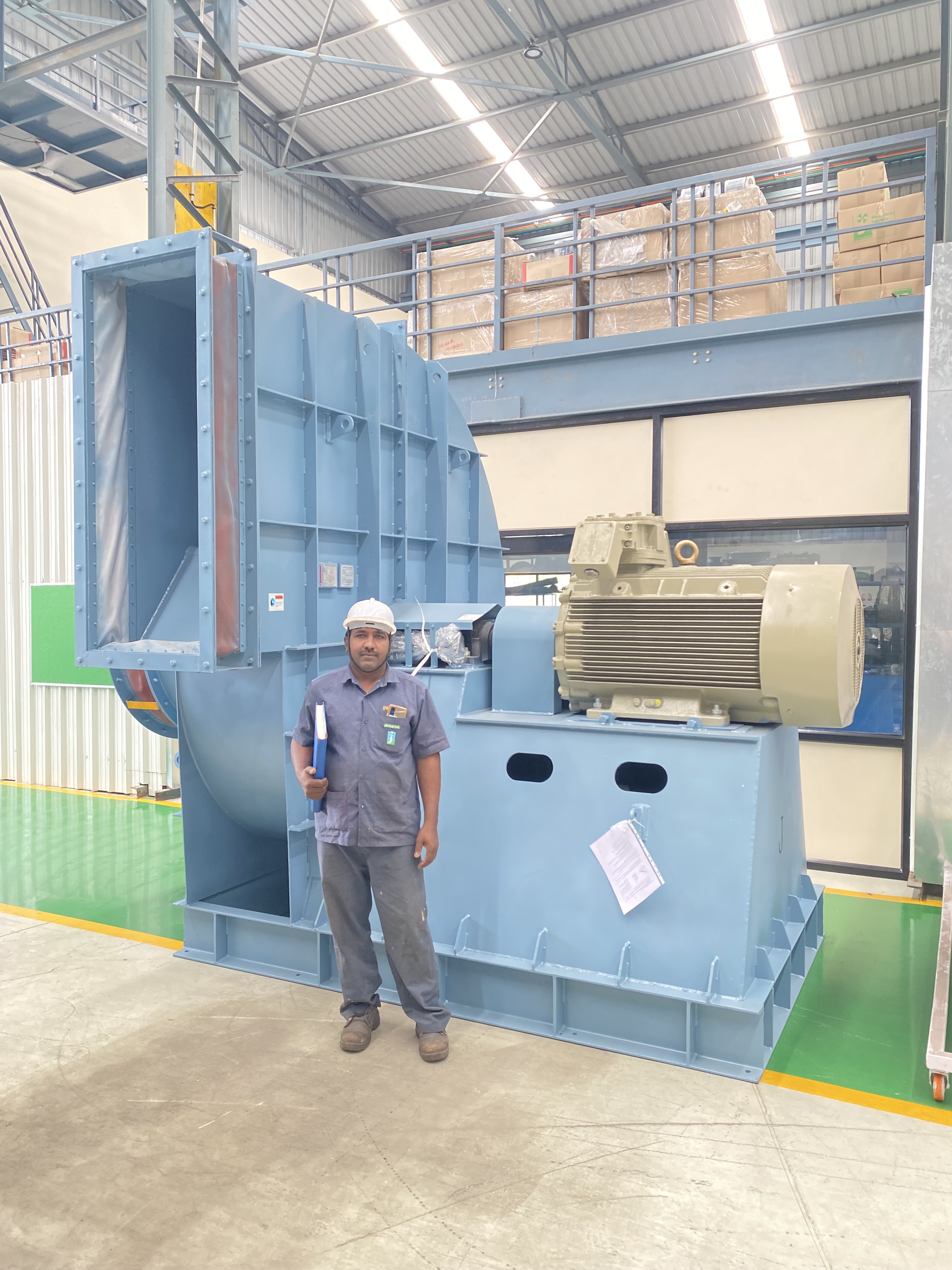
Grain dust is combustible. Do you build fans for an ATEX-classified grain plant?
Yes. Where the area is classified for combustible grain dust we build a spark-resistant, ATEX construction sized to the zone: non-sparking wheel and inlet materials, generous wheel-to-casing clearance so metal never rubs, earthing and bonding across the whole assembly, and bearings kept cool and outside the airstream so nothing inside a dust cloud can become an ignition source. To be precise, ATEX Zone 20/21/22 is self-declared per 2014/34/EU (Category 1D/2D/3D) where the classification calls for it — that is a self-declaration of conformity, not a third-party certification. Tell us your zone and dust classification (St class, minimum ignition energy) and we engineer the fan to it.
Fine grain dust cakes on the wheel and unbalances it. How do you manage that?
Two ways. First, a radial wheel geometry that resists build-up and self-cleans in the airstream, so fine dust does not key onto the blades. Second, inspection and cleanout doors so the wheel can be checked and washed down on a maintenance stop, and dynamic balancing to ISO 21940 G6.3 as standard (G2.5 or G1.0 on application) so the fan starts from a low residual imbalance and has the widest margin before any build-up begins to matter. On the dirtiest conveying and extraction duty the radial wheel is chosen specifically because it sheds dust rather than collecting it.
What temperatures do your grain-dryer and aeration fans handle?
Most grain-dryer air runs 60 to 120 °C, and aeration air is near-ambient, so temperature is rarely the limiting factor on a grain plant — the combustible dust is. That said, the same fan range is rated for continuous duty up to 600 °C across the envelope, so if you run a high-temperature dryer stage or a biomass-fired hot-air generator we simply select up the metallurgy and add a shaft cooling disc above about 350 °C. The fan is built for your stated air temperature, not a generic rating.
Can you supply the fans across the whole grain flowsheet, or only one duty?
Across the whole flowsheet. We engineer dryer and aeration air, dilute-phase pneumatic conveying, dust extraction on the transfer points and elevator boots, building dilution ventilation, combustion air for the dryer burner, and the pulse-jet draught on the bag filters. Each fan is engineered to its own air, moisture and combustible-dust classification — the clean aeration fan and the dirty extraction fan are different machines — but they come from one partner, on one engineering convention across the plant.
Can you build a replacement to match our existing grain fan's duty and footprint?
Yes. We reverse-engineer to the existing duty point (flow, static pressure, air temperature, density and dust load), bearing centres, inlet/outlet orientation and foundation bolt pattern so the unit drops onto the existing base and ducting — whether it is a dryer fan, a conveying blower, a dust-extraction fan or a bag-filter draught fan. Made to your installation, not a nearest-catalogue substitute. Send the old GA, the nameplate and a curve if you have one, and we match it — including the spark-resistant scope if the area is classified.
Do you performance-test the fans, and what about AMCA, CE, ATEX and quality certification?
Every fan is performance-tested in-house to the AMCA 210 / ISO 5801 method on our 200 HP VFD test rig, and dynamically balanced to ISO 21940 G6.3 as standard (G2.5 / G1.0 on application). To be precise: that in-house testing is to the AMCA 210 / ISO 5801 method, not AMCA-certified; CE is self-declared per 2006/42/EC and 2014/35/EU, and ATEX Zone 20/21/22 for combustible grain dust is self-declared per 2014/34/EU (Category 1D/2D/3D) where the area classification calls for it — those are self-declarations of conformity, not third-party certifications. Our only third-party certification is ISO 9001:2015.