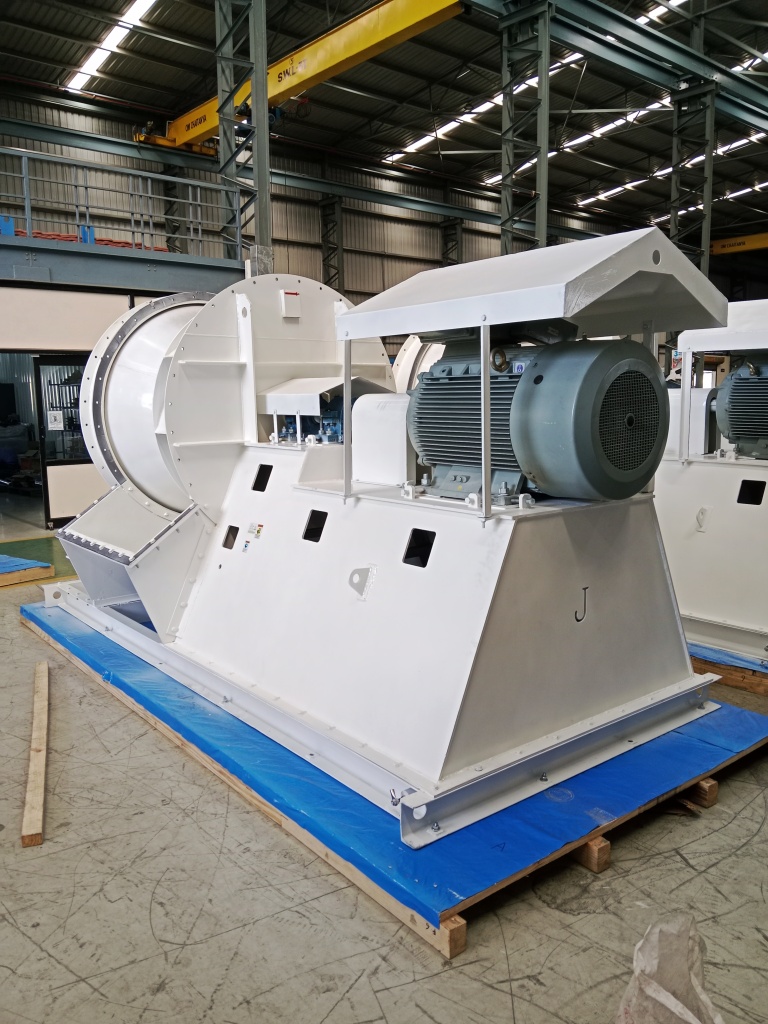
What fans on a gas-turbine package do you actually build?
The auxiliary and ventilation fans around the machine, not the turbine itself. That covers inlet-air and process-air boost toward the compressor, acoustic-enclosure and generator-hood ventilation, and auxiliary cooling air for lube-oil, alternator and control loads. These are clean-air fans, so the engineering focus is cleanliness, reliability and — on fuel-gas machines — enclosure gas and fire safety, rather than the erosion and corrosion that dominate flue-gas duty. We have executed this duty on a handful of turbine and genset packages and engineer each fan to the package rather than offering a shelf item.
The air is clean, so what makes this a hard duty?
The machine downstream, not the air. A turbine or alternator is worth many multiples of the fan and stops the moment the fan does, so the whole design load moves to protecting it. Inlet cleanliness protects the compressor from any debris the fan might shed, reliability protects uptime because a fan trip is a unit trip, and on a fuel-gas package the enclosure ventilation fan sits in a classified hazardous area. None of that erodes a wheel, but all of it has to be engineered out, which is why we do not treat this as a generic clean-air ventilation fan.
How do you make sure the inlet fan does not send debris into the compressor?
By building the fan so it cannot become a source of foreign object damage. The flow path is smooth, deburred and fully welded with a controlled internal coating, there are no wear liners that could spall and no exposed hardware in the airstream, and the impeller is balanced to a tight grade so it never sheds material or a loosened part toward the machine. On filtered inlet air the residual loading is already very low, so our job is simply to add flow without adding a single particle of our own.
A fan trip takes the turbine offline. How do you engineer the reliability?
We treat the fan as part of the critical train. Bearings are sized to a design target of L10h at or above 40,000 hours continuous, and on critical enclosure ventilation we supply duplex or N+1 fan sets so the loss of one fan does not stop the machine. The impeller is balanced to ISO 21940 G2.5 or G1.0, we provide for vibration and bearing-temperature monitoring so the package can trend the fan and act before it trips, and every unit is performance-tested and balance-verified on the rig before it ships. Unplanned turbine outage is measured in lakhs per hour, so the reliability case is where the money is.
Our turbine burns fuel gas. Is the enclosure ventilation fan a hazardous-area fan?
Yes. On a fuel-gas turbine or genset the acoustic enclosure can accumulate leaked fuel gas, so the ventilation air path is a classified hazardous area and the ventilation system is part of the enclosure fire-and-gas safety case. For that duty we build spark-resistant construction to AMCA 99 and self-declare ATEX Zone 2 per 2014/34/EU, Category 3G, with a non-sparking aluminium impeller, bonded earthing and T-class bearing control, coordinated with the package pre-purge and fire-and-gas trip logic. On clean inlet-air duty away from the classified zone, standard construction applies.
Do you supply the fan as a sub-package to a turbine or genset packager?
Yes. We supply auxiliary and ventilation fans separately to turbine and genset packagers and enclosure builders. You specify the duty and the integration interface — flange and enclosure-opening dimensions, mounting orientation, spark-resistant type and ATEX scope, the electrical interface and the control and trip protocol — and we document it up front and deliver the fan ready to mate, coordinated with your pre-purge and fire-and-gas logic. The engineering is identical to a direct-buyer fan; only the interface and who buys it differ.
Should I specify VFD or a damper for the enclosure ventilation fan?
VFD is our default. Enclosure ventilation demand tracks ambient temperature and machine load, and speed control holds the required air-change rate without the throttling loss of a damper at part-load, which matters on a fan that runs 8,000 hours a year or more beside a base-load machine. An isolation or shut-off damper is still supplied at the enclosure interface for maintenance and for the pre-purge sequence. We quote whichever the package logic calls for.
What certifications and test standards actually apply to these fans?
To be precise about the claims: performance is tested in-house to the AMCA 210 / ISO 5801 method on our 200 HP VFD test rig — that is testing to the AMCA method, not an AMCA certification, and we are not an AMCA member. Spark-resistant construction is built to AMCA 99. CE is self-declared per the relevant EU directives, and ATEX Zone 2/22 is self-declared per 2014/34/EU, Category 3, where the area classification calls for it — those are self-declarations of conformity, not third-party certifications. Balance is to ISO 21940 (G6.3 standard, G2.5 or G1.0 on this reliability-critical duty) and bearing life is a design target of L10h at or above 40,000 hours. Our only third-party certification is ISO 9001:2015.