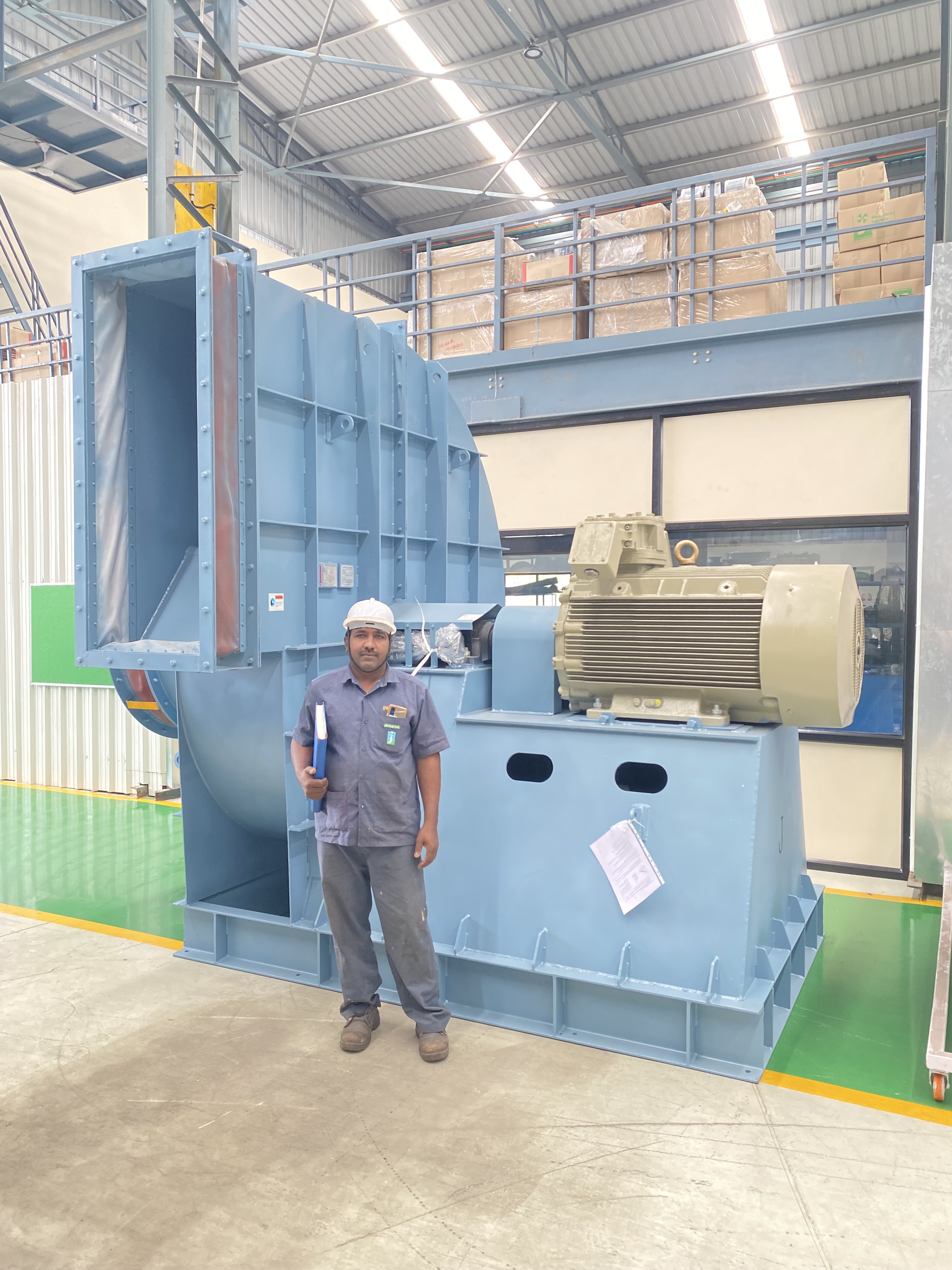
Why does inlet density matter so much on a vacuum or exhauster duty?
Because a fan develops pressure rise in proportion to the density of the air passing through it, and at high suction the inlet air is rarefied. At about -1,000 mmWC of vacuum the inlet density is roughly 9 to 10 percent below ambient, and it falls further as suction deepens. A fan sized on the standard 1.2 kg per cubic metre therefore develops less pressure rise than its datasheet promises and under-delivers vacuum in service. We size every exhauster on the actual inlet density at your operating suction, and carry that correction through pressure rise, shaft power and motor selection, so the fan holds its duty when it is running against real vacuum, not just on paper.
How do you keep the exhauster from falling short at deep suction?
Two things. First, the density correction above, so the fan is sized for the air it actually sees rather than ambient. Second, wheel selection: we use a robust radial or radial-tipped wheel that holds a steep, stable pressure-flow curve deep into the vacuum, so a swing in system resistance moves the operating point along a controllable slope rather than into instability. We then verify the curve on the 200 HP VFD test rig at the corrected condition before dispatch, so the vacuum you see on site is the vacuum we measured on the floor.
My exhauster line carries product. How do you protect the wheel from wear?
On vacuum-conveying and material-laden exhauster duty the pulled airstream carries granules, powder or fines that scour the blade and volute, and because a curved wheel packs and unbalances under abrasive load, uneven wear takes it out before it wears through. We default to a robust straight-radial or radial-tipped wheel that rejects material from the blade root rather than packing it in, add chrome-carbide hard-facing on the leading edges for severe grit, and bolt in AR400 wear plates and liners at the throat and outlet with access doors so they can be replaced in place, not cut out and re-welded. The wear package is sized to your carryover loading; on clean exhauster air it is usually not needed at all.
How do you stop false air leaking in under high vacuum?
Under high negative pressure the casing draws air in through any gap, and a leaking shaft opening bleeds false air that kills the vacuum and, on a conveying line, lets the process breathe. We fit a shaft seal matched to the service — a labyrinth or lip seal as standard, gland packing or a gas-tight seal where the suction is deep or the process must stay contained — together with a gas-tight casing and bonded earthing. The seal type is chosen for your vacuum level and product, and it is documented on the GA drawing you sign off.
Should I specify VFD or a suction damper for control?
VFD is our default. Exhauster and vacuum-conveying demand varies with process load and line-up, and VFD speed control holds the target vacuum across the range while avoiding the throttling loss that a suction or inlet damper incurs at part-load. A damper remains available for legacy retrofit where the existing motor and starter cannot accommodate a drive. We quote whichever your installation calls for, and size the fan so the control element has real authority across your operating range.
What wheel type do you use for high-suction exhauster duty?
Straight-radial is the default for the highest suction and the heaviest material carryover, because it is mechanically strong at high tip speed, self-cleaning under material load, and holds a steep curve deep into the vacuum. Radial-tipped is used for high suction with lighter carryover, and a backward-inclined wheel is only used on clean high-vacuum exhauster air where efficiency leads and there is no material to wear it. We describe the wheel by type on the GA drawing and size it to your suction, density and material load, not to a catalogue nearest-fit.
Can you match a replacement to our existing exhauster's duty and footprint?
Yes. We reverse-engineer to the existing duty point — flow, suction pressure, inlet density and material load — along with bearing centres, inlet and outlet orientation and the foundation bolt pattern, so the unit drops onto the existing base and ducting. Made to your installation, not a nearest-catalogue substitute. Send the old GA, the nameplate and a curve if you have one, and we match it. We have executed high-suction exhauster and vacuum-conveying duties on a handful of process lines and build each to its own numbers.
Do you performance-test before dispatch, and what standards actually apply?
Yes. Every fan is performance-tested in-house to the AMCA 210 / ISO 5801 method on our 200 HP VFD test rig, and dynamically balanced to ISO 21940 G6.3 as standard, with G2.5 or G1.0 on application. To be precise about the claims: that is testing to the AMCA 210 method in-house, not an AMCA certification, and we are not an AMCA member. CE is self-declared per 2006/42/EC and 2014/35/EU, and ATEX Zone 2/22 is self-declared per 2014/34/EU (Category 3) where the area classification calls for it. Those are self-declarations of conformity, not third-party certifications. Our only third-party certification is ISO 9001:2015. Bearing life is a design target of L10h at or above 40,000 hours continuous.