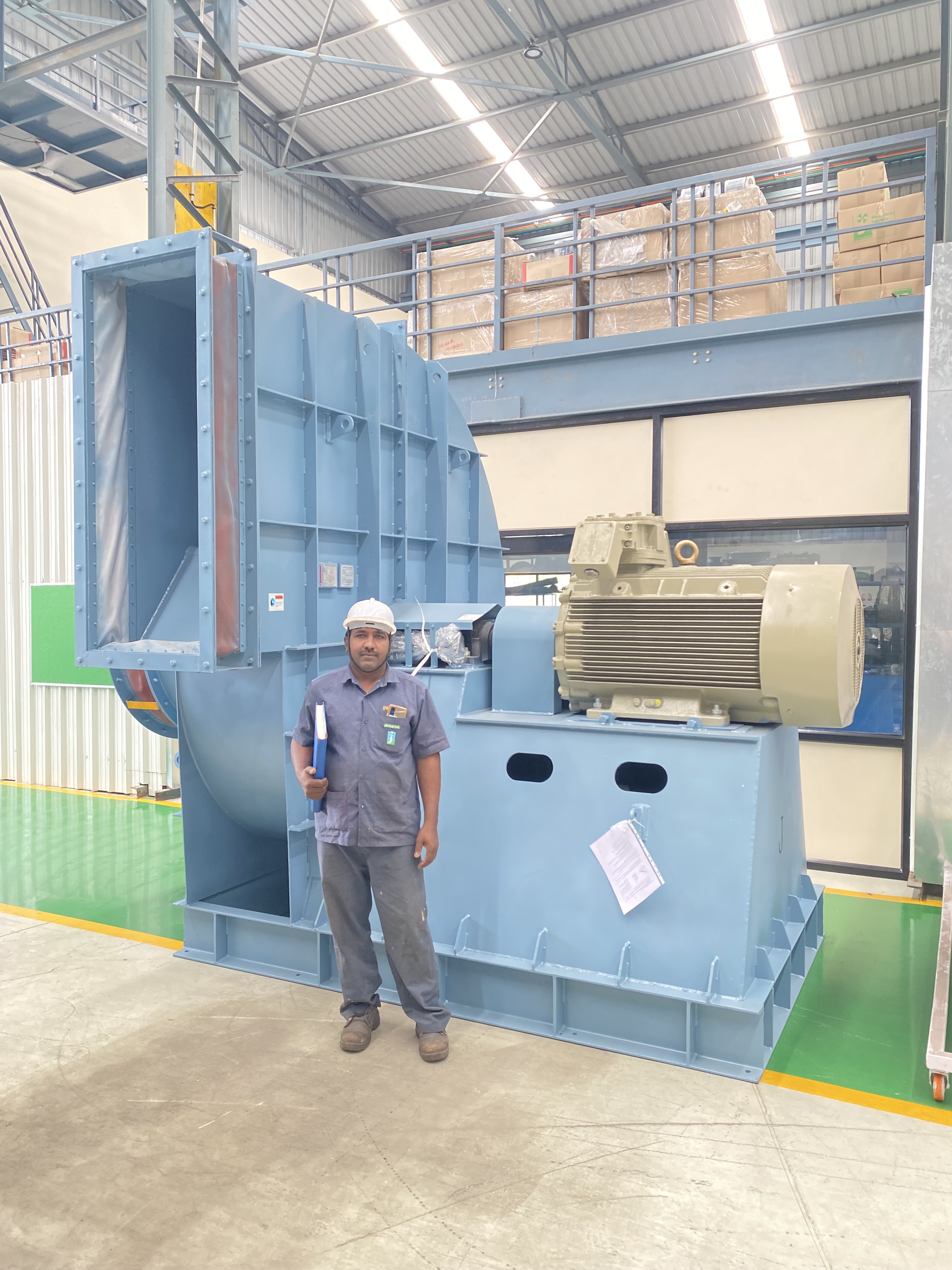
What is the difference between dense-phase and dilute-phase pneumatic conveying?
Dilute phase suspends the product fully in a fast air stream, typically 20 to 30 m/s, at low pressure and a high air-to-material ratio. Dense phase moves the product as slugs or plugs at low velocity, roughly 3 to 8 m/s, at high pressure and a low air-to-material ratio. Dense phase is gentler on friable or abrasive product and uses less conveying air, but it demands a high pressure rise, which drives a completely different fan. A dilute-phase blower is a lower-static, higher-flow machine; a dense-phase blower is a high-static, lower-flow high-pressure radial machine. This page covers the dense-phase duty; the dilute-phase page covers its sibling.
How much static pressure can your dense-phase conveying blowers make?
Up to 2,000 mmWC on a single stage across the envelope, with dense-phase lines typically needing 800 to 2,000 mmWC depending on line length, the number of bends, product loading and the air-to-material ratio. We reach it with high-pressure straight-radial or radial-tip construction at the tip speed the pressure rise requires. Where a single stage cannot make the head, we route to a multi-stage or blower-package solution and quote on enquiry. We size to your actual line resistance, not a generic rating, so the blower reaches the pressure the pipeline needs with margin, rather than stalling short of it.
My product is abrasive and some carries over to the fan. How do you protect the wheel?
Three measures, sized to your carry-over. A straight-radial self-cleaning wheel that rejects product from the blade root instead of packing it in; hard-faced chrome-carbide leading edges on the blades for abrasive powder such as cement, alumina, silica or fly ash; and bolted-in AR400 wear plates at the volute throat and outlet with hinged access doors so they can be replaced in place, not cut out and re-welded. The wear package is sized to how much product actually reaches the fan past the separator; where separation is clean it is minimal, and on heavy carry-over duty it is the full package.
The pipeline back-pressure swings as slugs form and clear. How do you keep the blower stable?
Slug flow means the pipeline resistance rises and falls as each slug forms, moves and clears, so the back-pressure the fan sees is constantly moving. A fan sized onto the flat or rising part of its curve can surge under that swing, oscillating the conveying air and stalling the line. We engineer the duty point onto the steep, stable portion of the pressure-flow curve, where the fan holds air delivery through the back-pressure swing, and then verify the curve on the 200 HP VFD test rig before dispatch. VFD speed control is our default because it holds the conveying velocity as line loading changes without throttling loss.
Should I specify VFD or a damper for a dense-phase blower?
VFD is our default. Conveying rate is set by the air delivery, and the line loading changes across a batch as the pipeline fills and empties, so speed control lets the blower hold the conveying velocity without throttling. It is more efficient than a damper and it helps keep the fan off the surge line at part-load, which matters on a high-static duty. An inlet damper remains available for a legacy retrofit where the existing motor and starter cannot accommodate a drive. We quote whichever your installation calls for.
Is dense phase better for friable or heat-sensitive product?
Often, yes. Because dense phase moves product at low velocity as slugs rather than fully suspended at high speed, it causes far less particle attrition and degradation, which matters for friable product like some polymers, crystalline chemicals and food powders, and it reduces wear on the pipeline itself. The trade-off is the high pressure rise, which is exactly what the blower is engineered for. For food and pharmaceutical product we build the wetted parts in 304 or 316L stainless for hygiene and add a special coating for hygroscopic or sticky powders. Tell us the product and the attrition limit and we design to it.
Do you also build the dilute-phase conveying blower, and can you match an existing unit?
Yes on both. Dilute-phase conveying is the sibling duty, a lower-static and higher-flow machine, and we engineer it on the same basis. For a replacement we reverse-engineer to the existing duty point, that is flow, static pressure and product density, plus the bearing centres, inlet and outlet orientation and foundation bolt pattern, so the new unit drops onto the existing base and pipeline. Send the old GA, the nameplate and a curve if you have one, along with the product and line details, and we match it rather than offering a nearest-catalogue substitute.
What certifications and test standards actually apply to these blowers?
To be precise about the claims: every fan is performance-tested in-house to the AMCA 210 / ISO 5801 method on our 200 HP VFD test rig, which is testing to that method in-house, not an AMCA certification, and we are not an AMCA member. Rotors are dynamically balanced to ISO 21940 G6.3 as standard, with G2.5 or G1.0 on application. CE is self-declared per the relevant EU directives and ATEX Zone 2/22 is self-declared per 2014/34/EU, Category 3, where the area classification calls for it, for example on combustible product dust; those are self-declarations of conformity, not third-party certifications. Our only third-party certification is ISO 9001:2015. Bearing life is a design target of L10h at least 40,000 hours continuous.